





The Paramount Chief of the Ada Traditional Area, His Royal Majesty Djetse Nene Abram Kabu Akuaku III, has warned that climate change is worsening Ghana’s water, sanitation and hygiene (WASH) challenges, turning them into interconnected water security, sanitation and public health concerns.
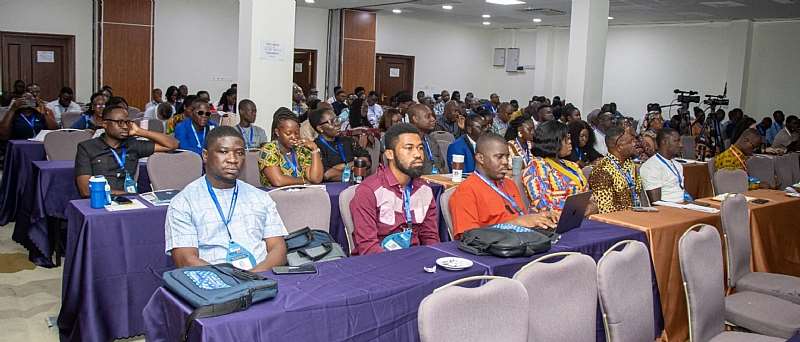
Delivering his welcome address at the 37th MOLE Conference (MOLE XXXVII) at Aqua Safari Resort in Big Ada, he said flooding, droughts, rising temperatures, changing rainfall patterns, pollution and extreme weather events were increasingly threatening the availability, quality and reliability of water services.
“It is therefore no longer sufficient to build water systems without considering the climate conditions under which they must operate. It is not enough to construct sanitation facilities without ensuring that they can withstand environmental pressures and remain functional over time,” he told participants, including Vice President Prof. Naana Jane Opoku-Agyemang.
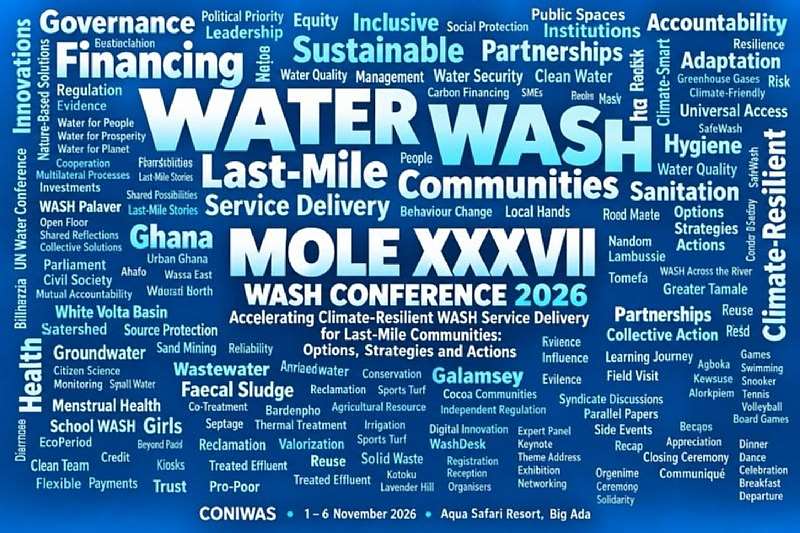
The conference, which runs from November 1 to 6, 2026, is being held under the theme, “Accelerating Climate-Resilient WASH Service Delivery for Last-Mile Communities: Options, Strategies, and Actions,” building on discussions from MOLE XXXVI.
The Media Coalition Against Open Defecation (M-CODe), with support from World Vision Ghana, is providing a strategic communication platform for the conference to enhance its national visibility and promote citizen engagement.
The Ada paramount chief called for a shift from treating infrastructure construction as the ultimate goal to developing sustainable service delivery systems capable of withstanding climate-related shocks and serving communities over the long term.
“We must move beyond infrastructure delivery as an end in itself and embrace sustainable service delivery systems that anticipate risks, withstand climate shocks, and continue to serve communities long after initial investment.
“Resilience must be built into our planning, financing, technology choices, institutional arrangements, and maintenance systems. The cost of inaction is often greater than the cost of prevention,” he stressed.
Drawing on Ada’s history and cultural identity, Djetse Nene Akuaku III noted that water resources had shaped the area's settlements, livelihoods and traditions for generations.
He identified the Volta River, its estuary, the Atlantic coastline and the Songor Lagoon as important natural features that have sustained the people of Ada over the years.
“The Songor Lagoon, in particular, represents an important natural and economic heritage of the Ada people. Its resources sustain livelihoods and carry historical, cultural, and communal significance.
“Yet, like many water bodies across Ghana, our natural resources face increasing pressures from pollution, environmental degradation, competing demands, and the consequences of climate change,” he said.
The traditional ruler also highlighted the importance of traditional authorities in addressing WASH challenges, insisting that they must be recognised as essential partners in environmental protection and sustainable resource management.
“As custodians of our traditions, lands, and natural resources, we must recognize that the environment we inherit is a trust, not an unlimited possession,” he stated.
He said the responsibility of traditional leaders extended beyond preserving customs to protecting natural resources, mobilising communities to adopt responsible environmental practices, promoting peaceful resource governance and collaborating with public institutions to advance sustainable development.
According to him, traditional authorities possess community-level legitimacy, local knowledge, historical understanding and the ability to mobilise residents around shared development priorities.
“Traditional leadership must therefore be recognized as an important partner in the WASH agenda. However, traditional authority must also work in partnership with technical experts, local government institutions, regulators, civil society, and the private sector. The challenges before us are too complex for any single institution to address in isolation,” he said.
He added that achieving sustainable WASH services required a combination of traditional knowledge, scientific evidence, sound public policy and active community participation.
“The future of sustainable WASH delivery requires a deliberate convergence of traditional knowledge, scientific evidence, sound public policy, and responsible community participation,” he added.
Djetse Nene Akuaku III commended the Ghana Coalition of Non-Governmental Organisations in Water and Sanitation (CONIWAS), its Executive Committee and Planning Committee for sustaining the MOLE Conference since 1989 as a platform for dialogue, knowledge sharing and collective action.
Welcoming participants with the traditional greetings, “Nyɛ hɛ manyɛ!!! Nye Yeee!!!”, he encouraged them to explore Ada’s cultural heritage and natural environment beyond the conference venue.
He also urged participants to make their deliberations productive, noting that the diversity of stakeholders attending the conference, including policymakers, development partners, researchers, civil society organisations, traditional authorities, private sector representatives and community leaders, provided an important opportunity for collective action.
He maintained that addressing the sector's challenges would require more than technical interventions, pointing to the need for political commitment, institutional coordination, adequate financing, effective regulation, public accountability and sustained community involvement.
“It requires political will, institutional coordination, adequate financing, effective regulation, public accountability, and sustained community engagement,” he said.
Concluding his address, the paramount chief called for wisdom, trust and accountability in the discussions and partnerships emerging from the conference.
“May our deliberations be guided by wisdom, our partnerships strengthened by trust, our commitments sustained by accountability, and our actions inspired by the well-being of present and future generations. May the waters that sustain our communities remain safe. May the environment that sustains our livelihoods be protected. And may the development we pursue leave no community behind,” he prayed.



 Loaded Transit Truck Left for Weeks Exposes Safety, Enforcement and National Sec...
 GRIDCo CEO gives December deadline for improved power supply in Ashanti Region
 GES to remove Twene Amanfo SHS teachers from Masters on Duty positions over stud...
 Speaker Bagbin urges PAC to detain officials who fail to account for public fund...
 Audit Service recovers over GH¢18bn in public funds between 2022 and 2026 – Audi...
 Mining Conference: Local Government Minister puts Regional Ministers, MMDCEs on ...
 'Illegal mining is direct assault on national security' — Lands Minister vows de...
 'Chiefs must protect lands from galamsey for generations unborn' — National Hous...
 'I’ll make you impotent' – Wife threatens husband on live radio over 'baby mamas...
 NIA begins nationwide crackdown on illegal Ghana Card photocopying


