




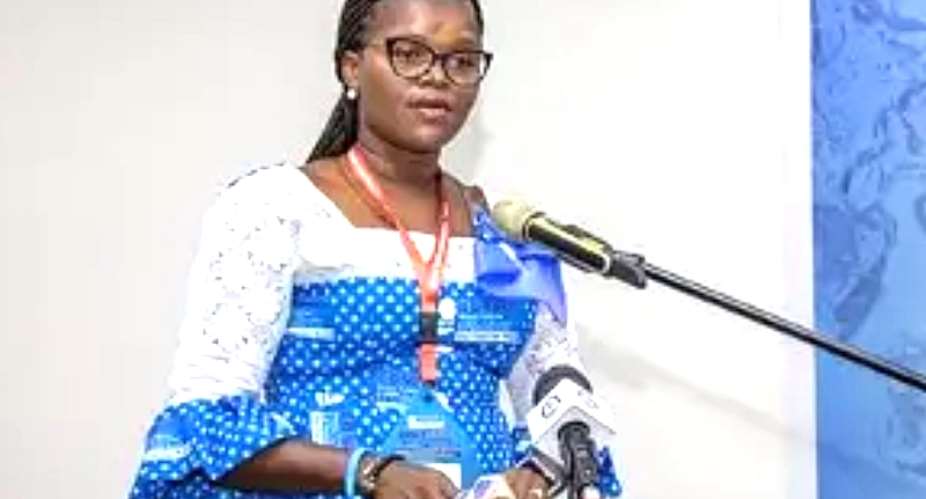
The Chairperson of the Ghana Coalition of Non-Governmental Organizations in Water and Sanitation (CONIWAS), Dr. Beata Awinpoka Akanyani, has painted a stark picture of WASH inequality in Ghana, revealing that about one in four rural residents lack basic water and only 17 percent have access to safely managed water.
Delivering her welcome address at the opening of the 37th MOLE WASH Conference at Aqua Safari Resort, Ada Foah, Dr. Akanyani said rural hygiene has gone backwards, falling from 36 percent in 2015 to 31 percent in 2024, while open defecation remains concentrated in rural areas at 31.3 percent compared to 8.9 percent urban and 17.7 percent nationally.
She quoted the Ministry of Local Government data from August 2026 showing basic water at 96.4 percent urban against 74.4 percent rural, a 22-point gap, while the Community Water and Sanitation Agency (CWSA) reports rural and small-town water coverage of only 61.87 percent as of 2023.
On sanitation, she disclosed that in 2021, 74 percent of households lacked exclusive use of an improved toilet—32.5 percent shared one and 23 percent used public toilets, with only 25.3 percent having an improved toilet of their own.
“At the 2015–2024 pace of about 1.2 points a year, basic sanitation would reach only about 39 percent by 2030,” Dr. Akanyani warned.
The conference is being held on the theme "Accelerating Climate-Resilient WASH Service Delivery for Last-Mile Communities: Options, Strategies, and Actions," building on deliberations of MOLE XXXVI.
The Media Coalition Against Open Defecation (M-CODe), through the empowerment of World Vision Ghana, is providing a strategic and targeted communication platform for the conference, ensuring national visibility and citizen engagement.
Dr. Akanyani, addressing the gathering chaired by Nene Agudey Obichere III, Mankralo of Ada State, representing the Paramount Chief of Ada Traditional Area, said the last mile is not merely a geographical description.
“It represents people and places too often excluded from reliable services: deprived rural communities, small towns, peri-urban and informal settlements, as well as schools, health facilities, markets, and other public spaces,” she said.
“Our measure of success must be whether these communities experience tangible, lasting improvements in their daily lives. These figures should compel us to act with urgency, with fairness, and with a clear commitment to climate resilience.”
She said the conference comes at a strategic moment for Ghana, as the African Union has dedicated its 2026 Theme of the Year to sustainable water availability and safe sanitation, with President John Dramani Mahama serving as First Vice-Chairperson of the AU ahead of Ghana's chairmanship in 2027, and Ghana co-chairing the “Water for People” dialogue with Switzerland at the upcoming UN Water Conference.
The CONIWAS Chair was candid about constraints confronting the sector, identifying financing as the central challenge.
She disclosed that the CONIWAS budget review identified a sharp decline in the sector’s share of the national budget from 0.81 per cent in 2023 to 0.29 per cent in 2024, with allocations of approximately GH¢741 million in 2024 and GH¢544 million in 2025.
For 2026, the review identified approximately GH¢1.874 billion across selected WASH-related allocations, including district-level earmarks, solid-waste infrastructure, and central water projects.
Measured against the estimated annual requirement of US$1.7 billion to achieve national WASH targets, this points to a financing gap of more than US$1.5 billion.
“We must also remember that allocations, releases, and actual expenditure are not the same,” she cautioned.
She also cited unfinished institutional reforms, including Sanitation Authority legislation not progressing beyond Cabinet, the revised Environmental Sanitation Policy awaiting approval, and Environmental Health Units at MMDAs remaining inadequately resourced.
Reliable information is another critical gap, with consolidated public data on rural water-system functionality and WASH conditions in schools not readily available, weakening planning and accountability.
She also revealed that civil society itself faces mounting pressures with delays in finalizing funding agreements and shrinking financial support threatening the continuity of national NGOs.
Dr. Akanyani urged the government to adopt a credible multi-year pathway for increasing domestic WASH investment and ensure timely release of funds.
She also tasked Parliament to champion the National Sanitation Authority and Sanitation Fund and strengthen oversight of the 20 percent DACF allocation.
She further challenged MMDAs to ensure transparent use and public reporting of Common Fund allocations, development partners to enable climate finance to reach districts, the private sector to develop blended financing models for rural populations, traditional authorities to oppose galamsey and destructive sand winning, and civil society and media to sustain evidence-based advocacy.
“Let this 37th MOLE Conference be remembered not only for the quality of our conversations but also for the strength of the commitments that follow. Let us work towards a Ghana where access to safe water, dignified sanitation, and good hygiene is not determined by where one lives, what one earns, or how vulnerable one is to a changing climate,” she said.
The welcome address was delivered in the presence of Mr. Ahmed Ibrahim, Minister for Works, Housing, and Water Resources; Mr. Mahama Ayariga, Minister for Local Government, Chieftaincy, and Religious Affairs; Madam Linda Obenewaa Akweley Ocloo, Greater Accra Regional Minister, Members of the Parliamentary Select Committee on Sanitation and Water Resources; and international guests from the Netherlands, United States, and Canada.


 'I’ll make you impotent' – Wife threatens husband on live radio over 'baby mamas...
 'Some radio stations struggle to buy prepaid electricity' – GIBA president
 GMet warns of prolonged dry spells and hotter days from December to February
 'Watch your words on air' – Suhuyini cautions journalists
 'I killed them for saliva' – Man confesses to killing three people for Ghc500
 Some NDC MPs must lose their seats for Upper East region to get development – Ko...
 Dumsor looms as El Niño could reduce Akosombo Dam inflows and affect power gener...
 'I will suggest we limit TraffiTech-GH's application to some major routes within...
 NIA begins nationwide crackdown on illegal Ghana Card photocopying
 Lebanese customs say 46.7kg cocaine trafficker through Accra used insulation tec...


