




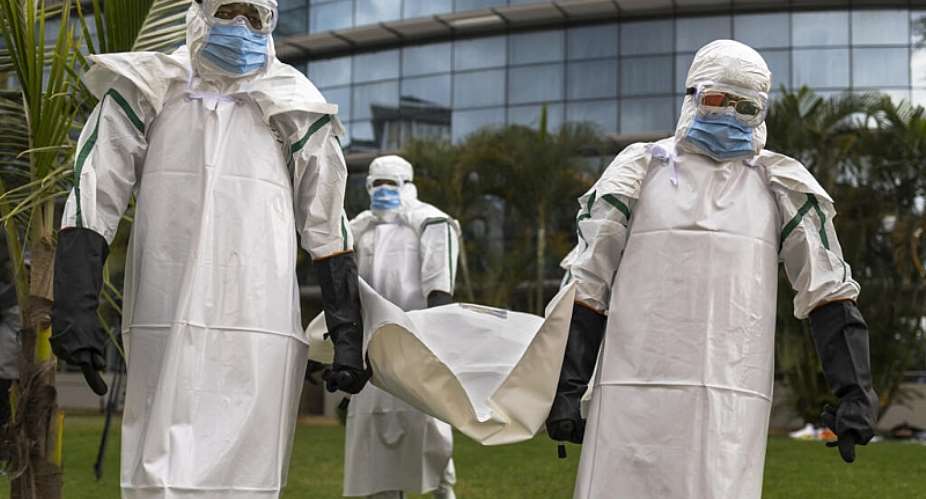
The Nigeria Centre for Disease Control and Prevention said on social media that the two individuals had been isolated while officials carried out contact identification, listing and laboratory testing.
Nigeria confirmed its first Ebola case in more than a decade on 23 October in a 42-year-old Swiss woman who had travelled to Uganda and then returned to the capital Abuja in central Nigeria.
She and her husband returned to Switzerland on 26 October. It remains the only confirmed case of the Bundibugyo strain of the virus in Nigeria.
After registering 20 cases and two deaths, neighbouring Uganda was declared Ebola-free by the World Health Organization (WHO) in August.
Kenya has recorded two deaths from the virus out of nine cases. Most of those infected had recently travelled to the Democratic Republic of Congo (DRC) where more than 5,000 people have died since the outbreak was declared in May.
DRC centre of Ebola outbreak
As the DRC deals with its deadliest Ebola epidemic, neighbouring Central African Republic (CAR) has tightened frontier controls, with daily checks on travellers crossing the border.
At the M'Poko Bac pier, in the Bimbo district south-west of the capital Bangui, health workers supervise medical checks.
"One of my colleagues is there to direct them to the hand-washing station. We brief them on the situation, then direct them to the tent for temperature checks and registration," Maldiana Bagalama explained.
The DRC and CAR share a porous frontier stretching for more than 1,500 kilometres.
Ebola, transmitted through contact with bodily fluids and which causes a severe haemorrhagic fever, has claimed more than 15,000 lives in Africa over the past 50 years.
Despite the risks, economic activity continues apace along the Oubangui river.
Fishermen, canoe operators, sellers of fresh fish all depend on the waterway.
'We are worried'
"We are worried because we work right here, by the river, and if Ebola reaches here we shall be the first to fall victim to it," said Neige, a fishmonger and mother-of-three.
"We're asking the ministry of health to take far greater precautions," she added.
A few metres away, Foxy Yeti Nzapa, 25, ferried passengers by canoe.
The father-of-two said he was frightened that travelling between the two countries might expose him to the virus.
"It's hard to find work in the Central African Republic and this is my only source of income," he added.
"My concern is that the people we bring back from the other side might also put us at risk, given that we provide transport between the two countries without any protection. It's dangerous," he said.
Inside Bunia's fight to protect families from DRC's deadliest Ebola outbreak
"From over there, we sometimes hear this or that person has died of Ebola. I could also become infected. So we need preventive measures to protect ourselves, as we are in constant contact with the other side."
State of preparedness
In addition to the screening checks at the river crossing, health authorities in the CAR have launched awareness-raising campaigns.
Neighbourhood chiefs, community leaders and religious figures are being drafted in to pass on prevention guidelines to residents.
"Preparedness also means keeping the public engaged," said Dr Valentin Nebanga, departmental head at the Ministry of Health.
"We need to make sure that people understand the importance of protective measures, particularly while there are no reported cases in the CAR."
Nurse killed
The response to the DRC's outbreak has been hampered by the distrust of parts of the population.
According to the WHO, a nurse was killed and another health worker seriously wounded in an attack on 24 October in Bafwasende, in the DRC's north-eastern Tshopo province.
Africa CDC chief warns 'no country is safe' as Ebola reaches Nigeria
Doctor Marcel Likolo, chief medical officer of the Bafwasende health district, told the French news agency AFP that young people from the area had accused the victims of trying to infect locals with tablets before attacking them.
The Ebola treatment centre where the incident took place has since shut down, he said.
Testing of the Ervebo vaccine, which has proven to be effective against the more common Zaire strain of the Ebola virus, has begun in recent weeks to determine whether it could also provide protection against the Bundibugyo variant which has no approved treatments or vaccines.

 'I’ll make you impotent' – Wife threatens husband on live radio over 'baby mamas...
 'Some radio stations struggle to buy prepaid electricity' – GIBA president
 GMet warns of prolonged dry spells and hotter days from December to February
 'Watch your words on air' – Suhuyini cautions journalists
 'I killed them for saliva' – Man confesses to killing three people for Ghc500
 Some NDC MPs must lose their seats for Upper East region to get development – Ko...
 Dumsor looms as El Niño could reduce Akosombo Dam inflows and affect power gener...
 'I will suggest we limit TraffiTech-GH's application to some major routes within...
 NIA begins nationwide crackdown on illegal Ghana Card photocopying
 Lebanese customs say 46.7kg cocaine trafficker through Accra used insulation tec...


