




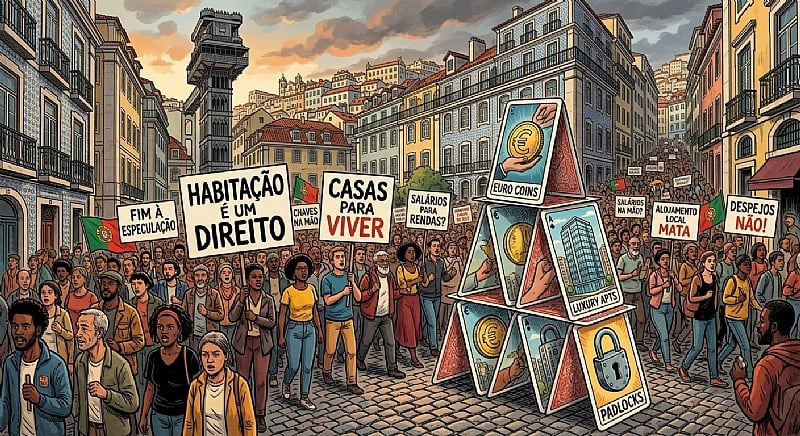
Portugal’s housing protests have become two stories at once. By day, thousands march and hold open-air assemblies over rents, evictions and wages. By night, police have repeatedly moved in to take down the tents.
The latest round came early on Sunday, 1 November. Hours after thousands marched against a government rental bill, police cleared camps in Lisbon’s Rossio Square and Porto’s Praça D. João I at about 4:30 a.m., removing 99 tents and arresting 13 people. By that evening, around 2,500 people had gathered in the same Porto square and voted to pitch tents again.
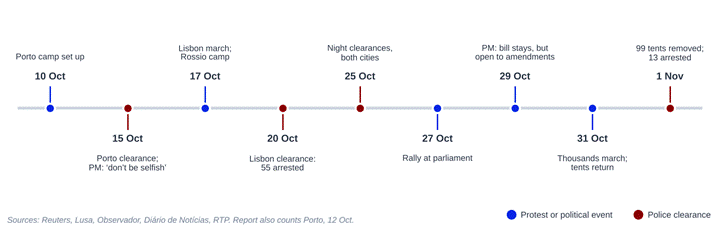
Figure 1. How the protests and police operations built up from 10 October to 1 November.
That cycle is the heart of the study’s warning. It reads the marches and camps as a measurable trust signal about housing. It treats the clearances as a second, separate question about how the state answers peaceful protest.
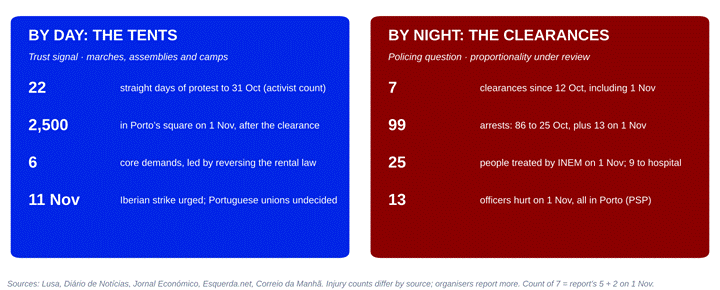
Figure 2. Two strands of one crisis: a trust signal by day and a policing question by night. Injury counts differ by source.
The central question is no longer whether Portugal has a housing problem. It is whether the state can answer that problem without turning a policy dispute into a contest over legitimacy.
The study puts Latent Public Trust at 33 out of 100, which it classes as very low, and estimates Youth Institutional Trust at 34 out of 100. Its Trust–Risk Exposure score is 32, in the red range.
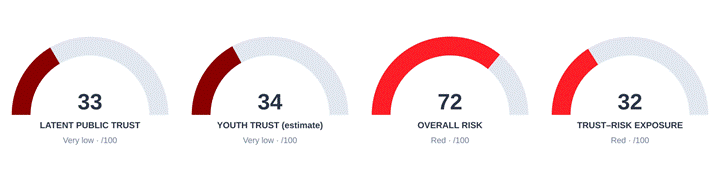
Figure 3. The study’s four headline indices on a 0–100 scale. Youth trust is an estimate, not survey data.
Yet Portugal did not enter October in a trust collapse. In the OECD survey carried out between September and November 2025, 40% of adults trusted the national government, in line with the OECD average, and 68% trusted the police. The study therefore describes a shock tied to housing and policing, not a long-term breakdown of confidence in institutions.
| Indicator | The study’s assessment |
| Latent Public Trust | 33/100, very low |
| Youth Institutional Trust | 34/100, very low (analytical estimate) |
| Trust in housing policy | 18/100 (analytical estimate) |
| Government responsiveness | 28/100, low |
| Institutional legitimacy risk | 68/100 |
| Protest escalation risk | 76/100 |
| Policing and public-order risk | 63/100 |
| Housing and youth-opportunity risk | 80/100 |
These are not conventional opinion-poll results. No survey has yet measured trust since the protests began, so the study builds its 2026 indices as analytical estimates from several evidence streams. The scores were set in the study’s 1 November report and do not reflect a fresh recalculation after that day’s clearances.
The protest is about more than rent
The grievances underneath the tents
The camps began in Porto on 10 October and reached Lisbon a week later. Their demands are specific: reverse the new rental law, end evictions and demolitions without alternative housing, stop investment funds buying homes, expand public housing, bring vacant buildings back into use, and set rent ceilings that are truly affordable.
The numbers behind that list are stark. Eurostat data show house prices up about 180% between 2015 and 2025, the second-largest rise in the European Union. Rents on new leases have nearly doubled, and the Bank of Portugal estimates a cumulative shortfall of around 300,000 homes, roughly equal to Lisbon’s entire housing stock.
The immediate target is a government bill that protesters say would make evictions easier and end rent caps on new leases. It passed its first parliamentary reading when the far-right Chega party abstained. On 29 October, Prime Minister Luís Montenegro ruled out scrapping it but said he was open to amendments before a final vote in the coming weeks, saying parties “have to move closer”.
The study identifies ten strategic issue clusters. Housing affordability leads, but the next three are the most revealing: wages, the government’s tone and policing. Three of the top four, in other words, concern what people earn and how the state has responded to them.
| Issue | Latent trust question | Trust | Risk |
| Housing affordability | Can people who work here afford to live here? | 15 | 93 |
| Wages and cost of living | Does work still secure a decent life? | 22 | 82 |
| Government responsiveness and tone | Does government take the grievance seriously? | 18 | 81 |
| Policing and the right to protest | Is peaceful protest protected or punished? | 35 | 80 |
| Rental law and evictions | Does the law protect tenants or landlords? | 20 | 76 |
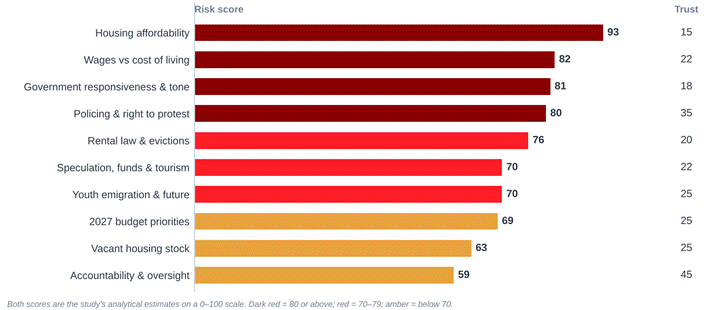
Figure 4. All ten issue clusters, ranked by the study’s risk score, with the trust estimate for each.
Tone matters here. Montenegro’s “don’t be selfish” remark on 15 October became one of the most-cited signs of perceived disregard, and placards in Lisbon later answered it: “It isn’t selfishness, it’s resistance. The latent issue connecting the demands is not simply housing costs. It is whether people believe institutions see those costs as their problem to solve.
The study also points to a wider generational signal. The Emigration Observatory estimates that about 30% of people born in Portugal and aged 15 to 39 now live abroad. Some economists dispute that figure, arguing it overstates recent departures, and the study marks it as contested.
Even on the lower reading, the concern is real. If young adults conclude that the realistic answer to rent is an airline ticket, the cost will show up in lost skills, weaker demographics and thinner confidence that staying and participating can change anything.
Read this way, the tents are a visible expression of a less visible problem: a widening distance between what people expect a job and a home to deliver in Portugal and what they believe the state will do about it.
A trust gap on one issue
Portugal’s institutions are not failing equally
One of the study’s most important findings is that the gap is concentrated, not general. Citizens can keep confidence in the police and the courts while doubting the parties and, above all, the state’s housing policy.
That changes the diagnosis. Against a benchmark of 60, the study estimates trust in housing policy at 18/100, a 42-point gap. That is the widest in the report and close to the depths of the bailout years, but it applies to one policy area and not to government as a whole.
| Institution or measure | Current evidence |
| Police | 68% trust (OECD 2025, before the clearances) |
| Courts and justice | 49% trust (OECD 2025) |
| Civil service | 43% trust (OECD 2023) |
| National government | 40% trust (OECD 2025) |
| Assembly of the Republic | 31% trust (OECD 2023) |
| Having a say in government | About 29% (OECD 2021–25) |
| Political parties | 26% trust (OECD 2025) |
| Housing policy | 18/100 (the study’s analytical estimate) |
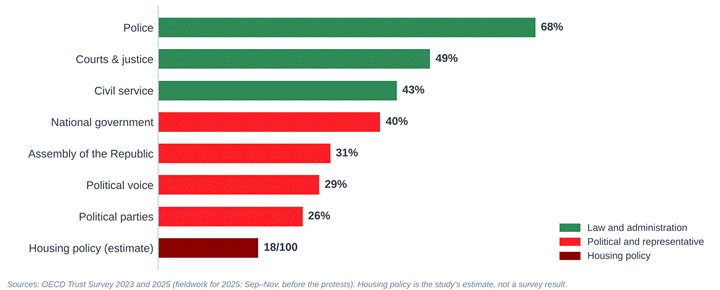
Figure 5. Trust is strongest in the police and courts and weakest on housing policy. Survey fieldwork pre-dates the protests.
The caution is in the dates. The police and government figures were collected before the protests. Whether the high trust in police has survived weeks of televised clearances is an open question, and the next OECD or Eurobarometer wave will test it.
Portugal also has unusually rich historical data, and it complicates any story of steady decline. Trust in government was about 42% in 2006, fell to about 12% in 2013 during the bailout austerity, recovered to 37% by 2018, dipped to 32% in the 2023 political crisis and returned to 40% in 2025.
The study therefore finds no net 20-year decline in general trust. The gap to its benchmark was about 18 points in 2006 and about 20 in 2025. These surveys use different questions and scales, so the shape of the line matters more than any single number.
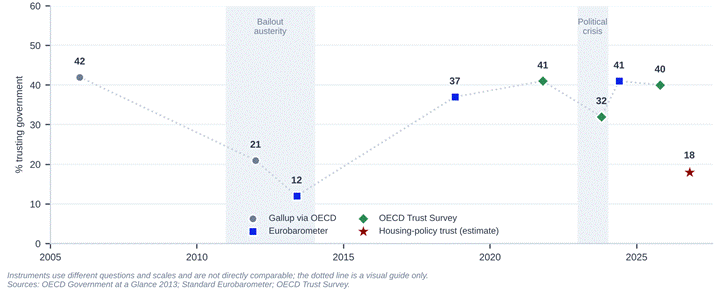
Figure 6. Readings from three survey instruments, which are not directly comparable. The direction, not a precise number, is the finding. Portugal is not witnessing the collapse of faith in its institutions. It is witnessing a sharp loss of confidence that those institutions will solve one defining problem.
That volatility carries a hopeful implication. Portugal has rebuilt trust twice before, after the bailout and again after 2023. A shock on a volatile baseline can be repaired in a way that a 20-year slide cannot, if people see delivery on housing and accountability on policing.
When policing became the story
Each clearance added a second grievance
The clearances did not create the housing dispute, but they changed it. The study counts five operations up to 25 October. The Rossio and Porto actions on 1 November bring that to seven, each followed by a return to the squares.
Earlier operations had already left about 50 protesters and one officer injured, with 86 arrests. The police inspectorate, IGAI, and prosecutors are investigating. Allegations of excessive force, including the use of batons, dogs and a taser, remain allegations under review and are not findings of the study.
The 1 November accounts differ sharply, and the study’s method is to report them side by side.
| Measure, 1 November | Police (PSP) | Protest organisers | Other |
| Arrests | 13 (6 Lisbon, 7 Porto) | 7 in Porto; 10 in Lisbon, later 6 | All released, due in court on Monday |
| Injured | 13 officers, all in Porto; 8 sent to hospital; civilian total not given | Porto: 35 minor, 4 serious. Lisbon: more than 30, 10 in hospital | INEM emergency service: 25 treated, 9 taken to hospital |
| Tents removed | 99 (69 Lisbon, 30 Porto) | Not given | Not given |
The police say they first sought voluntary compliance, met active resistance, and acted on grounds of legality and proportionality. A spokesman said force followed paint and firecrackers being thrown at officers. He also confirmed that a plain-clothes officer in Porto drew a firearm as protesters approached. The PSP later said it found three home-made incendiary devices in Rossio, one intact and two broken, none of which ignited. Forensic tests are pending.
The camps tell a different story. The Acampada de Lisboa says it occupied Rossio peacefully, without blocking movement, and that it has been shown no legal basis for removing the tents. Lusa reported seeing people struck with batons in Porto, and a CMTV camera operator was hit with a baton while working. A lawyer for the protesters has announced a criminal complaint for abuse of power against the interior minister and the PSP’s national director.
This creates a second trust problem. Citizens expect public space and the law to be upheld. Protesters expect peaceful assembly to be protected. The state has to do both at once, in full view of the cameras. Peaceful protest is not the threat. The risk lies in a repeating cycle of night-time clearance and return, in which every round adds injuries, arrests and a sharper contest over legitimacy.
The political pressure rose quickly on Sunday. President António José Seguro asked the government and the Ombudsman for detailed information and spoke with the Prime Minister. Observers from the Ombudsman’s prevention mechanism had followed the Rossio operation. Socialist leader José Luís Carneiro had already urged talks in place of “arrogantly imposing” the government’s views, and the Communist Party has asked for an urgent parliamentary debate.
The study identifies five main threat pathways:
• Non-responsiveness on housing can breed futility, harder tactics or exit.
• Repeated night clearances can produce injuries and arrests, then larger mobilisation.
• Delayed or opaque oversight findings can harden distrust of the police.
• Affordability failure can push young adults to emigrate.
• Party polarisation over policing can displace the housing debate into a law-and-order contest.
Its city assessment places Lisbon and Porto at a red early-warning level and other cities at amber. The study names no organisation, party or community as a threat actor.
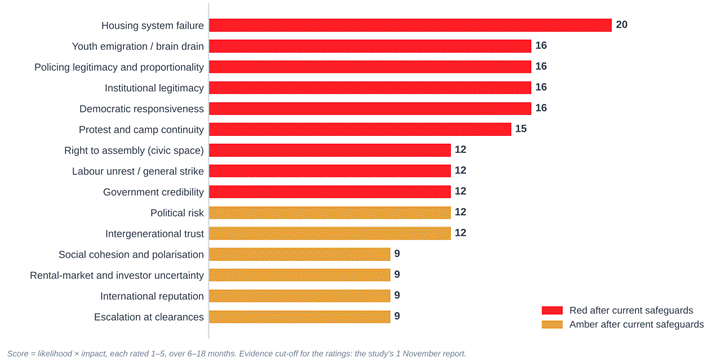
Figure 7. Fifteen latent risks ranked by score (likelihood × impact, each rated 1–5) over the next 6–18 months.
The response will shape the next chapter
A public-order answer alone could widen the trust gap
The government has defended the police and held to its bill while signalling room for amendments. That answers one question: who controls the squares. The study argues it cannot be the whole response, because it leaves the housing grievance and the policing question tangled together.
Its central recommendation is to separate them. Housing belongs in a structured dialogue and in legislation. Policing belongs with the oversight bodies, on a published timetable.
The first proposed step is deliberately simple. Within seven days, the government would issue a statement acknowledging the housing grievance and the right to protest, kept separate from its public-order messaging. The second is a structured dialogue with housing movements, tenants and municipalities within 30 days.
| Proposed action | Purpose |
| Statement on housing and the right to protest | Show that the grievance has been heard |
| Structured housing dialogue | Create a credible channel for representation |
| Housing measures in the 2027 budget | Show visible delivery on rents and vacant stock |
| Youth housing guarantee | Give young adults a reason to stay |
| Publish IGAI and prosecutor findings | Settle proportionality through independent review |
| Protest-site protocol, pausing night clearances pending findings | Protect both public space and lawful assembly |
| Review of force guidance for peaceful assemblies | Set clear rules on dogs and tasers |
| Early engagement with the CGTP and UGT unions | Reduce the risk of strike escalation |
The study also asks organisers to strengthen their own safeguards with stewards, de-escalation teams and a clear commitment to non-violence. It presents all this not as political persuasion but as institutional risk management.
The openings are real but fragile. The Porto mayor, Pedro Duarte, has offered a meeting, including on occasional camps and a wider housing forum, and the President’s office has sought to meet the Porto camp. But the Porto assembly voted on Sunday to decline the mayor’s invitation, so an offer alone will not rebuild the channel.
The calendar adds urgency. Spain’s main unions have called a housing general strike for 11 November, and protesters want Portugal to join. The CGTP and UGT had not committed as of the latest reporting available to the study, and the CGTP has said such a strike would take time to prepare. The final budget vote is expected on 24 November, according to the CGTP. The test of the state is not whether it can clear a square. It is whether it can uphold the law without convincing peaceful citizens that their housing crisis is being answered with batons.
The study singles out the next 90 days as decisive, with early action on the dialogue, the budget, the oversight findings, a protest-site protocol and talks with the unions.
What Portugal does next
The protest is a warning, not yet a verdict on Portuguese democracy
The study’s most consequential conclusion is also its most restrained. These protests should not be read as proof that trust in Portuguese institutions has collapsed, and the clearances should not be taken as settled evidence of wrongdoing by the police.
The evidence instead points to a shock tied to one issue and one procedure, on a baseline that has moved sharply before and recovered. Housing policy is deeply distrusted. People doubt they have a say. Yet the most recent survey still recorded strong trust in the police, oversight bodies are at work, and the movement describes itself as peaceful.
| Outlook | The study’s assessment |
| Current condition | Issue shock on a volatile baseline |
| Trust level | Latent Public Trust 33; Youth Institutional Trust 34 |
| Trust gap | 42 points on housing policy |
| Risk level | Red; Trust–Risk Exposure 32 |
| Trajectory | Deteriorating (inferred) |
| Priority action | Housing dialogue and protest-site protocol |
What happens next depends on whether these indicators move. The study’s signs of recovery are dialogue sessions being held, housing measures in the budget, published IGAI findings and peaceful negotiated sites. Its signs of escalation are new night clearances with injuries, a general strike, delayed findings and a budget passed without housing measures.
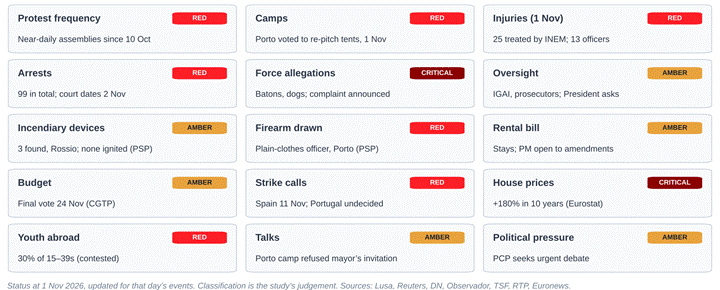
Figure 8. Fifteen early-warning indicators to watch through November.
The immediate challenge, then, is not only to avoid another night in Rossio. It is to break a cycle in which grievance produces a camp, a camp produces a clearance, a clearance produces a bigger protest, and a bigger protest deepens the distrust that began it.
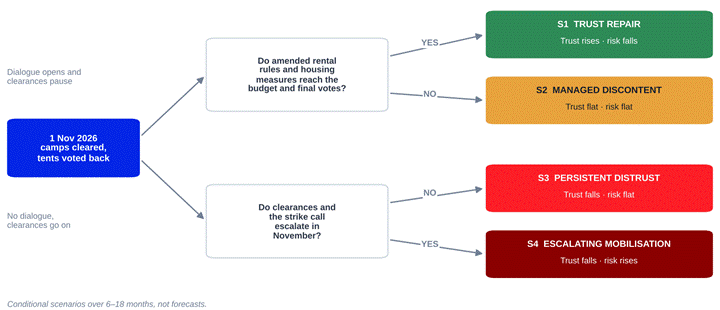
Figure 9. Two decisions determine which of four conditional scenarios unfolds. These are not forecasts.
The opportunity is equally clear. Portugal still has real assets: oversight bodies already at work, a President engaged on the question, a history of rebuilding trust, and a housing debate that has reached the top of national politics. The tents may ultimately be remembered less for the nights they were cleared than for the question they forced into the open: who is listening to people who cannot afford to live in their own cities?
Polling alone cannot answer that question. The answer will come from what institutions do next, and from whether people in Lisbon and Porto can see a credible link between raising a grievance, being heard and seeing something change.
Neutrality and analytical independence
This study is independent, non-partisan and non-advocacy. It does not represent the political interests of the Portuguese Government, any municipality, political party, protest organisation, housing movement, trade union, police authority, business or property association or any other stakeholder, and it neither supports nor opposes any party, policy or protest.
The study measures and interprets observable evidence, institutional indicators, documented public concerns and latent trust and risk signals. References to risks, threats, distrust or institutional weaknesses are not allegations of wrongdoing. Allegations of excessive force are under investigation or review and are reported as allegations, not findings. Statements by police, officials, organisers and parties are reported as claims by those parties, not as findings of this study.
Where representative public-opinion data is unavailable, the study’s trust indices are analytical estimates derived from triangulated evidence and are clearly distinguished from survey findings. Scenarios are conditional and risk-informed, not predictions of inevitable events. The purpose is constructive: to identify trust deficits, emerging risks and opportunities for evidence-based trust repair.
Source basis: The study “Portugal’s Housing Protests: Measuring the Latent Trust Gap Behind the Encampments, the Clearances and the Rally at Parliament” (1 November 2026), with later events drawn from the reporting below. The study draws on Reuters, AP, Lusa, Observador, Diário de Notícias, RTP, Euronews, Al Jazeera, the OECD Trust Survey, Eurobarometer, the Emigration Observatory and Eurostat.
Reporting on the events of 29 October to 1 November: Reuters via Yahoo News; Diário de Notícias; Lusa via TSF; Lusa via Observador; Lusa via SOL; Jornal Económico on INEM; Jornal de Negócios on the unions.
About The Author: Messan Mawugbe (PhD), [email protected]


 'I’ll make you impotent' – Wife threatens husband on live radio over 'baby mamas...
 'Some radio stations struggle to buy prepaid electricity' – GIBA president
 GMet warns of prolonged dry spells and hotter days from December to February
 'Watch your words on air' – Suhuyini cautions journalists
 'I killed them for saliva' – Man confesses to killing three people for Ghc500
 Some NDC MPs must lose their seats for Upper East region to get development – Ko...
 Dumsor looms as El Niño could reduce Akosombo Dam inflows and affect power gener...
 'I will suggest we limit TraffiTech-GH's application to some major routes within...
 NIA begins nationwide crackdown on illegal Ghana Card photocopying
 Lebanese customs say 46.7kg cocaine trafficker through Accra used insulation tec...


