




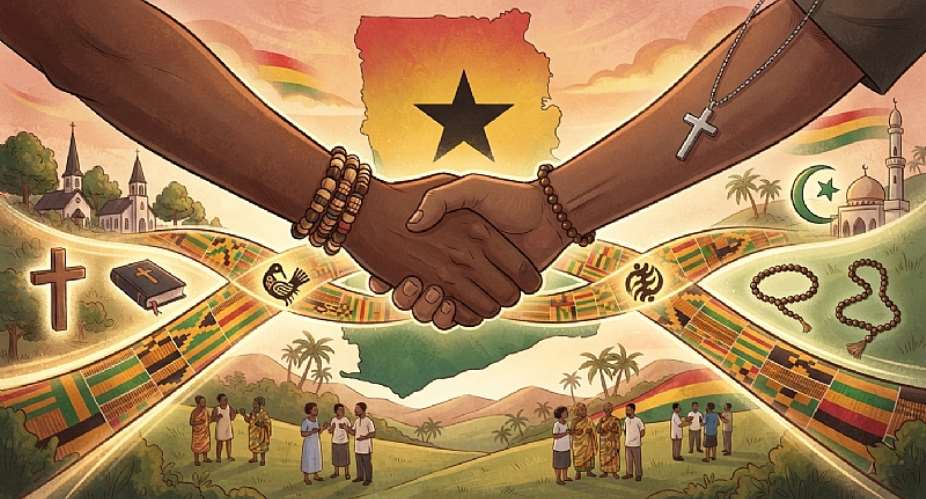
“Who do people say the Son of Man is?” … “But what about you?” he asked. “Who do you say I am?” Peter answered, “You are the Christ, the Son of the living God” (Matthew 16:13–16).
This passage brings to light the issue of identity. Believers are very attached to their religious identity. The statements made by Christians about Jesus Christ and Muslims about the Prophet Muhammad are not just theological statements but statements that resonate with convictions, identities and communities. Religious disagreement needs freedom and responsibility precisely because sacred personalities are so important. There is no one or religion that owns God.
Religious belief should never be used as an excuse to hate, intimidate or attack people who have a different understanding of God and religious truth. The inflammatory interactions and conflicts between some Christian and Muslim religious actors in recent times should be of concern to all Ghanaians. It started with controversial religious statements and responses to alleged insults against sacred personalities, which then escalated to threats, arrests and a physical confrontation. These events should not be interpreted as individual cases of specific people. They raise a much bigger question for our society: How do we safeguard Ghana’s longstanding tradition of peaceful Christian-Muslim relations in the face of religious conviction, provocative speech and public anger? The lesson is not that Ghana has become religiously intolerant. Instead, it is the peaceful coexistence that is not guaranteed. Ghana needs to establish relationships and institutions that can absorb religious provocation without it spiraling into communal hostility.
Ghana has been commended for its relatively peaceful interreligious relations. Christians and Muslims are neighbours, work together, attend the same schools and social events, and sometimes belong to the same extended families. Religious plurality is not just a theoretical reality in Ghana, it is a social reality, especially in the north of Ghana. This religious peace should thus be interpreted as a social legacy, something that needs to be valued and safeguarded.
It has been passed on through generations through coexistence, family relationships, interreligious friendships and the work of religious and community leaders. But an inheritance can be lost when it is not nurtured. The recent events remind us that peace must be worked for.
Religious freedom comes with religious responsibility
Ghana's Constitution of 1992 provides for the right to freedom of speech and expression, and the right to practise and manifest one's religion or belief (Article 21). These freedoms are vital to a democratic and religiously pluralistic society.
However, rights need to be used responsibly. Christians should be free to proclaim and defend Christian beliefs, and Muslims should be free to proclaim and defend Islamic beliefs. But religious freedom should not be a license to intentionally disparage what another community sees as sacred. Also, threats, intimidation or physical violence cannot be justified on the grounds of religious offence.
This is an important distinction. We must stand up for religious belief, but not religious provocation; and we must condemn religious provocation, but not legitimise violence. State institutions must be fair and impartial when religious differences enter into the realm of the law. No one or no religious group should take the place of the law.
However, Ghana's bigger problem is not who has committed an offence but who has not. It's about learning how people who have very different beliefs can disagree, and still be neighbours.
From interreligious tolerance to interreligious resilience
We have been talking about religious tolerance for many years. While tolerance is significant, Ghana now needs to take a step further from interreligious tolerance to interreligious resilience. Tolerance asks: Can I live next to someone whose religion I don't agree with? Interreligious resilience is a more challenging question: What if one of us feels offended, misrepresented or provoked, can our relationship survive? Tolerance can be passive: I leave you alone, you leave me alone. Resilience requires more than that: a relationship that is resilient enough to handle disagreement and provocation. Interreligious resilience is the ability of religious communities to absorb disagreement, to avoid collective retaliation, to correct misinformation, to limit inflammatory voices and to restore relationships when tensions arise. A religiously resilient society is not one in which offensive statements are never made. That is not possible. Instead, it's one in which the wrongdoing of one pastor, imam, preacher or person is not easily converted into a battle between whole religious communities. This is the kind of resilience that Ghana needs to purposefully develop.
Dialogue Before Crisis, Not Dialogue Because of Crisis
Interreligious dialogue should not be a “fire service” that comes when a religious controversy has erupted. The leaders of the Christian and Muslim communities should meet regularly, not just during times of tension. Pre-established relationships facilitate the resolution of problems that arise during a crisis without escalation. The interfaith platforms can be reinforced at the national, regional and district levels through the involvement of the National Peace Council, Christian and Muslim leadership, traditional authorities, universities and civil society organisations. However, these platforms need to be more than just a one-off conference. They require trusted leaders, agreed communication channels and quick response systems to enable religious leaders to interact with each other before an inflammatory statement or social media post escalates into a broader Christian-Muslim confrontation. Interreligious dialogue should also go beyond the bishops, pastors and imams. There needs to be a seat at the table for young religious leaders, theological students, women, youth organisations and influential religious communicators. The
Digital Space has become an interreligious space
Much of the religious controversy of today starts outside the formal religious institutions. They often start online and can escalate in hours. Religious communication has been revolutionized by social media. What used to be a message for a church, mosque or small gathering can now be sent to thousands of people in hours. Short video clips can be shared without their original context, and reactions can be more inflammatory than the original message.
The smartphone has thus emerged as one of the most significant areas of modern interreligious interaction. Dialogue is no longer limited to churches, mosques and conference halls, but is also happening on WhatsApp, Facebook, TikTok, YouTube and other digital platforms. A religious leader can speak to a few hundred people in person, and a short controversial clip can be viewed by thousands online.
Digital ethical responsibility is thus a requirement for religious leadership in the digital age. Digital responsibility should consequently be included in the formation of religious leaders in churches, mosques, seminaries and Islamic educational institutions. Communicators should ask themselves: Does this communicate what I really want to say before publishing or sharing religious material? Does it help to advance religious debate or does it unnecessarily stir up antagonism towards another community?
There should be an ethics of religious communication in addition to freedom of religious communication.
Religious literacy is a part of peacebuilding
Sometimes hostility grows because people don't know enough about their neighbours' beliefs and practices.
There is a need for Christians to be more aware of the importance of some personalities, beliefs and symbols for Muslims. Muslims also require opportunities to gain an understanding of Christian beliefs, practices and sensitivities. Religious literacy is not religious compromise.
I don't have to believe what my neighbour believes to understand why it is sacred to my neighbour. It just allows me to disagree intelligently and respectfully. A Christian does not have to believe in Islam in order to respect Muslims.
Likewise, a Muslim does not have to accept Christian theology in order to respect Christians. The purpose of interreligious dialogue is not to eradicate theological differences, but to allow people to live with theological differences in a constructive way. The universities, schools, seminaries, Bible colleges and Islamic educational institutions thus have a significant responsibility.
The development of interreligious competence, constitutional rights, conflict transformation, peacebuilding and responsible public communication should be increasingly integrated into religious leadership development.
Religious leaders must guard the peace
Religious leaders in Ghana have a strong moral influence. They can defuse or escalate communities. The religious leader is thus a public figure with a public responsibility. A pastor, priest, imam or other religious leader should resist the temptation to attack another religion for popularity.
The more influential a person is in religion, the more responsible he or she is in the public sphere. A big crowd, a following on social media or a respected religious position should not be an excuse for inflammatory speech, but rather a greater duty to be restrained.
The followers must also be aware that defending one's faith does not involve insulting another person's faith. Theological differences are not a problem, religious animosity is. When a dispute between two people is magnified by social media, it can easily be seen as a clash between Christianity and Islam. Religious leaders, therefore, have to understand that they are not only protectors of their faiths but also protectors of Ghana's social cohesion.
Protecting Ghana’s Religious Peace
The recent incidents provide Ghana with a chance to reflect on the preparedness to safeguard the religious peace bequeathed to us by our predecessors. There is a need for Christian and Muslim leaders to develop a shared model for responsible public religious communication. Current interfaith institutions need to be enhanced with quick response systems to deal with inflammatory religious debates before they get out of hand. These processes should also be inclusive of young people and women, and done on purpose.
The state, in turn, should enforce the law fairly and impartially. A sense of differential treatment of offensive or violent behaviour based on religious identity can erode public confidence and social cohesion. Interreligious peace cannot be achieved by law enforcement.
Arrests can only deal with specific offenses, not build trust. Building those relationships is a shared responsibility of religious leaders, state institutions, educators, the media and ordinary citizens. The true measure of Ghana's religious maturity is not whether Christians and Muslims agree on Jesus Christ, the Prophet Muhammad, scripture, revelation or salvation. They don't and they don't have to. The question is whether deep theological differences can be lived with in a way that is respectful and peaceful. Is it possible to disagree without hating? Is it possible to stand up for what we believe in without using intimidation or violence? Is it possible to be neighbours when we have such deep differences in our religious beliefs?
The coexistence of Christians and Muslims in Ghana is a priceless social legacy. It should not be romanticised, nor should it be taken for granted. It needs to be made stronger, and that must be done with conscious effort. Religious peace is a gift that Ghana has received, but it is not something that will be preserved by itself. It is up to each generation to choose whether to safeguard it. We have such a moment of decision in the present controversy.
We can let provocation, outrage and social media mobilisation shape Christian-Muslim relations, or we can build up the relationships and institutions that have bound our communities together.
Ghana needs to go beyond tolerance to interreligious resilience, beyond crisis-driven dialogue to sustained dialogue, and beyond condemning religious provocation to creating a society that is resilient to the divisive effects of religious provocation.
We do not have to compromise our religious beliefs in order to engage in interreligious dialogue. The ability to stand firm for what we believe, and to respect and defend the dignity of those who believe differently, may be one of the best examples of religious conviction. Ghana has received a valuable gift of religious peace. It is our duty to pass it on to the next generation in a stronger condition, not weaker.
He is a Lecturer with the Department of Philosophy and Religious Studies at the Faculty of Social Sciences of University For Development Studies, Nyankpala Campus.

 Loaded Transit Truck Left for Weeks Exposes Safety, Enforcement and National Sec...
 GRIDCo CEO gives December deadline for improved power supply in Ashanti Region
 GES to remove Twene Amanfo SHS teachers from Masters on Duty positions over stud...
 Speaker Bagbin urges PAC to detain officials who fail to account for public fund...
 Audit Service recovers over GH¢18bn in public funds between 2022 and 2026 – Audi...
 Mining Conference: Local Government Minister puts Regional Ministers, MMDCEs on ...
 'Illegal mining is direct assault on national security' — Lands Minister vows de...
 'Chiefs must protect lands from galamsey for generations unborn' — National Hous...
 'I’ll make you impotent' – Wife threatens husband on live radio over 'baby mamas...
 NIA begins nationwide crackdown on illegal Ghana Card photocopying


