




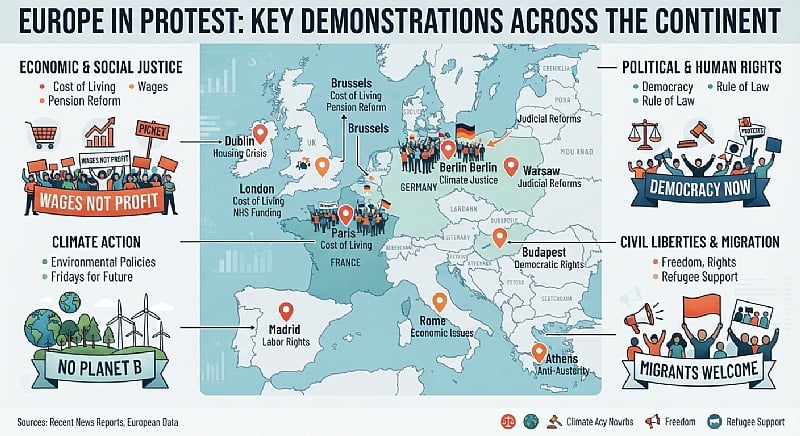
Across France, Belgium, Italy, Germany, Spain, Portugal and parts of the Balkans, a growing sense of anger and frustration is visible on the streets. Protests, riots, political upheaval and public dissatisfaction have become recurring features of European life. While each country has its own unique problems, many of the underlying causes are remarkably similar. Beneath the surface lies a deeper question: are these merely temporary crises, or are they symptoms of a continent entering a period of historic decline?
For decades the European Union was presented as one of the greatest political achievements in modern history. It promised prosperity, stability, economic integration, open borders and rising living standards. The vision was that a more united Europe would be stronger, richer and more influential. Yet today many Europeans feel that promise has not been fulfilled. Economic growth across much of Europe has slowed, productivity has lagged behind competitors such as the United States, and many young people feel their future is less secure than that of their parents.
One of the clearest signs of this crisis is housing. In cities across Europe, home ownership has become an increasingly distant dream for millions. House prices have risen dramatically while wages have struggled to keep pace. Young adults remain with parents longer, families postpone having children and entire generations find themselves locked out of property markets. Housing, once a foundation of middle-class security, has become a source of anxiety and resentment.
At the same time, Europe continues to grapple with a severe cost-of-living crisis. Energy bills, food prices, rents and everyday expenses have risen sharply over the past decade. Although inflation rates have eased in some countries, the cumulative impact has left many households feeling poorer than before. The promise that each generation would enjoy a higher standard of living than the one before it is increasingly being questioned.
Underlying these immediate concerns are deeper structural weaknesses. Many European economies have experienced years of stagnation. While Asia's major economies continue to expand and Africa's population surges, much of Europe struggles to generate the dynamism that fuelled its post-war success. Governments face mounting debt burdens while public services require ever-greater investment. Infrastructure in many countries is ageing, transport networks need upgrading, healthcare systems face staffing shortages and public confidence in political institutions has begun to erode.
Yet perhaps the greatest challenge facing Europe is demographic. Across much of the continent birth rates have fallen below replacement level. In country after country, fewer children are being born each year. The consequences are profound. A shrinking younger population must support a growing number of retirees through taxation and social welfare systems. Pension schemes become harder to sustain. Healthcare costs increase. Labour shortages emerge. Economic growth slows.
This demographic crisis explains why immigration has become such a central issue in European politics. The reality is that many European economies increasingly depend upon immigration to maintain workforces, support public finances and offset population decline. Without significant migration, many countries would experience even faster population ageing and labour shortages. Yet immigration itself has become a source of political tension, creating fierce debates about identity, integration, culture and the future character of European nations.
At the same time, Europe's position in the wider world is changing. For centuries European powers dominated global politics, trade and finance. Those centuries shaped the modern world. But the balance of power is shifting. Asia is rising. Africa is becoming increasingly important economically and demographically. New powers are emerging across the Global South.
This shift is particularly significant for France. For decades France maintained considerable influence across parts of West and Central Africa, especially within Francophone countries. Critics often described these relationships as a continuation of neo-colonial influence through economic, military and monetary arrangements. In recent years, however, countries such as Mali, Burkina Faso and Niger have moved away from French influence. Military partnerships have been terminated, French troops have withdrawn and new regional alliances have emerged.
For France, and by extension Europe, these developments carry strategic significance. Access to influence, markets and resources that were once taken for granted can no longer be assumed. Africa is increasingly asserting its own priorities and sovereignty. The old relationships are changing. Whether one views this as liberation, geopolitical realignment or simply the natural evolution of international relations, it signals that Europe's influence is no longer as uncontested as it once was.
Taken together, these trends paint a troubling picture. Economic stagnation. Housing crises. Ageing populations. Falling birth rates. Rising debts. Political polarisation. Infrastructure pressures. Cost-of-living struggles. Shrinking global influence. None of these challenges exist in isolation. They reinforce one another.
The unrest seen on the streets may therefore be more than a reaction to individual government policies. It may represent a broader anxiety about the future itself. People sense that something is changing. The assumptions that guided Europe for generations are no longer certain. The promise of automatic progress no longer feels guaranteed.
Europe remains wealthy by global standards. It retains world-class universities, powerful industries, advanced infrastructure and immense cultural influence. Predictions of imminent collapse would be exaggerated. Yet history teaches that great civilisations rarely fall in a single dramatic moment. More often, decline is gradual. It begins when institutions become complacent, when economic dynamism weakens, when populations age, and when younger generations lose confidence that tomorrow will be better than today.
Chilling Closing
Perhaps this is not the end of Europe.
Perhaps Europe will reform, adapt and find a new path forward.
But if birth rates continue to fall, if economic stagnation persists, if housing remains unaffordable, if younger generations continue to lose hope, and if governments fail to confront the realities of demographic decline, then the continent faces a stark future.
A future where there are too few workers, too many retirees and too few children to replace those who pass away.
A future where immigration becomes not merely a political choice, but an economic necessity.
A future where nations that once shaped the world struggle simply to sustain themselves.
For centuries Europe expanded across continents, built empires and projected power across the globe. Yet today its greatest challenge may come not from foreign rivals, but from within: empty cradles, ageing societies and a loss of confidence in the future.
And if those trends continue unchecked, historians may one day look back on this era and conclude that the fires in the streets, the political fragmentation, the economic frustrations and the demographic collapse were not separate crises at all.
They were the warning signs.
The warning signs of a continent entering a long twilight.
Not the end of Europe overnight.
But the end of the Europe that dominated the last five hundred years.
The end of the Europe that believed history had chosen it forever.
And in the silence of empty classrooms, shuttered factories and ageing cities, future generations may ask a question that today still sounds unthinkable:
Not whether Europe is declining... but whether Europe, as it was once known, quietly ceased to exist.
Sources:


 Loaded Transit Truck Left for Weeks Exposes Safety, Enforcement and National Sec...
 GRIDCo CEO gives December deadline for improved power supply in Ashanti Region
 GES to remove Twene Amanfo SHS teachers from Masters on Duty positions over stud...
 Speaker Bagbin urges PAC to detain officials who fail to account for public fund...
 Audit Service recovers over GH¢18bn in public funds between 2022 and 2026 – Audi...
 Mining Conference: Local Government Minister puts Regional Ministers, MMDCEs on ...
 'Illegal mining is direct assault on national security' — Lands Minister vows de...
 'Chiefs must protect lands from galamsey for generations unborn' — National Hous...
 'I’ll make you impotent' – Wife threatens husband on live radio over 'baby mamas...
 NIA begins nationwide crackdown on illegal Ghana Card photocopying


