




Javits Frimpong was 15. A year ago, he left Ghana to join his father in New York, hoping for a better life. On Thursday morning, October 29, he was shot on his way to school in the Bronx and died. His father says Javits had been bullied at school and had reported it. My heart goes out to Mr. Thomas Frimpong, to Javits’s mother in Ghana, and to everyone who loved him. We join the calls for a full, transparent investigation and answers from the school authorities about the bullying he reported.
In the days since, I have watched another fight break out online. Some African immigrants have turned their anger on African Americans as a whole. Some African Americans have answered with their own generalizations about Africans. As I write, no one has been arrested. We do not know who killed Javits or why. And when we do know, the crime will belong to those who committed it, not to an entire people. Javits’s death must not become a tool to confirm the biases we already carry. A grieving family deserves justice, not a debate in which each side uses his name to prove what it already believed.
Wholesale stereotyping of each other does not serve us. It will not bring Javits back, and it does nothing for Black unity. The walls between Africans and African Americans did not grow naturally. Many were built by slavery, by colonialism, and by the stories told about both of us. Instead of rebuilding the bridges that were broken to divide us, we have come to accept them as permanent differences and to use them against each other.
Much of this comes from a knowledge gap. Many African immigrants, Ghanaians included, arrive in America knowing little of Black American history. They meet African Americans first through Hollywood, which has rarely shown Black life in full. Many African Americans, for their part, grew up with an image of Africa as poverty, disease, and jungle, everything opposite to the modern world. Just as African Americans rightly push back against being called lazy, Africans push back against being seen as backward. Yet these images remain alive on both sides, breeding suspicion where solidarity should be. Accusing each other is easy. Learning each other’s history is harder and far more necessary.
We should also be honest about how generalization wounds. Africans are uncomfortable when told they “sold their own people” into slavery, and they rightly ask for specifics. Some Africans did take part in the trade and profited from it, and we must face that history. But it would be wrong for an African American to tell any African, "You, your father, or your ancestors sold mine.” In the same way, it is wrong to take the wrongs of a few Black Americans and hang them on all. If we demand precision when discussing our own histories, we owe others that same care.
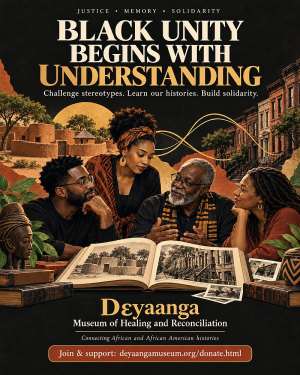
This is why we are building the Dɛyaanga Museum of Healing and Reconciliation in Navrongo, northern Ghana.
We are working toward exhibitions and educational programmes on African American history: slavery and resistance, emancipation, the struggle for civil rights, and African Americans’ contributions to American life. We want African American returnees and diaspora collaborators to lead and shape this work, bringing their knowledge, experiences, and authority into the museum.
Alongside this, we are documenting how communities in Africa resisted slave raiding, protected one another, survived violent displacement, and continue to remember relatives who never returned. Their descendants also carry histories of loss, silence, and unanswered questions.
If you believe in this work, join us. Bring your knowledge, your time, your networks, or your support: https://www.deyaangamuseum.org/index.html
Rest well, Javits.
Emmanuel John A. Awine, PhD Candidate, Johns Hopkins University: [email protected]
Founder & Executive Director, Dɛyaanga Museum of Healing and Reconciliation

 'I’ll make you impotent' – Wife threatens husband on live radio over 'baby mamas...
 'Some radio stations struggle to buy prepaid electricity' – GIBA president
 GMet warns of prolonged dry spells and hotter days from December to February
 'Watch your words on air' – Suhuyini cautions journalists
 'I killed them for saliva' – Man confesses to killing three people for Ghc500
 Some NDC MPs must lose their seats for Upper East region to get development – Ko...
 Dumsor looms as El Niño could reduce Akosombo Dam inflows and affect power gener...
 'I will suggest we limit TraffiTech-GH's application to some major routes within...
 NIA begins nationwide crackdown on illegal Ghana Card photocopying
 Lebanese customs say 46.7kg cocaine trafficker through Accra used insulation tec...


