




A GhanaPostGPS address can locate a property within a grid measuring five metres by five metres and assign it a unique code. The platform describes itself as a national system that provides permanent digital addresses for land and property.[1]
That is useful. It can support deliveries, property identification, and location-based services. But a digital address is not the same thing as a smart city. It tells a city where something is. It does not, by itself, make the journey to that place safer, cheaper, or easier.
This is the test Ghana should apply to every smart-city proposal: What burden will this technology remove from an ordinary resident, and how will the public know that it has worked?
Ghana’s Urban Question Is Now Practical
Ghana’s urban future is no longer a distant planning exercise. The 2021 Population and Housing Census recorded 17,472,530 people living in urban areas, representing 56.7 percent of the national population. The Ghana Statistical Service reported that the urban share had increased from 50.9 percent in 2010.[2]
That growth places increasing pressure on roads, drainage systems, transport networks, housing, and public services. A digital platform cannot replace a missing road or a collapsing drainage channel. It can, however, help institutions understand demand, coordinate services, and explain decisions.
Ghana’s own urban development programmes illustrate why “smart” must mean more than connected devices. In 2022, the World Bank approved an additional US$145 million financing package for the Ghana Secondary Cities Support Programme. The initiative was designed to improve urban services for two million people across 35 secondary cities, strengthen urban management capacity, and support critical infrastructure such as roads and flood-mitigation systems.[3]
That is a smart-city challenge, even when the term itself is not used. Can a municipal assembly plan roads, drainage, land use, and essential services in an integrated way? Can it maintain what it builds? Can residents identify the institution responsible when a project fails to deliver what was promised?
Ghana’s revised National Urban Policy and Implementation Plan (2026-2035) places these same questions within a national framework. On July 28, 2026, the government launched the policy alongside the National Slum Upgrading and Prevention Strategy. According to the United Nations in Ghana, the two frameworks are intended to guide inclusive, resilient, and well-planned urban development through improvements in housing, infrastructure, basic services, climate resilience, and local implementation mechanisms.[4]
These are important commitments. They are not, however, proof that every city is already delivering on them. The gap between policy intentions and lived experience is where Ghana’s smart-city test begins.
Every Technology Needs a Public Job Description
In June 2025, reports indicated that the Minister for Communication, Digital Technology and Innovations had presented a Smart Cities Plan involving smart electricity and water meters, digital transport systems, and intelligent lighting and security infrastructure. The emphasis was on making existing cities smarter rather than constructing entirely new ones.[5]
That distinction deserves attention.
Ghana does not need a new label for every urban problem. It needs a clear public job description for every piece of technology it adopts.
A digital transport system should answer practical questions for passengers:
- Is the service running?
- Where can commuters change vehicles?
- What will the journey cost?
- What happens when the information is wrong?
A system that produces attractive dashboards but leaves passengers uncertain has not solved the problem it was introduced to address.
Smart meters should be assessed by whether they improve service delivery, reduce waste, and make billing more transparent. Residents should know what information is being collected, how it is protected, and how errors can be corrected.
Similarly, intelligent street lighting should be judged by measurable improvements in public safety and energy efficiency, not by the number of connected lamps installed.
Digital addressing faces the same test. A location code becomes valuable when emergency services, government agencies, businesses, and residents can use it consistently. It becomes less useful when people cannot access it easily, institutions fail to recognize it, or the underlying database is not maintained.
The question is not whether Ghana should use technology. The question is whether every technological tool serves a measurable public purpose.
Residents Already Understand the City
Cities often function because residents compensate for shortcomings in formal systems. They share transport information, establish informal landmarks, organize access to services, and develop practical workarounds when public systems fail.
A co-authored publication in the Cities Forum Mentorship Knowledge Series describes this form of distributed, place-based knowledge as “informal urban intelligence.”[6]
That knowledge can help institutions better understand how cities actually operate. But residents should not be expected to absorb the costs of poor planning or weak public systems.
A commuter who spends extra time changing vehicles bears the cost of a transport network that does not connect properly.
A trader who relies on informal directions is solving an information problem that an effective public service could address.
A community that organizes its own drainage maintenance demonstrates initiative, but it may also be exposing a failure of public infrastructure management.
A truly smart city should learn from these signals without using them as substitutes for public responsibility. It should combine official data with residents’ lived experience, test the evidence, and report back on what it has learned and how it has acted.
Four Questions Every Smart-City Project Should Answer
For every smart-city initiative, the responsible institution should publicly answer four questions:
- What problem are we solving?
- Who benefits, and who might be excluded?
- What information are we collecting, and how is it protected?
- How will we measure whether daily life has improved?
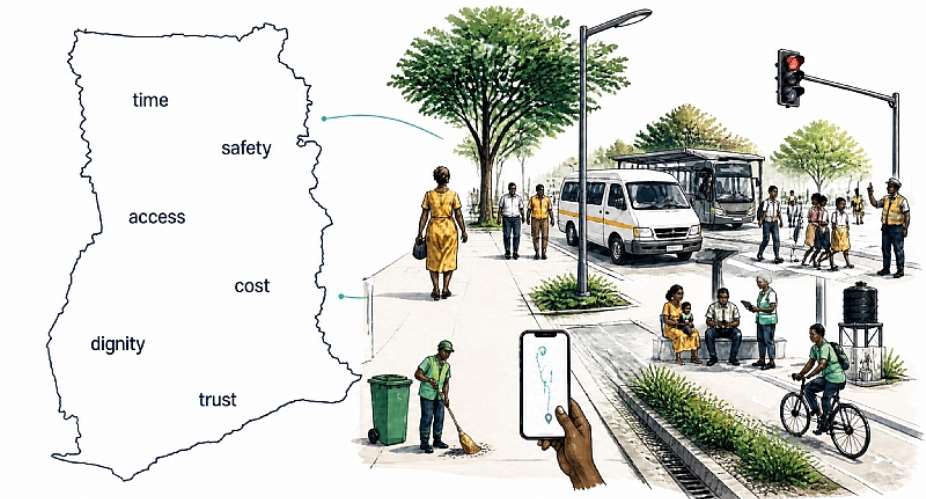
The most important measure of a smart city is not how advanced its technology appears. It is whether residents experience tangible improvements in time, safety, access, affordability, dignity, and trust.
As Ghana implements its urban policy and expands services in secondary cities, the decisive question is no longer whether a project sounds innovative. The question is whether the institution responsible can identify the everyday burden it intends to remove and demonstrate, with evidence, that it has done so.
References
[1] GhanaPostGPS, official digital addressing platform.
[2] Ghana Statistical Service, 2021 Population and Housing Census, General Report highlights.
[3] Modern Ghana, World Bank supports Ghana with $145 million to improve urban services, 9 June 2022.
https://www.modernghana.com/news/1163500/world-bank-supports-ghana-with-145-million-to.html
[4] United Nations in Ghana, Ghana launches its National Urban Policy (2026–2035), 28 July 2026.
[5] Modern Ghana, Communication Minister outlines vision for smart cities and innovation at Ghana-China Business Summit, 30 June 2025.
https://www.modernghana.com/news/1413009/communication-minister-outlines-vision-for-smart.html
[6] Francis Attikpo-Magloe and Hitesh Vaidya, The City That Plans Itself: What African Cities Teach Us About Informal Urban Intelligence and the Institutions That Must Learn From It, Cities Forum Mentorship Knowledge Series.

 Illegal mining threatening Ghana’s relations with neighbouring countries - Zanet...
 NPP started TraffiTech-GH pilot in 2023 – Akim Swedru MP
 Osahen Afenyo-Markin calls for stronger enforcement of audit findings across Afr...
 Ahafo North farmers clash with Newmont, accuse Lands Commission of delaying comp...
 Loaded Transit Truck Left for Weeks Exposes Safety, Enforcement and National Sec...
 GRIDCo CEO gives December deadline for improved power supply in Ashanti Region
 GES to remove Twene Amanfo SHS teachers from Masters on Duty positions over stud...
 Speaker Bagbin urges PAC to detain officials who fail to account for public fund...
 Audit Service recovers over GH¢18bn in public funds between 2022 and 2026 – Audi...
 Mining Conference: Local Government Minister puts Regional Ministers, MMDCEs on ...


