




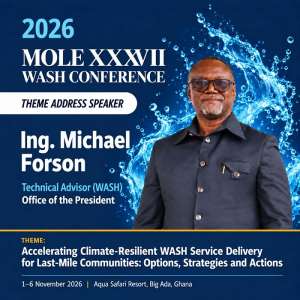
The 37th MOLE Conference is set to examine strategies for accelerating access to climate-resilient Water, Sanitation and Hygiene (WASH) services, with particular focus on underserved communities as Ghana works towards achieving universal coverage by 2030.
The conference, organised by the Ghana Coalition of Non-Governmental Organizations in Water and Sanitation (CONIWAS) under the chairmanship of Dr Beata Awinpoka Akanyani, will take place from November 1 to 6, 2026, at Aqua Safari in Ada.
The Media Coalition Against Open Defecation (M-CODe), with support from World Vision Ghana, is providing a strategic communication platform to promote the conference, enhance its national visibility and encourage citizen engagement.
Held under the theme, “Accelerating Climate-Resilient WASH Service Delivery for Last-Mile Communities: Options, Strategies, and Actions,” the conference will pursue 5 key objectives.
These include assessing Ghana’s climate-resilient WASH delivery options against Sustainable Development Goal 6 targets; evaluating progress in equity and innovative financing; and showcasing solutions in schools, healthcare facilities and economic sectors.
The conference will also examine ways to strengthen political commitment and governance, explore inclusive financing arrangements and technologies that respond to gender and disability needs, and develop practical recommendations supported by strong Gender Equality, Disability and Social Inclusion (GEDSI) monitoring indicators.
To guide discussions, CONIWAS has identified 4 major sub-themes covering political leadership, financing, service delivery innovations and climate resilience in public institutions.
The first sub-theme, WASH as a Political Priority—Leadership, Governance, and Accountability, will focus on the need for stronger political leadership, reliable financing, effective policy implementation and accountability to address persistent challenges in the sector.
Discussions will examine how recent allocations of 10 per cent of the District Assemblies Common Fund (DACF) for water and sanitation can be translated into adequately funded projects.
Participants will also consider the responsibilities of central government, Parliament, Metropolitan, Municipal and District Assemblies (MMDAs), regulators, civil society organisations, development partners, traditional authorities and private sector players in improving coordination, data management, performance monitoring and regulatory enforcement.
The discussions will focus on converting policy commitments into funded interventions, strengthening sector coordination and data systems, and enforcing standards to guarantee safe and inclusive WASH services.
The second sub-theme, Sustainable and Innovative Financing for Reaching Last-Mile Communities, will address the funding gap facing the sector.
According to the Ghana WASH Sector Development Programme, approximately US$1.7 billion is required annually to achieve national targets by 2030, an amount that exceeds the capacity of conventional public financing and donor support.
The discussions will explore alternative funding mechanisms, including climate finance, vertical funds, bankable WASH investment pipelines, public-private partnerships (PPPs), blended finance, results-based financing, revolving funds, microfinance, impact investment, enterprise financing and green bonds.
Participants will also examine effective subsidy arrangements for poor and vulnerable households, alongside sustainable financing models for post-construction operation and maintenance (O&M), which remains a major challenge for many rural water systems.
Key areas of focus will include predictable public financing, access to climate finance and bankable investment opportunities, as well as PPPs and blended financing arrangements.
The third sub-theme, Inclusive Service Delivery Options and Innovations for Last-Mile Communities, will examine practical approaches to extending services to communities facing difficult terrain, scattered settlements, low ability to pay, weak maintenance systems, limited local capacity, water-quality risks and climate vulnerability.
Discussions will cover appropriate technologies, professionalised rural water services, sanitation marketing, faecal sludge management, hygiene behaviour change, digital solutions and community-based management systems.
The role of MMDAs, the Community Water and Sanitation Agency (CWSA), Ghana Water Company Limited (GWCL), private service providers, NGOs and local entrepreneurs will also come under consideration.
Particular emphasis will be placed on delivery models that are gender-responsive, disability-inclusive and sensitive to the needs of poor households.
The fourth sub-theme, Climate-Resilient WASH in Institutions and Public Spaces, will address the growing impact of climate change on water, sanitation and hygiene services.
CONIWAS notes that flooding, droughts and heatwaves are placing increasing pressure on water resources, heightening contamination risks, damaging infrastructure and contributing to disease outbreaks.
The coalition also highlights persistent WASH deficiencies in healthcare facilities, schools, markets, lorry parks and transport terminals, which undermine infection prevention and control (IPC), the wellbeing of learners, menstrual hygiene, food safety and human dignity.
The discussions will therefore examine WASH and waste management in healthcare facilities, sanitation and menstrual hygiene in schools, as well as services in markets and other heavily used public spaces.
Attention will also be given to facility management, operation and maintenance, emergency preparedness and inclusive access.
Key areas will include IPC-WASH in health facilities, school WASH and learner wellbeing, and improved services in markets and transport terminals.
Dr Akanyani told M-CODe that the conference would combine plenary sessions, expert panels and facilitated group discussions to generate concrete proposals for inclusion in the final communiqué.
The programme will also feature verbal and poster presentations to share both successful interventions and lessons from unsuccessful initiatives, alongside side events for start-ups and innovators and exhibitions.
She said the format was intended to encourage meaningful engagement and support efforts to build a harmonised and regulated WASH sector.
The conference is expected to bring together representatives from ministries, departments and agencies, MMDAs, traditional authorities, development partners, academic institutions, NGOs, community-based organisations, the private sector, the media and financial institutions.
"The 37th edition is about ensuring that no community is left behind because of where they live, their ability to pay, or the changing climate," Dr Akanyani stressed.
The final communiqué is expected to provide recommendations to inform national policy, MMDA development planning and Ghana’s roadmap towards achieving Sustainable Development Goal 6.

 'I’ll make you impotent' – Wife threatens husband on live radio over 'baby mamas...
 'Some radio stations struggle to buy prepaid electricity' – GIBA president
 GMet warns of prolonged dry spells and hotter days from December to February
 'Watch your words on air' – Suhuyini cautions journalists
 'I killed them for saliva' – Man confesses to killing three people for Ghc500
 Some NDC MPs must lose their seats for Upper East region to get development – Ko...
 Dumsor looms as El Niño could reduce Akosombo Dam inflows and affect power gener...
 'I will suggest we limit TraffiTech-GH's application to some major routes within...
 NIA begins nationwide crackdown on illegal Ghana Card photocopying
 Lebanese customs say 46.7kg cocaine trafficker through Accra used insulation tec...


