




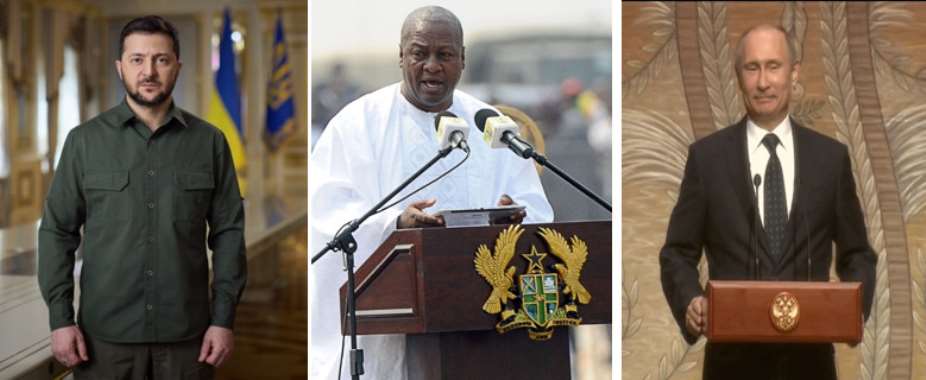
When Ghana's name was mentioned at the United Nations over allegations that its citizens were being recruited to fight in Russia's war against Ukraine, the country could not afford to look the other way.
Our citizens deserved protection, our government owed the nation answers, and the world deserved to know where Ghana stood. Today, following President John Dramani Mahama's engagement with Russian President Vladimir Putin, Ghana's Foreign Affairs Minister says Moscow has agreed to halt the recruitment of Ghanaians. This is welcome news. But the bigger question remains, “will this commitment translate into lasting protection for Ghanaian lives?”
The reported commitment by Russian President Vladimir Putin to halt the recruitment of Ghanaians to fight in the ongoing Russia-Ukraine conflict is a significant diplomatic development that deserves national attention.
According to a statement by Ghana's Minister for Foreign Affairs, Samuel Okudzeto Ablakwa, President Putin gave the commitment following discussions with President John Dramani Mahama on the sidelines of the recently concluded Russia-Africa Summit.
The announcement, first reported by GhanaWeb, represents an important development in Ghana's efforts to address concerns about the involvement of its citizens in a foreign war. It also brings renewed attention to an issue that should never have been treated as a distant international controversy.
Ghana was mentioned at the United Nations. Why were we not talking about it?
When Ukrainian President Volodymyr Zelenskyy addressed the United Nations General Assembly, he raised concerns about the alleged recruitment of citizens from Ghana and other countries to fight on Russia's side in the war against Ukraine. He called on President Mahama and the governments concerned to take responsibility for protecting their citizens.
That was a serious diplomatic allegation involving Ghana's national image, the safety of its citizens and the responsibility of the state to protect its people wherever they may be.
Yet, following that public accusation, I was concerned by the apparent absence of a sufficiently clear and direct public response from Ghana's leadership.
I therefore took the matter to the public through an article published across media platforms, asking a question I believed every concerned Ghanaian had the right to ask.
"Mr. President, Ghana was mentioned at the U.N. Why aren't we talking about it?"
In that article, published by MyJoyOnline, I challenged the government to address the matter and explain what steps were being taken to establish the facts and protect Ghanaians who might be caught up in the conflict.
Read my earlier article here:
https://www.myjoyonline.com/mr-president-ghana-was-mentioned-at-the-un-why-arent-we-talking-about-it/
My expectation was that the issue would receive the attention it deserved, particularly when news emerged that President Mahama was travelling to Russia for the Russia-Africa Summit, where an opportunity for direct diplomatic engagement with President Putin presented itself.
It was therefore encouraging to hear that the matter was raised and that the Foreign Affairs Minister subsequently announced a commitment from the Russian leader to stop the recruitment of Ghanaians.
A diplomatic commitment must become practical protection.
While this development deserves commendation, Ghanaians must not confuse a diplomatic assurance with the complete resolution of the problem.
The government must now provide further clarity on how the commitment will be implemented, monitored and enforced. What mechanisms will prevent Ghanaian citizens from being recruited through unofficial channels, deceptive employment arrangements or intermediaries? What support will be available to Ghanaians who may already have been recruited or find themselves in the conflict zone? How will families seeking information about missing or affected relatives receive assistance?
These are not unnecessary questions. They are legitimate concerns arising from the government's fundamental responsibility to protect its citizens.
The Ministry of Foreign Affairs must also strengthen public education, provide reliable channels for reporting suspicious recruitment activities and work with relevant diplomatic partners to identify and assist affected Ghanaians.
Above all, the government must ensure that no Ghanaian is misled into believing that an attractive employment opportunity abroad is worth risking their life in a foreign conflict.
A salute to citizen journalists, bloggers and professional journalists
I also want to use this opportunity to congratulate fellow citizen journalists, social media bloggers, content creators and professional journalists who helped bring this matter into the national conversation and sustained public attention until the government responded.
This is a moment worth reflecting on.
For too long, some have been quick to dismiss social media journalism and citizen-led reporting as unprofessional or irrelevant. Admittedly, social media can be abused through misinformation, personal attacks, insults and sensationalism. But when used responsibly, it can become a powerful instrument for public accountability.
The lesson here is that journalism is not defined merely by the platform on which a story appears. It is defined by the principles guiding the work, accuracy, fairness, verification, responsibility and the courage to ask difficult questions.
When citizen journalists, bloggers, content creators and professional journalists work within these principles, they can help expose injustices, challenge institutional silence and demand accountability from those entrusted with public office.
This development should remind us that responsible journalism does not have to insult anyone to make an impact. It does not have to descend into political propaganda to demand answers. A well-researched question, presented professionally and supported by facts, can be powerful enough to compel public attention.
Ghanaian lives must always come first.
I welcome the announcement by the Foreign Affairs Minister and commend President Mahama for raising this matter during his engagement with President Putin.
However, the ultimate measure of this diplomatic engagement will not be the announcement itself. It will be whether Ghanaian citizens are genuinely protected from recruitment into a war that is not theirs to fight.
Our national interest must never be sacrificed on the altar of international politics. Ghanaian lives are precious, whether at home or abroad.
And to my fellow journalists and citizen reporters, let us continue to ask the difficult questions, hold public officials accountable and defend the public interest, not through insults, but through facts, professionalism and responsible journalism.
Because when the government is silent, responsible journalism must keep asking. And when citizens are at risk, the nation must never look away.
…End…


 'I’ll make you impotent' – Wife threatens husband on live radio over 'baby mamas...
 'Some radio stations struggle to buy prepaid electricity' – GIBA president
 GMet warns of prolonged dry spells and hotter days from December to February
 'Watch your words on air' – Suhuyini cautions journalists
 'I killed them for saliva' – Man confesses to killing three people for Ghc500
 Some NDC MPs must lose their seats for Upper East region to get development – Ko...
 Dumsor looms as El Niño could reduce Akosombo Dam inflows and affect power gener...
 'I will suggest we limit TraffiTech-GH's application to some major routes within...
 NIA begins nationwide crackdown on illegal Ghana Card photocopying
 Lebanese customs say 46.7kg cocaine trafficker through Accra used insulation tec...


