




(I borrowed the title, with apologies, from Georges Clemenceau, who famously said that war is too important to be left to the generals. The old fox was right about the generals. He would have been even more right about the diplomats.)
We start this piece with another question meant to provoke you to put on the thinking cap and ponder.
What exactly is it about the pinstripe suit and the flag lapel pin that turns otherwise ordinary human beings into pompous, self-important windbags who believe that the fate of nations rests on their cocktail-party circuits?
Anyone who has paid close attention knows they don’t always look pretty.
In most of them, we have a gaggle of overfed, overpaid, and overcompensated bureaucrats with peacock pride shuttling between five-star hotels and air-conditioned conference halls, reading bureaucratese speeches written by other overfed bureaucrats, shaking hands with people they privately despise, and signing communiqués that nobody, absolutely nobody, will ever read again.
Alas, it is into the hands of these pampered and arrogant people that we have entrusted the sacred duty of relating human beings to one another.
And we pretend to wonder why the world is in the sorry state it is in!
Mercifully, while the diplomats wine and dine themselves silly (at the expense of the taxpayers, mind you), and are busy failing at the jobs for which they get paid, ordinary people are quietly succeeding at it.
Every day, ordinary citizens without communiqués, without flag lapel pins, and without anyone's permission connect and build relationships.
Consider the Ghanaian market woman who trades with her Burkinabè and Nigerian sisters across borders that colonial cartographers drew with rulers in distant European capitals. Consider the fishermen of our coasts, who have shared the same waters, the same storms, and the same engine parts with their neighbors long before anybody heard of an Exclusive Economic Zone.
Consider the roadside mechanic in Accra fixing the car of a stranded Malian truck driver, refusing payment because "we are all Africans." Consider the young Nigerian programmer writing code for a client in Warsaw, the Kenyan and Zimbabwean nurses in London, the Senegalese chef in Paris whose thiéboudienne has done more for France's reputation in Africa than a century of françafrique ever did!
These people are the real diplomats.
The tragedy of our age is that we celebrate impostors and ignore the genuine article.
Since we are always brutally honest on this blog, let’s ask: why does the political class care so much that ordinary people do NOT relate to one another directly?
This is a simple question we should all ask.
When a Ghanaian and a Nigerian quarrel on social media, it makes headlines and security briefings. But when the same two people fall in love, start a business, form a band - suddenly the state has no vocabulary for it.
The bureaucrat can process a war; he cannot process a wedding.
And this is not an accident. Throughout history, the ruling classes of every empire have understood something fundamental: people who talk to each other cannot easily be made to kill each other. It is hard to convince a man his neighbor is a cockroach when his neighbor's daughter is married to his son.
Which is precisely why the first casualty of every manufactured conflict is people-to-people contact - visas are revoked, flights are canceled, cultural exchanges are suspended, and the curtains come down.
These measures were not designed to punish governments; governments are never punished for it. They are visited upon ordinary people - to make sure we stay strangers to one another, because strangers are so much easier to control and mobilize for war.
The visa wall is not a wall against migration. It is a wall against fraternization.
Kwame Nkrumah, the Osagyefo himself, understood this best. And the proof is on the record.
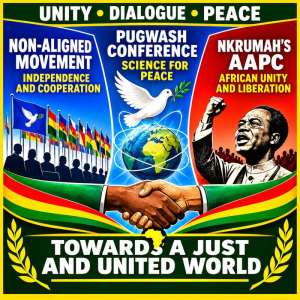
In December 1958 - barely a year after independence, with Ghana itself still struggling to its feet - Nkrumah convened the All-African Peoples' Conference in Accra, December 8-13, 1958. It was not a summit of presidents, but a gathering of 300 actual people of Africa continental as well as the Diaspora - trade unionists, students, freedom fighters, market women, chiefs, journalists.
The AAPC ‘s principal objectives included:
Ending colonialism and imperialism in Africa.
Promoting African unity and solidarity.
Supporting national liberation movements.
Advancing the vision of a united and independent Africa.
A young Patrice Lumumba was there. So was Tom Mboya of Kenya. They came to Accra not with briefcases and prepared statements, but with grievances, songs, and a shared determination that Africa's division into fifty-odd colonial compartments was a crime that had to end. That conference of ordinary Africans drew the map of African unity long before the Organization of African Unity was dreamed up in Addis Ababa - and unlike the OAU, which spent decades being polite to dictators, the Accra gathering actually scared the colonial powers.
They immediately understood what it meant when Africans began to see each other as family rather than as subjects of different flags.
The same instinct worked at Bandung in April 1955, where Asian and African peoples - not just their governments, but the movements and organizations behind them - gathered in Indonesia and declared that the peoples of two continents refused to be permanent enemies in other people's wars.
Out of that people's energy grew the Afro-Asian Peoples' Solidarity movement, whose Cairo gathering in 1957 created the AAPSO - an organization that, for all its later bureaucratization, began as a pure expression of the idea that Asians and Africans should know each other directly, not through the filter of London, Paris, or Washington.
When the Non-Aligned Movement formally rose in Belgrade in 1961, its moral force did not come from presidential podiums - it came from the millions of ordinary people across the Global South who had decided they would not send their sons to die in Europe's quarrels.
And here is my favorite example, because it involves scientists - the least political people on earth. In 1955, Albert Einstein and Bertrand Russell issued a manifesto (Russell-Einstein Manifesto of 9, July, 1955) warning that nuclear weapons had made war between the great powers unthinkable - literally unthinkable, in the sense that nobody would remain alive to think it. From that manifesto sprang the Pugwash Conferences in Pugwash, Nova Scotia, Canada, where Soviet and Western scientists - people whose governments were pointing missiles at each other - kept meeting, kept talking, kept dining together year after year, decade after decade.
While diplomats sharpened their ultimatums, physicists shared tea.
That is the pattern, and it never fails: when official diplomacy works in history, it is usually because citizens had already done the spadework. The doctors who kept treating each other through the blockades. The musicians, Bob Marley with his giant dreads, Fela and his horns, Miriam Makeba and her voice, doing in one concert what a hundred diplomatic cables could not do in a decade.
Even the Eurocrats in Brussels, in their less stupid moments, stumbled upon this truth. Why do you think the European project invested so heavily in student exchanges and town-twinning? Because some clever person understood that a German student who has drunk wine in a French village will think twice before firing a shell at it. People-to-people contact is the cheapest defense budget ever invented - and the only one that actually prevents wars instead of postponing them.
Let’s look at what technology has handed us! We live in the age of the most powerful people-to-people instrument in human history.
A young woman in Kumasi is in a study group with peers in Nairobi, Mumbai and Manila. Football fans in Lagos and London mourn the same defeats. Nollywood has made the Ghanaian and the Congolese neighbors in a way the African Union - that talking shop of presidential egos - has signally failed to do.
Diaspora remittances - money sent home by ordinary people to ordinary people, bypassing every ministry of finance on earth - now dwarf official development aid to Africa!
The taxi driver in Hamburg moves more real resources to Africa than the European Union's entire aid apparatus.
This is the people's parallel diplomacy. It needs no ambassadors and asks no permission. It recognizes no visa regimes. And it terrifies every government that survives by keeping populations suspicious of one another.
So here is my modest proposal, and I make it in all seriousness: Let us consciously, deliberately, and joyfully build the People's Republic of Ordinary Encounters.
Let us revive the spirit of Accra 1958 - not by waiting for another summit of presidents, but by doing what those delegates did: simply showing up for one another. Twin our neighborhoods, not just our capital cities.
Let the mechanics of Accra twin with the mechanics of Dakar; let the market women of Kumasi correspond with the market women of Kano and Abidjan and Douala. Let our universities open their doors wider to each other's students than any foreign "development partner" ever will. Let our musicians tour, our chefs exchange recipes, our farmers compare rainfall, our nurses share notes - the way the Pugwash scientists kept sharing theirs, even when the politicians raged.
Let every professional association, every traders' union, every church choir, every football supporters' club become an embassy - a genuine embassy, an embassy of the people, answerable to no ministry.
We do not need bureaucrats' permission to be human to one another. We never did. The bureaucrat's job, properly understood, is to get out of the way of human connection - and where he refuses to get out of the way, we must learn to route around him, the way water routes around a stone.
The diplomats have had their century and have proven their uselessness. They gave us two world wars, a Cold War, and a permanent arms bazaar. The people's movements - Accra, Bandung, Pugwash - gave us everything worth salvaging from that wreckage.
Give the people a century - just one - and watch what happens.
The embassy is open. It is called your neighbor. Go and present your credentials.
The future, they say, belongs to those who believe in the beauty of their dreams
©️ Ọ̀dọ̀fin Fẹ́mi Akọ́mọláfẹ́ (1st Dan, Ọ̀dọ̀fin I of Kasoa)


 'I’ll make you impotent' – Wife threatens husband on live radio over 'baby mamas...
 'Some radio stations struggle to buy prepaid electricity' – GIBA president
 GMet warns of prolonged dry spells and hotter days from December to February
 'Watch your words on air' – Suhuyini cautions journalists
 'I killed them for saliva' – Man confesses to killing three people for Ghc500
 Some NDC MPs must lose their seats for Upper East region to get development – Ko...
 Dumsor looms as El Niño could reduce Akosombo Dam inflows and affect power gener...
 'I will suggest we limit TraffiTech-GH's application to some major routes within...
 NIA begins nationwide crackdown on illegal Ghana Card photocopying
 Lebanese customs say 46.7kg cocaine trafficker through Accra used insulation tec...


