




A lawyer who defends the accused should not end up in the dock himself. A journalist who reports the news should not end up in a cell. Yet this is the world we are living in as November 2026 begins.
I write from Ghana, where I am free to publish this column, and I do not take that freedom lightly. I am writing it because millions of people across the world do not have that freedom, and some of them have lost years of their lives for using it.
One Man's Story: Ayachi Hammami
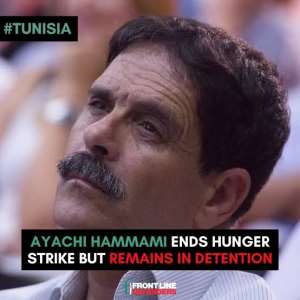
Ayachi Hammami is a Tunisian human rights lawyer, a husband, a father and a grandfather. He has spent decades defending people whose rights were under attack and speaking up for the independence of judges. After President Kais Saied's power grab in 2021, he kept speaking, and he defended judges, lawyers, journalists and opposition figures who were being punished for peaceful dissent.
For that, he was turned from defender to defendant. Hammami had represented people accused in Tunisia's so-called "conspiracy case." The authorities then added him to the same case. According to Amnesty International, a trial that lasted only minutes ended in an eight-year sentence in April 2025. An appeal court cut it to five years in November 2025, and police arrested him at his home on 2 December 2025. UN human rights experts said they were "shocked" by his conviction, which they linked directly to his work defending others.
Prison has not been gentle. He went on a hunger strike that lasted 43 days, ending on 15 January 2026, with his life reported to be in danger. On 3 September 2026, Tunisia's Court of Cassation upheld the convictions of 34 defendants in the conspiracy case, including Hammami. Amnesty called the decision a travesty of justice. In October, Amnesty reported that he had been moved to Monastir prison, far from his family, in what it called an arbitrary and punitive measure. He also remains under separate investigation for statements he made to the media in defence of judges dismissed by presidential decree, a charge that could carry up to ten years.
His case is one of the featured cases in Amnesty International's Write for Rights campaign for 2026/27. Amnesty is asking people everywhere to call for his immediate and unconditional release. I am adding my name and my voice to that call.
Tunisia Is Not a Single Case
Hammami is not alone.
In Tunisia, the human rights defender Sihem Bensedrine was sentenced to 25 years in prison in June 2026. The migrant rights activist Saadia Mosbah received eight years in March 2026. The lawyer and commentator Sonia Dahmani was sentenced to another two years in May 2026 for criticising prison conditions in a radio interview. Journalists Zied El Heni, Khaoula Boukrim and Haythem El Mekki were handed prison terms in June and July 2026 for statements made in the course of their work.
Most of these cases rest on one legal weapon: Decree-Law 54, a cybercrime law that punishes so-called "false news." Amnesty, Human Rights Watch and the European Parliament have all condemned it. On 1 October 2026, Tunisia softened the decree and replaced jail with fines for first-time offences. That is a step, and I will say so honestly, but critics are right that repeat offenders can still be jailed and the repressive character remains. The journalists' union and civil society want the decree scrapped completely, so that journalists are judged under the 2011 press freedom law. The people who forced even this small change were Tunisians who marched, and that should encourage all of us.
The World's Newsrooms Under Siege
The Committee to Protect Journalists counted 330 journalists in prison on 1 December 2025. That was the fifth year in a row above 300. Sixty-one percent were jailed on anti-state charges. Nearly a third reported mistreatment in custody, and one in five reported torture or beatings. CPJ also recorded at least 67 journalists and media workers killed in 2025, the highest number since 2018.
Reporters Without Borders says its 2026 index shows press freedom at its lowest point in 25 years, with more than half of the 180 countries assessed now classed as "difficult" or "very serious." RSF also reports that the Israeli army has killed more than 220 journalists in Gaza since October 2023, at least 70 of them while working.
Now look at my own continent. CPJ counted 42 journalists in prison across Africa at the end of 2025. Eritrea has held 16 journalists for at least two decades, and their legal status, health and whereabouts are all unknown. Some have been missing since 2001, which makes them the longest-held reporters in the world. In Ethiopia, five journalists face terrorism charges after covering the conflict in the Amhara region. In Senegal, the journalist René Capain Bassène is serving a life sentence on evidence that CPJ has called flawed. RSF ranks Eritrea last in the world, at 180th, for the third time. It reports that Niger fell 37 places in a single year to 120th.
Behind every number is a person who tried to tell their neighbours what was happening and was punished for it.
Why Ghana Must Not Be Silent
I am proud of one thing. Ghana climbed to 39th in the 2026 RSF index, up from 52nd the year before, and is fourth in Africa. The Ghana Journalists Association welcomed the news.
But I am also an honest columnist, and I must report the rest.
The Media Foundation for West Africa recorded 34 freedom of expression violations in Ghana in 2024 and 2025. The Media Research Institute warned that the ranking should not be mistaken for a finished job, pointing to political influence, economic pressure on media houses and the safety of journalists. The GJA itself has called on the Government and the Police Service to investigate attacks on journalists and punish those responsible.
We should also remember Ahmed Hussein-Suale, the investigative journalist shot dead near his home in Madina in January 2019. A country that wants to lead Africa on press freedom must never allow a journalist's murder to fade into silence.
A good ranking is not a reason to relax. It is a reason to lead. Ghana can speak up at the African Union, at the African Commission on Human and Peoples' Rights and at the United Nations, because we have the standing to do it.
What I Am Demanding
1. Immediate and Unconditional Release of Ayachi Hammami
His conviction should be quashed, together with those of every person in the "conspiracy case" and every other prisoner jailed solely for peaceful expression, advocacy or legal work.
2. Repeal of Decree-Law 54
There must be an end to prosecuting journalists outside Tunisia's press freedom law.
3. Protection for Lawyers
No lawyer should be prosecuted for representing a client or for speaking publicly about the cases and the justice system they work in. The UN experts who condemned Hammami's conviction said it undermines the independence of the legal profession, and they are right.
4. Answers From Eritrea
The government must say where its imprisoned journalists are, whether they are alive, and release them.
5. An End to Terrorism and "False News" Charges Against Reporters
In Ethiopia, Tunisia and everywhere else, reporting on a conflict is not terrorism.
6. An Independent Review of Bassène's Conviction in Senegal
There must be justice in every case where a journalist has been killed or has disappeared.
7. Ghana to Lead
I call on our government to investigate every attack on a journalist, to keep our digital space free of arbitrary arrests and censorship, and to use its voice in Africa's institutions to press for the release of imprisoned journalists and defenders.
What You Can Do
You do not need to be a lawyer or a journalist to defend one.
Amnesty's Write for Rights campaign works because ordinary people add their names and write letters, month after month, until a prison door opens. Amnesty has run it for years, and it has contributed to releases before. The petition for Ayachi Hammami is addressed to Tunisia's president and calls for his immediate and unconditional release.
Sign it. Write a letter of solidarity. Share his story. Ask your school, your church, your mosque, your union and your newsroom to take part.
Tyrants hope we will forget. Prisoners hope we will remember. A letter that reaches a prison cell tells a person that the world knows their name.
I think of how Mandela used his years in prison, and how those who campaigned outside kept his name alive until he walked free. That is why I am asking you to write, to sign and to speak. Say the name Ayachi Hammami. Say the names of the journalists in Eritrean cells. And keep saying them until they are free.
Reference Sources
- Amnesty International, Write for Rights 2026/27 page on Ayachi Hammami; Amnesty petition text (Amnesty Canada)
- Amnesty International, Tunisia: Upheld convictions in mass "conspiracy case" a travesty of justice (September 2026); Tunisia: Unjustly jailed opponents face isolation (21 October 2026)
- Front Line Defenders case file on Hammami's hunger strike (January 2026); UN human rights experts' statement on his conviction (December 2025)
- Joint NGO letter to the UN Human Rights Council (August 2026) and IFEX appeal (30 July 2026) on Tunisia; Al Jazeera explainer on the Decree 54 amendment (2 October 2026); CPJ reporting on Tunisia
- CPJ 2025 prison census (21 January 2026)
- RSF 2026 World Press Freedom Index, via reporting by The Fourth Estate, MyJoyOnline, News Ghana and The African Mirror
- Ghana Journalists Association statement (3 May 2026); Media Research Institute statement

 Chief Inspectors’ Amnesty Promotion: Supreme Court grants Police Administration ...
 Mahama outlines five priorities for reparatory justice talks with UK, says 'apol...
 GTEC warns universities to stop over-enrolling PhD students
 Police deploy officers and cameras nationwide as TraffiTech-GH enforcement begin...
 Govt to fund travel expenses of mother of murdered Ghanaian teenager to US funer...
 Stop labelling menopausal women as witches – Public told
 ‘Supreme Court is not your lawyer to explain the constitution to you' – Justice ...
 Ghana woos investors for US$100million vaccine manufacturing project
 Eight killed, 21 rescued in bus collision on Elubo–Takoradi Highway
 NPP asks US Embassy to suspend recognition of Ghanaian diplomatic and service pa...


