




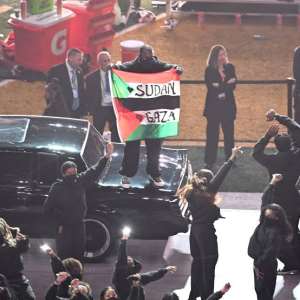
I am writing this from Ghana, a country that has long known the value of peace, and I am writing it for every child who will go to sleep tonight to the sound of bombs.
As I write, in the first days of November 2026, three wars are still burning. In each one, civilians are being killed, starved, raped and buried, and in each one the people responsible are largely free. This is not a failure of information. The evidence is in front of us, collected by the United Nations, by courts and by organisations like Amnesty International. What we lack is the will to act on it.
I am not a head of state and I command no army. I am a writer, a volunteer and a human rights defender, and I refuse to be quiet.
Sudan: Where the World Looked Away
The war in Sudan has now run for more than three years, and it is the largest displacement and hunger crisis on earth. The UN's 2026 response plan counts 33.7 million people in need of help, and about 8.6 million are displaced inside the country.
El Fasher in Darfur shows what silence costs. The Rapid Support Forces besieged the city for roughly eighteen months and captured it on 26 October 2025. The UN Human Rights Office documented more than 6,000 killings in the first three days alone. In one incident, around 500 people were shot with heavy weapons while sheltering in a university dormitory.
In July 2026, the UN Fact-Finding Mission concluded that the RSF committed genocide there. It pointed to mass killings, gang rape and deliberate starvation aimed at non-Arab communities such as the Zaghawa and the Fur. Amnesty International separately documented crimes against humanity and ethnic cleansing. In October 2026, a full year after the city fell, Amnesty reported that civilians are still being detained, tortured and cut off from aid.
This was not a surprise. The UN mission itself said the warning signs were visible before El Fasher fell. Today the same RSF forces are massed around El Obeid, a city of about half a million people. If we repeat the world's old response of statements and sympathy, we will be writing the same report next year with another city's name on it.
To be clear, I am not defending either side. Both the RSF and the Sudanese army have attacked civilians, detained and tortured people, and bombed homes. Accountability must reach every perpetrator.
Gaza: A Ceasefire That Still Buries Children
The ceasefire in Gaza began in October 2025. It has not stopped the killing. According to Gaza's Health Ministry, at least 1,580 Palestinians have been killed and more than 5,700 injured since it took effect, and the total toll since October 2023 is above 74,000. Those are the ministry's figures. UN Human Rights has independently verified over a thousand of the ceasefire-period deaths through July, including 268 children.
More than 100 humanitarian and human rights organisations, Amnesty among them, said this month that the ceasefire exists in name only. The UN's humanitarian office reports that 94 percent of Gaza's health facilities are fully or partly out of service. The Health Ministry says over 21,000 sick and wounded people still need to leave Gaza for treatment, and many are waiting at a crossing that is not open to them.
Amnesty International has concluded that Israel is committing genocide against Palestinians in Gaza. Israel disputes this, and the International Court of Justice has not yet issued its final judgment. My demand does not depend on how that debate ends. Every civilian life must be protected now, and every crime must be investigated.
That includes the crimes of 7 October 2023, when Hamas and other armed groups killed some 1,200 people and took hostages. It also includes the extrajudicial executions by Hamas-affiliated forces that Amnesty and the UN have documented inside Gaza. A principle that protects only one side's victims is not a principle.
Ukraine: The War Getting Deadlier
Ukraine has dropped out of many headlines, but the killing has not slowed. UN monitors report that civilian casualties from January to August 2026 were 55 percent higher than in the same period of 2025: 2,222 killed and 13,058 injured. July 2026 was the deadliest month for civilians since March 2022. Since the full-scale invasion began, the UN has verified at least 16,431 civilians killed, including 803 children.
On 26 October 2026, the UN's Independent Commission of Inquiry concluded that Russian authorities committed war crimes and crimes against humanity through attacks on civilians and on the energy infrastructure that keeps people warm. The Commission also examined Ukrainian strikes on energy targets, which shows that scrutiny must be applied honestly to everyone. Even so, UN rights chief Volker Türk has said Russia was responsible for the large majority of the documented cases.
Peace without justice only buries the problem. A ceasefire that lets a government abduct children, torture prisoners and bomb cities without consequence is a pause before the next war.
The Pattern Is Impunity
Sudan, Gaza and Ukraine are different wars with different causes, but they share one engine: those who give the orders believe nothing will happen to them.
The record gives them reason to believe it:
Sudan: Amnesty and the UN have documented weapons flowing into Darfur in breach of the existing arms embargo. Proposals to extend the embargo to all of Sudan have met opposition from Russia and China at the Security Council. The ICC convicted the Janjaweed commander Ali Kushayb of war crimes and crimes against humanity in October 2025. That conviction shows justice is possible, and it also shows how long justice takes.
Gaza: The ICC issued arrest warrants for Israeli and Hamas leaders. The United States has responded by sanctioning ICC judges and prosecutors. Punishing the judges is not a way to defend the law.
Ukraine: The ICC issued a warrant for Vladimir Putin in 2023, and he still travels. In June 2025, Ukraine and the Council of Europe signed an agreement for a special tribunal on the crime of aggression, and that tribunal now needs real support and funding.
A court cannot enforce its own warrants. Only states can, and too many of them look away when the accused is powerful or friendly.
What I Am Demanding
I stand with the call of Amnesty International for the world to act on armed conflict, and I add my own voice to it:
1. Protection Forces with a Real Mandate
Where civilians are encircled or starved, as in El Obeid and Darfur, the international community must deploy forces whose job is to protect civilians. They must be properly equipped and able to open humanitarian corridors.
The same applies to Gaza, where any international force must be mandated to protect Palestinian civilians and not merely to manage the conflict.
Ghana has sent its own sons and daughters to serve under the UN flag. I ask my country, the African Union and every troop-contributing nation to lead on this.
2. Independent Accountability
The Security Council should expand the ICC's Darfur mandate to cover all of Sudan. States must execute ICC warrants, and the sanctions against the Court's judges must end. Ukraine's special tribunal must be built and funded. Investigations must cover every party to every conflict.
3. A Sudan-Wide Arms Embargo That Is Enforced
Amnesty has asked for this for years. Any state that supplies weapons to the warring parties, whoever it is, should answer for it.
4. Unrestricted Humanitarian Access and Funding
Sudan's 2026 appeal is only about 40 percent funded, with $1.1 billion received against $2.9 billion needed. Aid agencies are warning that the system could collapse. Hunger is being used as a weapon, and underfunding helps it work.
5. A Real Ceasefire in Gaza, With Verification
The killing, the closed crossings and the blocked medical evacuations must stop, and monitors must have access.
To My Fellow Ghanaians and Africans, and to the World
Some of you will say these wars are far from us. Sudan is an African nation, and its dead are our brothers and sisters. But even if the distance were greater, human rights have no borders. If international law protects only some victims, then it protects none of us.
I call on our government to speak plainly at the African Union and the United Nations, as a state that has ratified the Rome Statute. I call on the media to keep these stories on the front page and not in the corner. I call on my fellow citizens to write to their representatives, to join Amnesty International's campaigns, to give to credible humanitarian groups, and to refuse to scroll past another atrocity.
A man I admire said it is always impossible until it is done. Mandela knew that justice is built, slowly, by ordinary people who refuse to accept what is called normal. Malala knew that one voice, once raised, can be the start of something larger. Gandhi taught that the powerful can be moved by those who will not stop asking.
I am raising my voice now. I ask you to raise yours, until no one can claim they did not know.
Editor's Reference Sources
- UN Human Rights Office (OHCHR), El Fasher report, February 2026; UN Fact-Finding Mission for Sudan, February and July 2026
- Amnesty International, El Fasher report (July 2026) and one-year update (October 2026)
- UN OCHA and WFP Sudan updates, August to September 2026; OCHA 2026 Humanitarian Needs and Response Plan
- Gaza Health Ministry figures as reported 10 to 31 October 2026; UN Human Rights Office in the Occupied Palestinian Territory, 12 October 2026; Amnesty joint statement with 100+ organisations, October 2026
- UN Human Rights Monitoring Mission in Ukraine, monthly and mid-year reports (July to September 2026); UN Commission of Inquiry on Ukraine, 26 October 2026

 Chief Inspectors’ Amnesty Promotion: Supreme Court grants Police Administration ...
 Mahama outlines five priorities for reparatory justice talks with UK, says 'apol...
 GTEC warns universities to stop over-enrolling PhD students
 Police deploy officers and cameras nationwide as TraffiTech-GH enforcement begin...
 Govt to fund travel expenses of mother of murdered Ghanaian teenager to US funer...
 Stop labelling menopausal women as witches – Public told
 ‘Supreme Court is not your lawyer to explain the constitution to you' – Justice ...
 Ghana woos investors for US$100million vaccine manufacturing project
 Eight killed, 21 rescued in bus collision on Elubo–Takoradi Highway
 NPP asks US Embassy to suspend recognition of Ghanaian diplomatic and service pa...


