




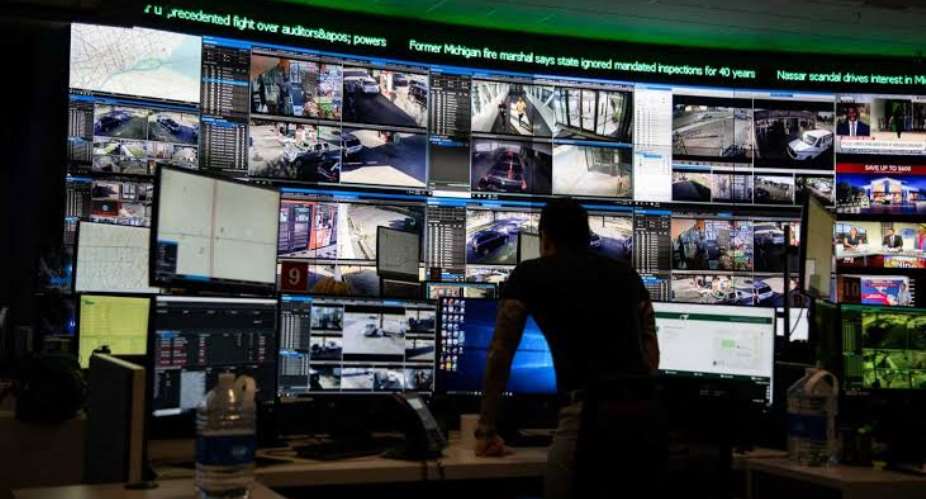
Think about the last time you walked through a busy street in Accra, Kumasi or Takoradi. Think about the phone in your pocket, the Ghana Card in your wallet, and the camera on the pole above you. Now ask yourself a question that most of us never ask: who is watching, who decides, and who can I complain to?
I am a human rights defender, and I have spent years writing about abuses you can see. This one you cannot, and that is exactly why I am writing about it. An invisible abuse needs more people willing to speak.
The Machines That Decide About Us
All over the world, police and security agencies are handing power to software. Cameras match faces to databases. Algorithms flag which neighbourhoods and which people are "risky." Phone-tracking tools and spyware are sold to governments that promise to use them only against criminals.
The trouble is that these systems are often secret, often unregulated, and rarely open to challenge. A person flagged by an algorithm usually cannot see why, cannot test the evidence and cannot appeal to anyone who understands the machine.
Human Rights Watch has spent years documenting how digital tools, from hacking software to facial recognition, are used against activists, minorities and workers. Their 2026 investigations show how big this problem has become.
What Human Rights Watch Found in 2026
In May 2026, Human Rights Watch published a 54-page report called Looking the Other Way. The researchers filed freedom of information requests in all 27 European Union countries to learn who was selling surveillance technology to whom. Their conclusion was blunt: the EU is failing to stop its member states from exporting surveillance tools to governments with well-documented records of spying on activists, journalists and critics.
Reporting on the findings named exports to countries such as Azerbaijan and Rwanda. Five of the biggest exporters, France, Germany, Greece, Italy and Spain, refused to hand over their licensing records at all. Read that again: the companies and governments selling the tools of surveillance would not even tell the public who their customers are.
In August 2026, Human Rights Watch also warned about how surveillance and profiling technology is expanding the abusive power of US immigration agents. They documented agents surveilling protesters and community observers during operations in Minnesota in December 2025 and January 2026. Witnesses told a congressional shadow hearing that such data can be used to profile and intimidate people in ways that chill protest, limit access to essential services and undermine privacy and due process. Congress had just sent large new funding to immigration enforcement without matching safeguards.
In June 2026, Human Rights Watch and other groups urged the UK Home Office to halt an experiment using facial age estimation on children seeking asylum. These are children, and the technology is unproven.
In July 2026, the UN human rights office published a position paper on facial recognition in policing. It acknowledged legitimate uses but called for bans on the most harmful ones. Those include live facial recognition at protests and in other public places, so-called emotion recognition, profiling to predict a person's beliefs or future behaviour, databases built by scraping people's photos without consent, and decisions made by facial recognition alone with no human judgment.
The pattern across all of these is the same. The technology arrives first, and the rules, if any, come years later.
When Regulators Blink
Even the world's strongest attempt at regulation has stumbled. The EU's AI Act was meant to put strict controls on high-risk systems, including AI used in law enforcement, biometrics and border control. In 2026 the EU agreed to delay those rules to December 2027, after pressure from industry. Amnesty International warned that the delay and weakening threaten to undermine the law's protections.
Civil society groups raised another fear. Systems rushed onto the market before the rules apply may escape them for good. If that happens, a delay becomes an exemption, and the people who pay for it are ordinary citizens.
This Is Not Only a Western Problem
Some of my fellow Ghanaians may think this is a story about Europe and America. It is not.
Researchers from the Institute of Development Studies and the African Digital Rights Network have documented Ghana's growing surveillance infrastructure. Known contracts with overseas companies totalled US$184 million, much of it for a "safe city" project that includes CCTV powered by Huawei facial recognition AI. They also noted that new biometric ID systems require citizens to hand over faces or fingerprints. That report is not new, and the infrastructure has only grown since. They pointed to cases where devices were seized by police, and they warned that a democracy can wear away when the state's power to watch grows faster than the public's power to question it.
Article 18 of our Constitution protects every Ghanaian from interference with their privacy, home and correspondence. The Data Protection Act of 2012 sets rules for how personal information may be collected and used. In 2026, our Data Protection Commission declared a year of real enforcement, with inspections, spot checks and complaint investigations. In October 2026, it even moved to review the public disclosure of the personal details of nearly two thousand Ghanaians evacuated from South Africa. I applaud that, and I want to see the same energy aimed at the state's own surveillance tools.
In March 2026, the government announced it is developing a new Data Protection Bill, which may create a stronger authority with more enforcement power. This is our chance, and I do not want us to waste it.
What I Am Demanding
I stand with Human Rights Watch, Amnesty International and the UN human rights office on one principle: powerful technology must not operate in the dark.
I am calling for the following:
1. A Public Register of Every Surveillance Tool Used by Police and Security Agencies
Citizens must be able to learn what exists, who bought it, how much it cost and who supplied it. Secret contracts should be a thing of the past. Ghana should publish the details of its safe city and CCTV contracts.
2. Independent Human Rights Impact Assessments Before Deployment
No facial recognition, predictive policing or mass data tool should go live until experts and civil society have tested it for bias, accuracy and harm.
3. Court-Issued Warrants and Judicial Oversight
The police should not be able to access phone data, location records, camera feeds or devices without a warrant from a judge, with clear limits on how long data is kept and a duty to delete it.
4. Bans on the Most Dangerous Uses
I echo the UN's call to prohibit live facial recognition at protests, emotion-reading systems, profiling that predicts political beliefs, and databases built by scraping our photos.
5. A Human Being, Not a Machine, Must Make the Final Decision
No person should be arrested, refused a service or flagged as a suspect on the word of an algorithm alone, and every person must have a way to appeal.
6. Transparent Export Controls
Countries that make surveillance tools must publish who buys them and must refuse sales to governments that use them to crush dissent. Africa must also ask hard questions of the countries and companies selling to us.
7. A Strong, Independent Data Protection Bill for Ghana
The new law must clearly cover the police and security agencies, give the regulator real power over state surveillance, and guarantee citizens the right to know when their data has been used and the right to seek a remedy.
A Word to My Fellow Citizens
Some will say, "If I have nothing to hide, why should I worry?"
I understand the feeling, but I reject the logic.
Privacy is not about hiding wrongdoing. It is about protecting the freedom to think, to organise, to worship, to protest and to make mistakes without being tracked by someone with power over you. A society that is watched constantly becomes a society that stays silent.
History teaches that surveillance is rarely used only on criminals. It is used on journalists, on opposition voices, on activists and on anyone inconvenient. The tools being sold today are far more powerful than anything past rulers had.
I am asking journalists to investigate. I am asking lawyers to challenge secret surveillance in court. I am asking Parliament to write strong protections into law. I am asking every Ghanaian to ask one simple question every time a new camera or database appears: who is watching, and who is watching them?
Privacy is not a luxury. It is the quiet foundation under every other right we hold. I will not stay silent while it is taken from us without our knowledge, and I invite you to speak with me.
Reference Sources
- Human Rights Watch, Looking the Other Way: EU Failure to Prevent Surveillance Exports to Rights Violators (12 May 2026), plus press coverage naming Azerbaijan, Rwanda and the five countries that refused to share records.
- Human Rights Watch, Technology Expands ICE's Capacity for Abuse (6 August 2026).
- Human Rights Watch letter on UK Home Office facial age estimation (18 June 2026).
- UN Human Rights Office, position paper on facial recognition in law enforcement (July 2026).
- EU Digital Omnibus on AI, high-risk rules delayed to December 2027; Amnesty International analysis (April 2026).
- Institute of Development Studies and African Digital Rights Network report on surveillance in Ghana.
- Ghana Data Protection Commission statements (October 2026); Data Protection Act, 2012 (Act 843); Government of Ghana announcement of a new Data Protection Bill (2 March 2026).


 Chief Inspectors’ Amnesty Promotion: Supreme Court grants Police Administration ...
 Mahama outlines five priorities for reparatory justice talks with UK, says 'apol...
 GTEC warns universities to stop over-enrolling PhD students
 Police deploy officers and cameras nationwide as TraffiTech-GH enforcement begin...
 Govt to fund travel expenses of mother of murdered Ghanaian teenager to US funer...
 Stop labelling menopausal women as witches – Public told
 ‘Supreme Court is not your lawyer to explain the constitution to you' – Justice ...
 Ghana woos investors for US$100million vaccine manufacturing project
 Eight killed, 21 rescued in bus collision on Elubo–Takoradi Highway
 NPP asks US Embassy to suspend recognition of Ghanaian diplomatic and service pa...


