




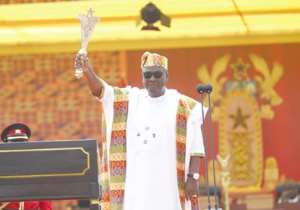
John Dramani Mahama accomplished in December 2024, what many seasoned political scientists considered a near-impossible feat in contemporary African politics: accomplishing a democratic comeback to secure the presidency for a second, non-consecutive term.
Arriving at the Jubilee House on a wave of immense public fatigue with the previous Akufo-Addo administration, Mahama assumed the office of President, as a repository of national hope for many Ghanaians.
Now, nearly two years later, with his government at the critical midterm point, an important question emerges: Is John Mahama still popular, and if so, why? The data
The short answer to the first question is: 'yes' – but it is a popularity increasingly moderated by the unforgiving realities of governance.
Recent empirical data provides a fascinating window into the Ghanaian psyche.
A September 2026 Global InfoAnalytics poll is instructive for the government.
According to the data, President Mahama has a personal approval rating of 65 per cent, a very high approval rating in Africa where public satisfaction with executive leadership is often low due to persistent economic challenges, price inflation, and public distrust of state institutions.
According to comparative data from Afrobarometer, fewer than half of citizens across surveyed African countries express trust or high approval in their president, making any rating above 60 per cent a distinct marker of majority public support.
Yet, a closer look at the trajectory reveals a subtle but discernible shift in public approval.
The recent 65 per cent figure is a notable decline from the 71 per cent approval recorded in June 2026.
Simultaneously, the president's disapproval rating rose from 23 per cent to 28 per cent.
This is by no means a collapse of support but it should register as a wake-up call: the political honeymoon is over; now is the time to deliver on election promises. Broad popularity
Explaining President Mahama's broad popularity is contextualised by the unique circumstances of his return.
Unlike his first presidency (2012–2017), heavily critiqued over infrastructure-led debt and the energy crisis popularly known as dumsor, time has been kind to the legacy of Mahama I.
During his decade away from power, many citizens began to appreciate his government's achievements: the terminal buildings, interchange projects, and healthcare facilities built during his first tenure; critical lifelines during the COVID-19 pandemic.
The speed of the economic turnaround achieved over the past two years is also important.
Fuel prices, although still a burden to the average citizen, are showing signs of stabilisation.
Business confidence is building, and macro-indicators reveal cautious optimism from international financial institutions.
Rapid economic stabilisation is key to avoiding the immediate voter backlash that often plagues midterm governments.
President Mahama's popularity has overcome traditional partisan fault lines.
September polling indicates that in the Ashanti Region, long a major electoral stronghold of the NPP, his approval is at an unprecedented 60 per cent.
This is largely attributed to his administration's strategic focus on completing high-visibility projects, such as the major Ashanti expressway expansion, underlining that highly visible development is the most effective way to build political support in Ghana.
There is, however, a downside, and the government needs to tread carefully.
The September poll uncovered a worrying dichotomy: the President's personal approval sits comfortably at 65 per cent, while his government's overall performance of 'Good' or 'Very Good' plunged from 22 per cent to a meagre 15 per cent.
This wide statistical gap reveals a dangerous phenomenon.
Two-thirds of Ghanaians trust the man: John Mahama; 85 per cent are not convinced of his government's efficacy. Judging by social media and media reports, many Ghanaians are growing impatient with the rollout of the President's flagship '24-Hour Economy' initiative.
The problem is that there is no real sense that it has successfully evolved from a conceptual campaign slogan into tangible, widespread job creation for the youth.
The NPP seeks to weaponise these unmet expectations, articulating what many 'ordinary' Ghanaians are saying: the NDC government talks the talk but it doesn't walk the walk. No third term
There is also another important factor to ponder: President Mahama's self-imposed expiration date. In July 2026, the President reiterated his firm intention to serve only a single four-year term, legally precluding himself from a third term.
While this 'one-and-done' declaration frees him from the immediate shackles of future electoral calculations – allowing him to theoretically pursue bold, uninhibited reforms – it also risks inducing a premature 'lame duck' status within the NDC, as ambitious successors begin manoeuvring for the 2028 presidential election.
Looking toward the final phase of the current administration, there are known knowns: President Mahama remains popular, but popularity is a declining asset.
Ghana's voters are sophisticated; they can distinguish between a likeable leader and an effective government.
If Mahama wishes to preserve his legacy and ensure his party's continuity, the next two years cannot merely be about maintaining his personal charm.
They must be about dealing with a known unknown: how to close the gap between presidential popularity and institutional performance.
The foundations have been laid, the economic bleeding is staunched, but the real work of delivering the promise of prosperity has only just begun – and time, for the NDC, is running out.
The writer is Emeritus Professor of Politics, London Metropolitan University, UK

 ‘The World Is Watching’ — Kwasi Kwarteng Demands Justice for Slain Ghanaian Teen...
 ‘Justice Must Be Served’ — Ghana’s US Ambassador Demands Full Probe into Killing...
 ‘The Constitution Is Clear’ — Fuseini Challenges NPP’s Supreme Court Suit on Pre...
 Audit GH¢49.7m South Africa Evacuation Spending, Kwasi Kwarteng Demands
 Inusah Fuseini to Mahama: Reject a Third-Term Bid Even If Supreme Court Approves...
 Trump admin approves potential Patriot missiles sale to Ukraine
 US and Russia block competing UN resolutions on Western Sahara
 'Atmosphere of fear': Trump moves to curtail voting rights ahead of the midterms
 Uncle and niece shot dead over alleged GH¢500,000 debt; woman arrested


