




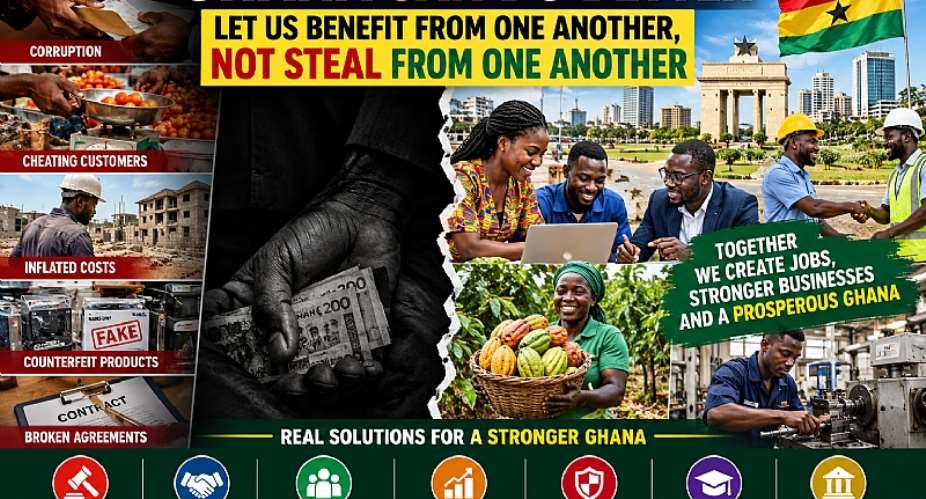
One of Ghana's greatest challenges is not simply the lack of money, resources or opportunities. It is the growing culture of dishonesty, mistrust and exploitation that continues to undermine our economic and social development.
Too often, we appear more interested in making quick money from one another than building relationships that create lasting prosperity.
Consider some everyday experiences in Ghana.
A homeowner engages an artisan to undertake construction work, only to discover that the cost of materials has been inflated, inferior materials have been purchased or money collected has been misused.
A customer purchases electrical appliances or spare parts from a market, only to discover that the products are counterfeit or do not meet the promised quality.
A trader deliberately manipulates weighing scales to cheat customers, while some landlords demand excessive rent advances despite legal restrictions.
In workplaces, some employees misuse company resources, while some employers delay salaries or fail to honour agreed conditions of employment.
Even among friends and relatives, business partnerships sometimes collapse because one party misappropriates funds or refuses to account for money entrusted to them.
These examples are not accusations against entire professions or communities. Many Ghanaian artisans, traders, employers and entrepreneurs operate honestly. Nevertheless, such experiences help explain why mistrust has become a serious obstacle to economic cooperation.
The consequences extend beyond individual financial losses.
When people cannot trust one another, entrepreneurs become reluctant to establish partnerships, investors hesitate to provide capital, and business owners fear delegating responsibilities.
As a result, many promising Ghanaian businesses remain small because their owners prefer working alone rather than risking dishonest partnerships.
This limits job creation, industrial expansion and the development of competitive local enterprises.
The problem is equally serious in public administration.
The Auditor-General's annual reports have repeatedly identified financial irregularities in public institutions, including unsupported payments, procurement breaches and weaknesses in financial management. Although not every irregularity represents theft or corruption, these findings demonstrate the importance of stronger accountability in managing public resources.
When public money is mismanaged, communities may lose opportunities for better schools, hospitals, roads and essential services.
The fundamental problem is that individual greed often takes priority over collective progress.
Yet Ghana has enormous opportunities for shared prosperity.
Consider cocoa farmers who form well-managed cooperatives to improve access to agricultural inputs, financing and markets. By working together, they can strengthen their bargaining position and reduce operating costs.
Similarly, small manufacturers in Suame Magazine, Kumasi, could benefit from stronger cooperation in equipment acquisition, technical training, quality control and access to larger markets.
Traders in Makola, Kejetia and other commercial centres could build greater consumer confidence through transparent pricing, accurate measurements and reliable product quality.
These examples demonstrate that cooperation can create more sustainable wealth than exploitation.
What Must Ghana Do Differently?
First, strengthen accountability and law enforcement. Fraud, corruption, theft and breach of contract must attract appropriate consequences. Commercial disputes should be resolved more quickly and affordably so that businesses can operate with confidence.
Second, promote honest business practices. Trade associations and professional bodies should establish clear standards for pricing, product quality and customer protection. Dishonest operators must face meaningful disciplinary or legal consequences.
Third, encourage business partnerships and cooperatives. Government agencies, financial institutions and business associations should support transparent partnerships among farmers, artisans, traders and small manufacturers. Proper accounting systems, written agreements and independent auditing can reduce the risks of financial misconduct.
Fourth, strengthen consumer protection. Institutions such as the Ghana Standards Authority and relevant regulatory agencies should intensify public education and appropriate enforcement against counterfeit goods, misleading product descriptions and unfair commercial practices.
Fifth, teach integrity from childhood. Schools, families, religious institutions and community organisations must emphasise honesty, responsibility and respect for other people's property. Young people should understand that success does not require cheating others.
Finally, leadership must set the example. Politicians, public officials, business executives and community leaders must demonstrate transparency and accountability. Citizens cannot be expected to embrace integrity when those entrusted with authority appear to benefit from dishonesty without consequences.
Ghana must recognise that sustainable wealth comes from creating value, not stealing value.
A trustworthy artisan attracts repeat customers. An honest trader builds customer loyalty. A responsible employee contributes to business growth. A fair employer earns the confidence of workers. An accountable public official protects national resources.
When these relationships function properly, everyone benefits.
We must also acknowledge that dishonesty is not unique to Ghana, and countless Ghanaians demonstrate integrity every day. Our responsibility is to build institutions and a business culture that reward such behaviour.
Ghana cannot develop sustainably if we continue to treat one another as opportunities for exploitation rather than partners in progress.
Our national prosperity depends not only on government policies, foreign investment or natural resources, but also on how we conduct business and treat one another.
We must move from a culture of cheating to a culture of cooperation, from personal greed to shared prosperity, and from mistrust to accountability.
The future of Ghana will not be secured by how cleverly we take advantage of one another, but by how effectively we help one another succeed.
Ghana will prosper not when we learn how to take more from one another, but when we learn how to create more value for one another.


 Uncle and niece shot dead over alleged GH¢500,000 debt; woman arrested
 Minister spotlights emerging security threats in Bono region
 NDC must accept same scrutiny demanded under Akufo-Addo — Afenyo-Markin
 Military commended for preparedness exhibited at Land Combat and Firepower Demon...
 Police arrest man with 91 parcels of suspected Indian hemp at Circle bus termina...
 How the record-breaking $6.3 billion heist in crypto history unfolded
 NPP will return to power with Bawumia in 2028 – Osahen Afenyo-Markin
 Ghana, Burkina Faso trade about US$1bn annually – Trade Minister
 NPP's new parliamentary aspirant selection process designed to favour Bawumia lo...
 ECOWAS steps up regional efforts to address climate-induced migration


