




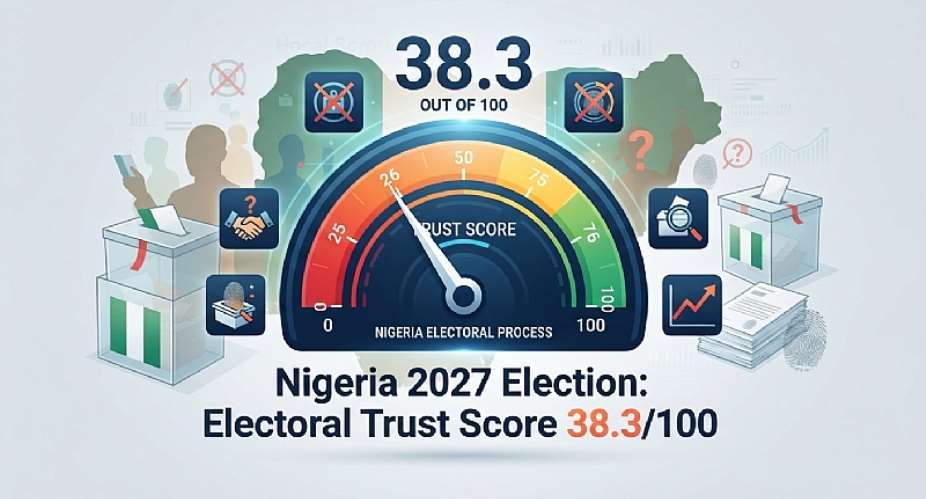
With Nigeria's 2027 general elections fast approaching, a new assessment has placed public trust in the country's electoral management system at 38.3 out of 100 — a level its authors describe as "fragile" and, more worryingly, deteriorating.
The Nigeria 2027 Electoral Trust Index measures trust, threats and risks, argues that the country's central challenge may not be whether citizens are willing to vote. It is whether they will continue to believe the system is credible enough for their votes to count. 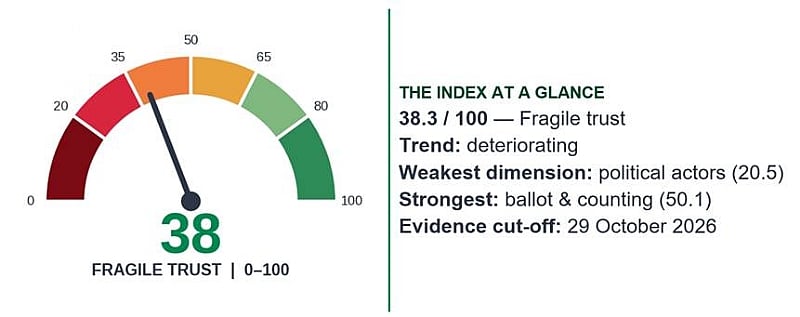
The index, which has an evidence cut-off of 29 October 2026, classifies Nigeria's Trust Velocity— the direction in which trust is moving — as "deteriorating". According to Yiaga Africa's National Voting Intentions Survey, the share of Nigerians confident that the Independent National Electoral Commission (INEC) will conduct credible elections fell from 45 per cent in March 2026 to 34 per cent in September. The longer trend is similar: Afrobarometer surveys show trust in INEC falling from about 35 per cent in 2017 to 16 per cent in 2024.
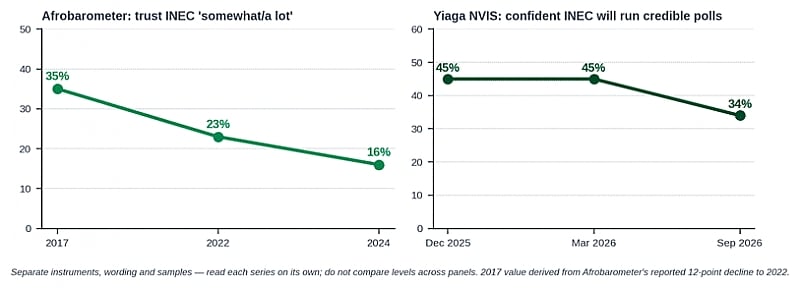
Trust in INEC is falling on two independent measures. The surveys use different questions and samples, so each line should be read on its own. Sources: Afrobarometer; Yiaga Africa NVIS 1–3.
This study, cautions against reading the findings as evidence that Nigerians have given up on democracy.
“The important distinction is between democratic demand and institutional confidence. Nigerians continue to want elections and continue to express a willingness to vote. What is weakening is their confidence in the system that is expected to guarantee that their participation will produce a credible outcome.”
The data support that distinction. According to the assessment, 73.8 per cent of Nigerians support regular, open and honest elections, and 84 per cent say they intend to vote. Yet only 41 per cent say they are certain and committed to voting — a sign that participation may depend on security and on confidence that votes will count.
▍ Technology is trusted more than the umpire
One of the report's most striking findings is the gap between confidence in INEC and confidence in the technology it deploys. Nearly half of respondents (49 per cent) trust the Bimodal Voter Accreditation System (BVAS) and the INEC Result Viewing Portal (IReV), compared with 34 per cent who are confident INEC will conduct credible polls.
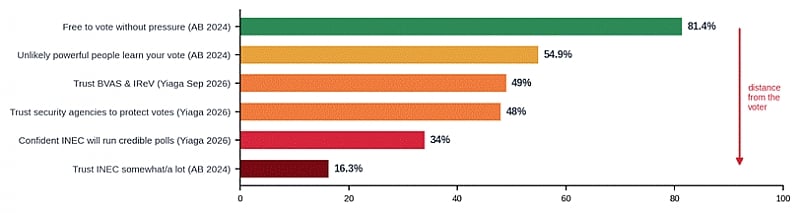
The trust stack: confidence is strongest closest to the voter and weakest for the institution running the election. Sources: Afrobarometer Round 10 (2024); Yiaga Africa NVIS 3.0 (Sep 2026).
This study describes technology as a potential "trust anchor" for 2027 — but also as a point of vulnerability. If IReV or BVAS fails visibly during a high-stakes contest, a technical problem may be read not as a glitch but as evidence of manipulation.
“Nigeria has reached an unusual point where the electorate may trust some of the tools of election administration more than the institution operating them. That makes technology both an asset and a vulnerability. A successful electronic transmission can strengthen confidence; a visible failure at a critical moment can have the opposite effect and immediately become a question of institutional credibility.”
The concern is sharpened by the Electoral Act 2026, which recognises electronic transmission of results for the first time but retains manual transmission as a fallback where technology or networks fail. Further, it does not argue that the provision itself is the problem. Rather, it warns that the absence of public, binding criteria for switching from electronic to manual transmission could become a major trust issue — and it ranks this as the most critical latent threat in its assessment.
▍ The biggest deficit is not technology — it is people
The measurements show trust weakening sharply as attention moves from voting procedures to the institutions and political actors around them. Political Actor Trust scores just 20.5, the weakest measured dimension. Institutional Trust in INEC scores 28.7 and Electoral Justice 35.4. By contrast, Election Technology scores 49.0 and Ballot and Counting Trust 50.1.
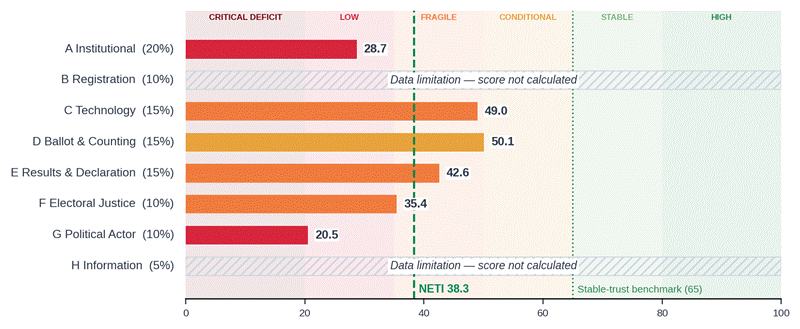
The eight dimensions of the Nigeria Electoral Trust Architecture™. Registration and Information Trust were not scored because no defensible survey evidence exists; Study did not estimate them.
The result is what this study calls a trust gap: Nigerians have considerably more faith in the physical and technological mechanics of voting than in the people and institutions responsible for them. That matters, the report argues, because electoral legitimacy depends not only on whether votes are counted, but on whether citizens and political actors accept the process and its outcome.
I must say that - the deeper concern is not simply whether Nigeria can conduct an election. It is whether all sides will believe the election was conducted fairly enough to accept its outcome.
“When trust becomes partisan — when one group trusts the umpire and another assumes the umpire is biased — the credibility of even technically sound electoral processes becomes vulnerable.”
My study notes that confidence in INEC appears to track approval of the government, while opposition parties have alleged institutional bias — allegations INEC rejects. The report treats those claims as signals of contested neutrality, not as established facts.
▍ Courts face a parallel trust problem
The deficit does not end with INEC. Electoral Justice scores 35.4, with 63 per cent of respondents not confident that the judiciary will resolve electoral disputes fairly — rising to 81 per cent in the South-South. The report also points to conflicting court decisions on electoral matters in 2026 as a further complication. That matters because the courts are the principal channel through which disputed elections are meant to be resolved.
Dr. Mawugbe describes this as a potential "second-order" electoral risk.
“If public confidence in the electoral umpire is weak and confidence in the dispute-resolution mechanism is also weak, a disputed election has fewer trusted institutional channels through which the dispute can be absorbed. That is why electoral trust should be treated as an early-warning issue rather than something to be measured only after election results are announced.”
▍ Different risks in different parts of the country
Nigeria, does not have a single electoral trust problem. The South-East and South-South emerge as significant acceptance-risk areas, where 62 and 57 per cent respectively lack confidence in INEC, compared with 39 per cent nationally. If results are disputed, the report argues, these areas could face greater legitimacy risks.
The North-East, North-West and parts of the North-Central present a different problem: participation and integrity. In the North-East, 78 per cent of respondents say fear of violence could stop them voting, while 32 per cent in the North-West report having received money to vote for a candidate.
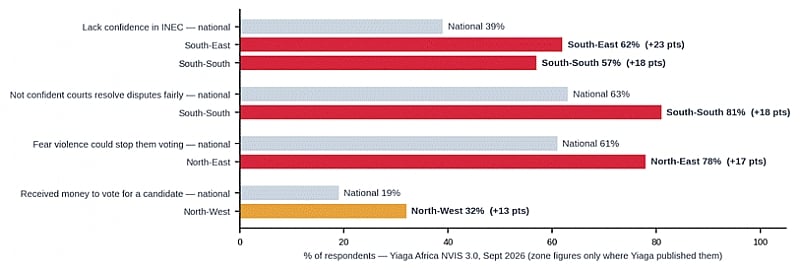
Where the risks concentrate. Zone figures are as published by Yiaga Africa (NVIS 3.0, Sep 2026); Study has not estimated values for zones without published data.
Here, it therefore distinguishes between two types of hotspots. In acceptance hotspots, the main risk is rejection of the election's legitimacy. In inclusion hotspots, insecurity, voter exclusion and inducement threaten participation and the integrity of voter choice. The distinction, is essential to designing interventions that work.
▍ What could trigger a trust shock?
The report traces a potentially dangerous chain of events, which it stresses is a conditional risk pathway rather than a prediction: a delay in IReV uploads leads to a manual fallback, which fuels suspicion; fabricated results fill the information gap; political actors reject the outcome; and confidence collapses.
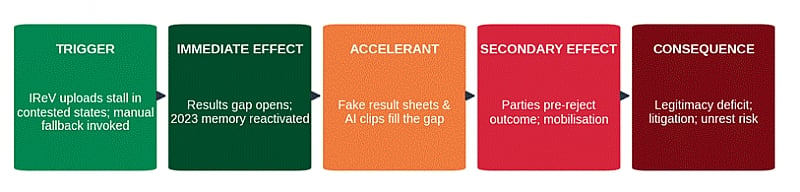
The principal trust-shock pathway — a conditional scenario for monitoring, not a forecast.
Other potential triggers include contradictory official communication, controversial court decisions, security incidents, political attacks on INEC, deepfakes and fabricated result sheets, and unresolved problems with the distribution of Permanent Voter Cards.
To reduce the risk, the report recommends that INEC publish clear criteria for any manual-transmission fallback before election day, alongside a live record showing where and why the fallback has been used. It also calls for an authenticated results-verification channel, transparent handling of neutrality allegations, stronger dispute procedures, and a rapid-response mechanism linking fact-checkers and technology platforms.
▍ The warning — and the opportunity
Despite the low score, the assessment is not uniformly negative. Independent parallel vote tabulations in the 2026 Ekiti and Osun governorship elections found official results consistent with polling-unit counts, and around 99 per cent of Anambra's results were uploaded on election night in November 2025. Study also cites the expansion and clean-up of the voter register to more than 103 million, including over 10.7 million new registrants.
These assets suggest that the question may be less whether Nigeria can technically run an election than whether it can make the election's integrity visible and believable to citizens.
“Trust is not created by asking citizens to believe that the system is working. Trust is created when the system makes its integrity observable. For 2027, transparency must become measurable. Citizens should be able to see what happened, when it happened, why it happened and how the system responded when something went wrong.”
▍ From election forecasting to electoral trust intelligence
The Nigeria assessment is part of a wider effort to build an African capability for measuring the trust, threats and risks surrounding elections. The agency says it does not predict winners or endorse parties or candidates; instead, it measures the conditions that shape electoral confidence, institutional legitimacy and risk.
My proposed Electoral Trust Watch would monitor these conditions continuously through the election cycle, tracking indicators that include institutional credibility, technology confidence, results transmission, electoral justice, misinformation pressure, political acceptance, the geographic concentration of distrust and emerging threats. In addition, it’s a proposal for an Africa Electoral Trust, Threat & Risk Observatory platform covering major African electoral markets and spaces. Hence,
the significance extends well beyond Nigeria. I therefore posit that:
Africa needs to move beyond asking only who is likely to win an election. We should also be asking whether citizens trust the process, whether political actors will accept the result, where institutional confidence is weakening and what conditions could turn a manageable problem into an electoral crisis. It is important to place institutional trusts in electoral systems at the center of measuring what may be forming beneath the visible surface of electoral spaces before it becomes an overt electoral problem.
With presidential and National Assembly elections scheduled for 16 January 2027, the assessment concludes that Nigeria's most important electoral challenge may not be whether Nigerians will vote — but whether enough of them will trust the process when the votes are counted.
This study is an independent, neutral, non-partisan and non-advocacy intelligence measurement. Its assessment does not endorse any political party, candidate or electoral outcome. The analysis measures observable and inferable indicators of public trust, latent threats and electoral risks using available evidence. Figures are drawn from Afrobarometer, Yiaga Africa, INEC, observer statements and the Nigeria 2027 Electoral open-source data.
About The Author: Messan Mawugbe. PhD , [email protected]


 I was the brain behind La General Hospital reconstruction – Dr Okoe Boye
 2027 budget: Gov't must account for jobs created under 24-hour economy – Prof Bo...
 I monitor TikTok, other social media platforms to address public concerns – Maha...
 I was joking about expecting Mahama to appoint me as Minister – Prophet Nigel Ga...
 'Go prove criminality in court, not on TV' — Shamima Muslim tells Minority on So...
 Ghanaian father narrates how his 15-year-old son was always bullied by two schoo...
 9% public sector salary increase for 2027 an insult to workers — Minority
 Kumasi residents to experience scheduled power cuts between October and November...
 TUTAG suspends nationwide strike, academic work resumes November 2
 Why charge GH¢5,000 just for people to declare interest in parliamentary primar...


