




THERE is a sickening, surreal farce playing out in the heart of the Nigerian nation. It is a spectacle so brazenly grotesque, so fundamentally inverted, that it lays bare the absolute moral bankruptcy of our national security apparatus.
While hordes of barefooted, rag-tag terrorists ride roughshod across our sovereign territory—displacing entire communities, mass-murdering rural farmers, and proudly flaunting raw, ransom cash in stacks of banknotes on TikTok, Facebook, and Instagram with absolute, unchecked impunity—the high command of the Nigerian Military has mobilized its vast administrative, legal, and operational machinery to hunt down a solitary, defenseless woman.
Her crime? She dared to speak out against systemic sexual violence. She dared to accuse senior officers of rape, harassment, and institutional oppression. And worst of all, she dared to demand that her dignity be recognized in a state that routinely treats the "daughters of nobody" as disposable collateral.
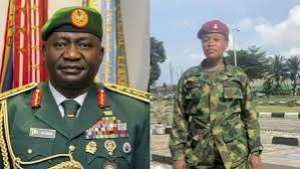
The recent, reported arrest and covert transfer of ex-Private Ruth Ogunleye from Lagos to a detention facility—first cited in Abuja, then reported as a prison in Kaduna State—under the heavy-handed shadow of the Minister of Defence, General Christopher Gwabin Musa (Rtd.), marks a chilling low in the history of the Armed Forces.
It is a scorched-earth display of institutional power: a punitive, high-stakes, blighting assault designed not to serve justice, but to enforce silence.
The Priority of Frivolity: Hunting Dissent, Emboldening Terror
We must call this what it is: a complete and catastrophic reversal of military priorities.
In what self-respecting military globally does the high command deploy its intelligence assets, interstate extradition mechanisms, and state infrastructure to chase, arrest, and incarcerate an ex-soldier over social media posts and public grievances, while actual terrorists stream their atrocities live without consequence?
The contrast is as revolting as it is damning.
On one side, heavily armed bandits and insurgents kidnap citizens at will, establish shadow governments, collect taxes from citizens, and broadcast their spoils online with zero fear of tracking or apprehension.
On the other side, an ex-female soldier who used the same digital space to cry out for redress after allegedly being subjected to sexual advances, forced injections, and institutional intimidation by her superiors is hunted across state lines, grabbed, and tossed into custody awaiting a murky trial.
This is the banal oppression of a compromised security architecture. Under the oversight of General Christopher Musa and the current military hierarchy as the Minister of Defence, the war on terror has been thoroughly politicized, transactionalized, and reduced to a theater of bureaucratic grandstanding.
Billion of dollars are budgeted, deployed, and swallowed up in an endless conflict that yields sparse victories for ordinary citizens. Yet, when a junior officer steps out of line to expose the insidious, long-standing rot of sexual violence within the barracks, the response is swift, surgical, and ruthlessly punitive.
The military hierarchy has chosen to prioritize trivialities over substance, fragile officer egos over national defense, and institutional suppression over securing a beleaguered nation.
The Military Cover-Up: Colonel Abdulkareem and the "Oath Of Secrecy"
The ordeal of Ruth Ogunleye is not an isolated administrative error; it is a textbook case of how a misogynistic military culture protects its own.
When Private Ogunleye went public on TikTok in January 2024, she named her accusers directly.
Chief among them was Colonel I.B. Abdulkareem, alongside Colonel G.S. Ogor and Brigadier General I.B. Solebo. She detailed an agonizing narrative of unwanted sexual advances, intimidation, denial of her legitimate service benefits, and administrative torment.
She did not stop at her immediate commanders. Following established protocols and human decency, she sought the intervention of top brass, explicitly reaching out under Section 179 of the Armed Forces Act to officers at the highest level—including General C.G. Musa himself, who was then the Chief of Defence Staff.
What was her reward for seeking redress through official channels? Silence. Indifference. A total failure of protection because, as she painfully observed, "he is my senior, and nobody was ready to give me a listening ear."
When public pressure forced the Chief of Army Staff to order an internal investigation, the outcome was entirely predictable. The Nigerian Army cleared Colonel I.B. Abdulkareem of all wrongdoing. It did not merely exonerate him; it turned the weapon of mental health stigma against the victim.
The military announced that Ogunleye was suffering from a condition rendering her "medically vulnerable," abruptly terminating her service with a medical discharge and a 50% life pension.
This weaponization of medical pathology is an ancient, cowardly tactic. When a female junior officer refuses to be silent, the system labels her "unstable." When she demands the written, full outcome of the investigation to prove her sanity and clear her name, the military hides behind the deepest, darkest cult of its internal oath of secrecy.
Colonel Abdulkareem remains firmly embedded in the military structure, unbothered and unpunished. Meanwhile, the woman who dared to challenge him has been stripped of her career, pathologized, stalked, and ultimately locked away.
Civilian Judicial Precedents: Breaking The Military Monopolization Of Justice
Let us be unequivocally clear: an institution cannot investigate itself when its own leadership stands accused of complicity and neglect. Whatever "investigation" the military claims to have conducted behind closed doors can never be trusted as the ultimate truth.
The internal panel that exonerated Colonel Abdulkareem was designed from its inception to protect the rank, prestige, and impunity of senior officers at the direct expense of a junior female soldier.
Because the domestic military legal framework is hopelessly compromised, the legal legalities surrounding Ruth Ogunleye's plight must transcend the jurisdiction of courts-martial and military tribunals.
Under Nigerian jurisprudence, constitutional rights—including the fundamental right to personal liberty (Section 35) and fair hearing (Section 36)—supersede internal military statutes when non-military offenses or human rights violations are at stake.
Furthermore, regional judicial avenues offer a vital mechanism to break this institutional siege. The ECOWAS Community Court of Justice has repeatedly established that state institutions, including armed forces, cannot hide behind internal disciplinary codes to perpetrate human rights violations, arbitrary arrests, or gender-based discrimination.
By filing a petition before the ECOWAS Court, civil rights litigators can bypass the military command's suppression and force the Nigerian State to account for arbitrary arrest and inter-state abduction. The illegal seizure and transfer of Ogunleye across state lines without clear, open charges further debased the military leadership.
The deliberate refusal to grant an open, independent civilian review of the sexual harassment claims, the weaponization of medical discharge procedures to strip a female soldier of her livelihood for reporting sexual assault is dehumanizing as much as it is morally reprehensible.
International Human Rights Sanctions: Target The Abusers Directly
The international community must no longer turn a blind eye to these egregious human rights abuses under the guise of diplomatic courtesy. The rhetoric of international security partnerships is utterly hollow when foreign governments fund, train, and arm a military apparatus that turns its weapons inward against whistleblowers and female personnel.
We must move beyond mere diplomatic statements of concern toward direct, punitive accountability mechanisms.
Under legislation such as the Global Magnitsky Human Rights Accountability Act in the United States, as well as equivalent global human rights sanction regimes in the United Kingdom and the European Union, foreign governments possess the legal authority to target individual foreign officials responsible for severe human rights abuses and the suppression of fundamental freedoms.
A Direct Charge to Diplomatic Partners
I reiterate my urgent call to the United States, the European Union, the United Kingdom, and international human rights bodies: Place targeted visa bans and financial sanctions on General Christopher Gwabin Musa and Colonel I.B. Abdulkareem.
Those who use state power to suppress the fair hearing rights of victims of sexual violence, sanction arbitrary arrests, and protect alleged abusers within their ranks must be declared persona non grata across the international community.
Therefore, urgent actions must be taken to save the military from itself: apply individual visa bans and asset freezes to hits the military leadership where it hurts most—stripping away their international legitimacy, revoking their travel privileges for diplomatic summits, and halting their personal financial transactions abroad.
Civil Society Mobilization: Smashing Barracks Misogyny And Securing Independent Oversight
The ordeal of Ruth Ogunleye exposes a broader, systemic pathology within the Nigerian military barracks—a culture of silence where female soldiers are viewed as fair game for senior officers, and where reporting abuse carries a death sentence for one's career and personal liberty.
Nigerian women's rights organizations, civil society coalitions, and legal aid groups must mobilize a sustained, nationwide campaign to challenge this status quo. The demand must go beyond the release of Private Ogunleye; it must focus on structural reform of how gender-based violence (GBV) is reported and investigated within the armed forces.
It is high time the federal government establish external, civilian-led oversight board composed of civil rights attorneys, human rights commissioners, and independent medical professionals to investigate all claims of gender-based violence, sexual harassment, and officer intimidation within the military.
The government should take a step further by creating a secure, anonymous reporting pathway outside the military chain of command, ensuring that junior officers can report abuse without fear of court-martial, forced medical pathologizing, or retaliatory discharge.
Lastly, the government, as matter of urgency must engender immediate referral of all allegations involving sexual assault, rape, and physical violence by military personnel to civilian law enforcement and prosecution agencies, barring military tribunals from conducting secret "in-house" clearing exercises.
President Tinubu and the Ultimate Duty
The systemic failure to protect Ruth Ogunleye is a fundamental test of civil supremacy over the tyrannical military scornfulness in a constitutional democracy.
President Bola Ahmed Tinubu cannot afford to remain a passive bystander while the military apparatus operates as a law unto itself, running secret detention networks and hunting down citizens who air their grievances. President Tinubu must immediately step up to address this military plague.
President has no choice than to direct an independent civilian agency—such as the Department of State Services (DSS) or the Nigeria Police Force—to take full custody of Ruth Ogunleye's case, guarantee her physical safety, and thoroughly investigate both her original sexual harassment claims and the lawfulness of her recent arrest.
Ruth Ogunleye must either be released unconditionally or immediately brought before a recognized civilian court with full access to legal representation of her choice. The follow up should be the complete, unredacted findings of the military's internal probe into Colonel I.B. Abdulkareem, Colonel G.S. Ogor, and Brigadier General I.B. Solebo must be made public.
A state that hunts its victims while fraternizing with or failing against its terrorists is a state teetering on the edge of moral collapse. If the Nigerian Government allows the military high command to crush Ruth Ogunleye in the dark, it confirms that power in Nigeria exists solely to shield the influential and devastate the powerless.
If President Tinubu fails to checkmate this rogue display of military overreach, the presidency and the entire Nigerian state deserve to be placed on a global watchlist for state-sponsored persecution.
Ruth Ogunleye may be a "daughter of nobody," but her fight is the fight of every Nigerian who dreams of a nation where justice is not determined by the rank on one's shoulder, the thickness of one's wallet, or the connections of one's family.
Her voice must not be extinguished in a cell in Kaduna or Abuja. The truth must be brought to light, and those who weaponized state power to crush her must be held to account.
Erasmus Ikhide is a Nigerian social commentator, journalist, and media practitioner

 Netanyahu piles pressure on Arab parties with claims of foreign funding to 'stea...
 [VIDEO] How Ghanaian allegedly defrauded Dutchmen of €200,000 in romance scam
 NPP to stage 'Y3gye y3 sika' protest on November 3 over South Africa evacuation ...
 'Ama Sey is no pushover' – Hawa Koomson justifies choice as deputy
 Sucking breasts, deodorants do not cause breast cancer – Dr. Tackie
 Kufuor backs proposal for five-year presidential term
 22-year-old arrested over murder of mother in Tarkwa
 NPP parliamentary aspirants to pay GH¢5,000 for declaration of intent
 Six NIA staff arrested, seven others sacked over alleged extortion at Galaka Gha...
 NPP has no plan to remove Osahen Afenyo-Markin as Minority Leader – Justin Kodua...


