




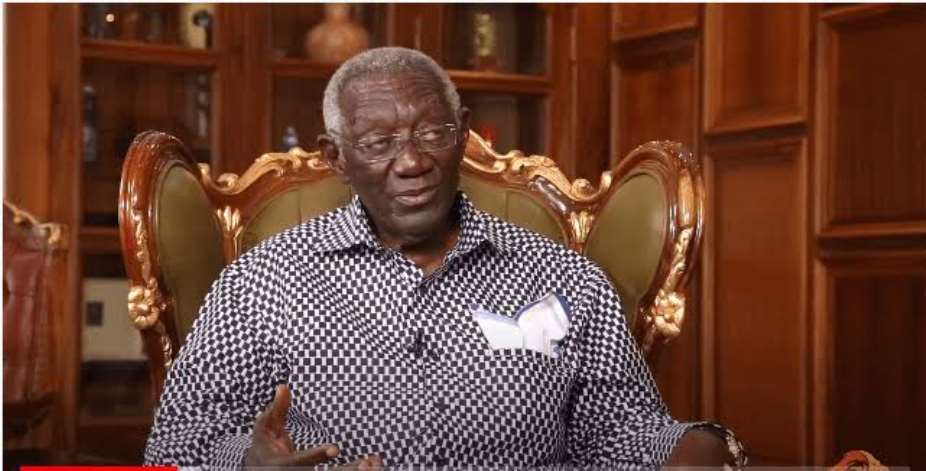
Former President John Agyekum Kufuor has endorsed a proposal to extend Ghana’s presidential term from four to five years, arguing that the current arrangement leaves governments with insufficient time to implement their development agenda.
His position contrasts with that of the New Patriotic Party (NPP), of which he is a member. The party has opposed the proposed extension and called for the retention of the existing four-year presidential term.
Speaking on JoyNews’ PM Express on Wednesday, October 28, 2026, Mr Kufuor said an additional year would allow governments more time to develop policies, execute programmes and demonstrate results before returning to the electorate for another mandate.
"I believe in the two terms but four years for a developing young country like ours," he said, drawing on his experience as President between 2001 and 2009 to explain his position.
The proposal forms part of Ghana’s ongoing constitutional review process. The Constitution Review Committee has recommended extending the presidential term to five years, alongside a corresponding extension of Parliament’s tenure.
The government accepted the recommendation in July 2026, arguing that the existing four-year cycle does not provide sufficient time for policy development, implementation and assessment. However, the proposal has yet to become law.
The NPP announced on September 17, 2026, that it would oppose the change, insisting that the four-year term should remain in place. The party argues that regular elections enable citizens to evaluate the performance of their elected leaders and decide whether to renew or withdraw their mandate.
It has also maintained that difficulties associated with implementing policies, managing transitions and forming governments should be addressed through improved efficiency rather than extending presidential terms.
Kufuor cites challenges facing new administrations
Explaining his support for a longer term, Mr Kufuor said the effective governing period was often shortened by the time ministers needed to understand their responsibilities, develop policies and prepare for the next election.
He noted that newly appointed ministers had to familiarise themselves with their ministries and establish effective working relationships with the civil service, which possessed much of the institutional knowledge required to implement government policies.
According to him, the first year of an administration could largely be consumed by appointments, orientation and the development of policy proposals.
"First year, he doesn't know much is left from his right in the ministry," he said, describing the difficulties ministers could encounter when taking up new positions.
He added that policy proposals required further consideration by Cabinet and Parliament before implementation could begin, leaving governments with limited time to demonstrate tangible results.
Mr Kufuor observed that the third year of an administration was often when voters began assessing its performance, while the fourth year became increasingly dominated by election preparations and campaigning.
"Fourth year is there and it's election year. Election year anywhere on earth is mad year," he said.
Former President insists two-term limit should remain
Mr Kufuor argued that extending the presidential term to five years would give successive administrations more time to execute their programmes before entering an election year.
He stressed that his proposal would not alter the existing two-term limit for presidents but would instead provide more time for governing within each term.
He also cautioned against allowing individuals to remain in political power for excessive periods, warning that prolonged control could encourage abuses of authority.
"Power tends to be like a nectar sweet," he said, underscoring the importance of maintaining constitutional restrictions on presidential tenure.
The NPP, however, continues to defend the four-year term as a means of preserving regular electoral accountability.
The party has also argued that moving presidential elections from December to November, as proposed under the constitutional review, would give incoming administrations more time to prepare for an orderly transition without extending the length of the presidential mandate.

 [VIDEO] How Ghanaian allegedly defrauded Dutchmen of €200,000 in romance scam
 NPP to stage 'Y3gye y3 sika' protest on November 3 over South Africa evacuation ...
 'Ama Sey is no pushover' – Hawa Koomson justifies choice as deputy
 Sucking breasts, deodorants do not cause breast cancer – Dr. Tackie
 Kufuor backs proposal for five-year presidential term
 22-year-old arrested over murder of mother in Tarkwa
 NPP parliamentary aspirants to pay GH¢5,000 for declaration of intent
 Six NIA staff arrested, seven others sacked over alleged extortion at Galaka Gha...
 Here are new guidelines for prospective NPP parliamentary candidates
 NPP has no plan to remove Osahen Afenyo-Markin as Minority Leader – Justin Kodua...


