




In the ancient past, when human communities were small and the only way to travel was by walking, what were the chances of meeting a stranger? And what would happen next?
We know that ancient people lived by foraging their food from wild plants and animals, but we know a lot less about their social lives. Would there be conflict as people defended territory? Or would they choose to share? Sometimes survival depends on choosing wisely between these options. Defending a territory has a cost, and it's not always worth it.
To understand how ancient people interacted with one another, we can start by looking at the food they ate. When food resources are densely clustered in predictable ways, it makes sense to establish and maintain a territory around them. When resources are sparsely distributed, they are harder to defend.
One example of territoriality in modern foraging people comes from the Okiek in the mountains of Kenya. Here, families control the crucially important activity of honey-harvesting. In contrast, foraging groups that live in places where the next meal is less predictable also tend to be less territorial. For example, until recently !Kung foragers in the arid parts of the Kalahari Desert searched for animals to hunt across wide areas, and boundaries between groups were much more fluid. A smoky torch used to harvest honey. Jessica Thompson , CC BY-ND
The strategies used by the Okiek and the !Kung are different solutions to the same problem: weighing the risk of going hungry against the risk of unfriendly social encounters.
Applying this principle to archaeological finds can reveal clues about ancient human social organisation. The problem is how to find food remains from the ancient past.
We are archaeologists who do research in Malawi, excavating fossil animal bones and stone tools from natural shelters of rock. Our aim is to understand how early humans lived from the end of the last ice age, between 19,000 and 10,000 years ago, until the start of farming and herd-keeping just a few thousand years ago. Although no glaciers were present in tropical Malawi during the last ice age, global environments were different from today. We wanted to know more about food availability then, and how this might have affected social interactions.
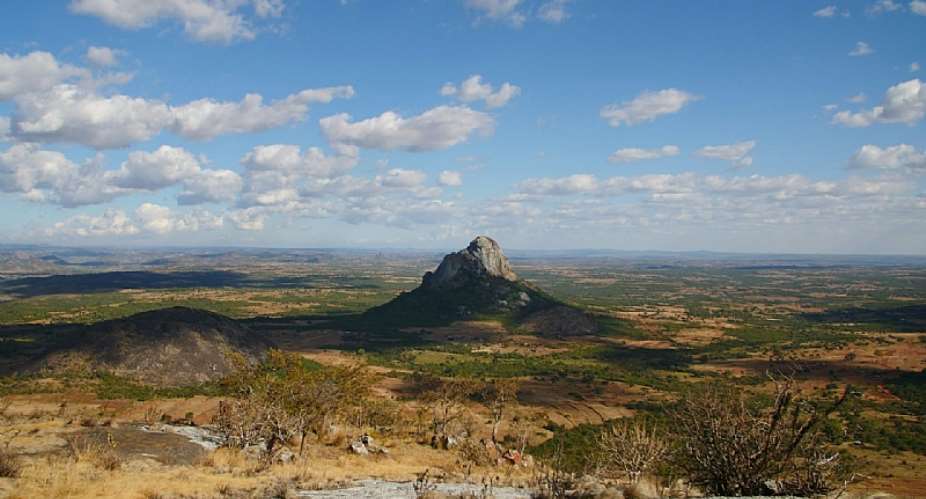
We focused on a large shelter called Hora 1, located on a spectacular granite mountain that emerges like a tooth from the open woodlands in northern Malawi. Traces of ancient human activity are everywhere in this area: red coloured paintings on the rock walls, stone tools made of shiny quartz, hearths, human burials and, in the layers of earth carefully excavated over several visits, hundreds of thousands of bones. These are the remnants of uncountable meals for the communities who lived here. Hora Mountain rising from the landscape of northern Malawi. Chelsea Smith , CC BY-NC
Of this formidable number of broken, cooked, cut, chewed and discarded animal parts we were able to identify almost 13,000 individual fragments, collectively spanning the last 21,000 years of human occupation.
We have published a paper about these fragments and what they tell us about ancient cultural boundaries related to food availability. Our findings challenge the existing view that it was mostly coastal environments that promoted boundary formation in the past.
Hunting close to home
Large animals can provide a meal for a large group, so when hunters encounter them, they may prefer to chase them, even if that means ignoring smaller prey. But most of the bones we found belonged to small animals: tiny antelopes, hares, monkeys, and other creatures. That suggests that large prey with a lot of meat – like zebras, wildebeest and even rhinoceroses – were not very common in this valley in the past.
Although the fragments were very small, we could see that they came from everywhere in the body: limbs, torsos and heads were all present. This suggests that these animals were hunted close to the site, and the whole carcass was brought back (not just the best parts of large animals).
The bones indicate that foragers at Hora 1 hunted close to home throughout the thousands of years recorded in the archaeological deposits. We confirmed this by comparing the chemistry of the local geology to chemical traces in the animal teeth: we found that they matched. The fossil tooth of a wildebeest from HOR-1, an animal that has not been recorded in modern times in this part of Malawi. The lines in the tooth are where small samples were taken for chemical analysis. Ruoyang Tu , CC BY-NC
But there is a twist to this story.
The animal bones were extremely fragmented, on average only the size of a little finger. Then we looked at some of the smallest and most nutrient poor bones in the skeleton: the phalanges, or finger and toe bones. Most had been broken open to recover even the smallest amounts of fatty marrow from inside. Probably food was not so abundant in this valley if people spent their time on such meagre packages of nutrients.
So why didn't people just range further to find more food, and what kept them at that site for so long?
We think the answer lies in their social worlds.
In-group cooperation and out-group hostility
We found that animals were of different ages when they died: youngsters, adults, and even animals so old their teeth were worn down. This suggests some form of indiscriminate mass hunting such as the use of nets or traps. It is also possible that fire was used to aid communal game drives of larger animals. All these practices would have required coordination of labour, as well as social norms on how to split the bounty.
This in-group cooperation likely came with some sense of shared identity, like a cultural group.
The next question is how far across the landscape this group would have roamed. Were they like the !Kung, who maintain strong social ties with neighbouring groups? Or were they more like the Okiek, focused on keeping resources within their families?
A clue came from an unexpected source: ancient DNA. DNA preserved in some of the human burials found at these sites showed that relatedness became smaller very quickly as one moved further from the sites. Starting 19,000 years ago, at the end of the ice age, an invisible boundary was taking shape in tropical Africa, separating “us and them”. Ancient human DNA was recovered from ancient foragers buried at Hora 1 and at this cave, which is about 100km north of the Hora 1 site. Jacob Davis , CC BY-NC
All this evidence together points to behaviour that was very “local” in nature. However, the focus on recovering every scrap of food suggests that prey were not abundant enough to justify active defence of this territory. We also do not see evidence for persistent violent encounters or large, stable settlements, as have been documented near rich sources of food such as lakes and oceans. It is possible that these boundaries were only symbolically defended, for instance through collective practices like the 9,500-year-old funerary pyre that we recently described from Hora 1.
Most “cultural groups” that are known from archaeology are inferred from durable artifacts that preserve well, such as ornaments made of animal teeth and shells, or pottery shaped in a specific way. But most foragers spent so much time on the move that they never made such heavy things. In tropical Africa, our research has unearthed evidence for ancient cultural boundaries even without these objects.
We have also found that there can be a “home” territory and a strong sense of in-group cultural belonging without violence against other groups. Finally, we have shown that the vast interior of the continent, while less studied than its coasts, is a rich source of information on the evolution of human cooperation and competition.
Alex Bertacchi received funding for this research from the US National Science Foundation.
Jessica C. Thompson has received funding for excavations at the Hora 1 site from the National Geographic Society, Wenner-Gren Foundation, Emory University, and Yale University.
By Alex Bertacchi, Engineer in Mass Spectrometry and Stable Isotope Research, University of Kiel And
Jessica C. Thompson, Assistant Professor of Anthropology, Yale University

 Six NIA staff arrested, seven others sacked over alleged extortion at Galaka Gha...
 Here are new guidelines for prospective NPP parliamentary candidates
 CareFlight launches Ghana’s first Mobile Stroke Unit with onboard CT scanner
 NPP has no plan to remove Osahen Afenyo-Markin as Minority Leader – Justin Kodua...
 Africa must move beyond aid and raw material exports – Mahama
 Ghanaian workers deserve at least 15% pay rise, not 9% – Dr Zaato
 Bawumia outlines vision for policy-driven NPP in meeting with KAS Secretary-Gene...
 Parties should be allowed to remove non-performing presidents midterm – Kpebu
 Mahama owes Akufo-Addo apology over 'u-turn' on honorary doctorates – Nana Akome...
 I cautioned Obuasi SHTS headmaster not to allow female students’ visits to quell...


