




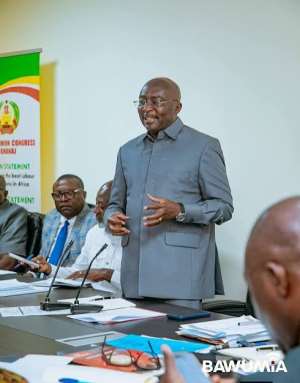
Dr Mahamudu Bawumia's meeting with the leadership of the Trades Union Congress (TUC) on wages, the cost of living, employment and pensions is important. Pensions are too important to be ignored in any national conversation about the welfare of workers. But pensioners must be allowed to ask a simple question: What exactly will be different this time?
According to reports of the meeting, pension reform was among the issues discussed, with Dr Bawumia indicating that the engagement would be followed by further discussions on specific proposals. That is welcome.
But Ghanaian pensioners have heard promises about pensions for many years. What they need now is not another round of political rhetoric. They need measurable, time-bound and independently verifiable reform.
Dr Bawumia and the New Patriotic Party (NPP) should also understand why pensioners will naturally examine any new promises against the party's record when it was in government.
The NPP was in power from 2017 to 2024. During that period, the country's pension system continued to operate principally under the National Pensions Act, 2008 (Act 766). The law provides the framework for the three-tier pension system and, among other things, governs the indexation of SSNIT pensions.
For 2023, SSNIT announced an overall indexation rate of 25%. For 2024, the announced overall indexation rate was 15%, comprising a fixed component and a redistributed amount intended to cushion lower-paid pensioners. Those figures are matters of public record. But the real question for pensioners is not simply whether government or SSNIT announced an increase. The real question is: Did the pension increases adequately protect the purchasing power and dignity of pensioners during those years? And if they did not, what is being done to address the consequences? That is where the conversation should move.
Pensioners Are Not Asking for Political Favours
Pensioners are not asking politicians to give them charity. They contributed to a national social security system during their working lives. Their pensions are not political gifts. They are earned benefits. This distinction is important.
When politicians speak about improving pensions, pensioners should therefore not be treated as people waiting for political benevolence. They are citizens asking whether the system into which they contributed throughout their working lives is being administered fairly, transparently and efficiently. That is why the discussion must go beyond annual announcements of pension increases. Ghana needs to examine the architecture of its pension system itself.
Is Act 766 Still Adequate?
Act 766 was an important reform when it was introduced. Indeed, Ghana did not arrive at the three-tier pension system overnight. The earlier reform process involved the Presidential Commission on Pensions chaired by Mr T. A. Bediako. The Commission examined the country's pension arrangements and made recommendations that ultimately contributed to the enactment of Act 766 in 2008. That history is instructive.
If the country was prepared to establish a Presidential Commission and an implementation committee before creating the current pension architecture, why should Ghana now be satisfied with political statements about reform? If Act 766 has developed weaknesses after years of implementation, let us identify them properly. Let us bring together actuaries, economists, pension experts, labour representatives, pensioners, investment specialists, lawyers, accountants and representatives of the institutions responsible for pension administration.
Let them examine the law. Let them examine the numbers. Let them examine the investments. Let them examine the governance structure. And let them tell Ghanaians what must change.
We Need an Independent Examination of SSNIT
There is also a broader issue that cannot be avoided. Ghanaians have contributed to SSNIT for decades. Pension assets have been invested over many years.
- What have those investments actually yielded?
- What has been the performance of the different asset classes?
- What were the costs?
- What investment decisions produced good returns and which did not?
- What has been the performance of SSNIT's investments over successive administrations?
- How have the assets been valued?
- What has been the administrative cost of managing the scheme?
- What are the governance safeguards?
These are not partisan questions. They are accountability questions. The recent decision by the NPRA to establish a working group to review SSNIT's investment guidelines is therefore significant. The Authority itself has recognized the importance of reviewing investment policy and examining asset classes and their performance over the years. But pensioners need to know whether this will be part of a comprehensive examination or merely another internal administrative exercise.
Tier 2 Deserves Particular Attention
Tier 2 also requires serious scrutiny. The mandatory second-tier occupational pension scheme has grown enormously. NPRA's 2023 Annual Report recorded almost 4.6 million Tier 2 member accounts at the end of that year. This is a huge pool of workers' retirement savings.
- Who manages these funds?
- How are the fund managers selected?
- What fees are being charged?
- What returns have they generated?
- How are their performances compared?
- How many contributors understand what is happening to their Tier 2 money?
- What happens when a contributor retires?
- How easily can the contributor verify the amount accumulated?
- And what happens to benefits that remain unclaimed?
These are questions that deserve clear answers. A forensic audit of Tier 2 should therefore not be dismissed as an attack on the pension industry. If the system is sound, an independent examination should strengthen public confidence in it.
Where is the Timetable?
President John Mahama has spoken about reviewing pensions and indicated that a working team would be put together to examine the pension system and make recommendations. That is encouraging. But pensioners need more than an announcement.
- When will the team be established?
- Who will appoint its members?
- What will its mandate be?
- Will pensioners and organized labour have representation?
- When will it begin its work?
- When will it submit its report?
- When will Parliament receive the recommendations?
- When will the necessary legislation be introduced?
Without timelines, even a well-intentioned reform programme can disappear into the machinery of government. And referring pension reform simply to a Minister of Finance does not, by itself, reassure pensioners. The problem is bigger than a budgetary issue. It involves law, actuarial science, investment management, institutional governance, accountability, retirement income adequacy and the fundamental question of whether Ghana's pension architecture is delivering what workers were promised.
Constitute an Independent Expert Commission
Ghana should therefore consider establishing an independent expert pension reform commission. Such a body should not be dominated by politicians or government officials. It should include independent pension and actuarial experts, organised labour, pensioner representatives, economists, investment professionals, accountants, lawyers and other relevant specialists.
Its mandate should be broad enough to examine Act 766 and its amendments, SSNIT governance and investments, NPRA's regulatory effectiveness, Tier 2 fund management, pension adequacy, indexation, pensioner representation and the transparency of pension administration. It should also examine whether the existing system sufficiently protects pensioners against inflation and whether there are mechanisms for correcting historical inequities where they can be demonstrated. Most importantly, its report should be made public.
Pensioners are Suffering Quietly
There is another uncomfortable reality that politicians should not ignore. Pensioners are generally not as politically powerful as organized workers. They are no longer on the streets every morning. They do not have the bargaining power of organized labour. Many are elderly. Many have health problems. Many depend entirely on their monthly pensions. Many cannot afford expensive litigation or prolonged campaigns. And some simply do not have the strength to fight. Their silence should not be interpreted as satisfaction.
A pensioner who receives a modest monthly pension and watches the cost of food, medicine, electricity, transportation and rent rise does not need a political speech about pension reform. He or she needs a pension that provides dignity. That is why pension reform should be treated as a national institutional issue rather than an election-cycle promise.
Let Every Political Party Answer the Same Questions
This should apply to the NPP. It should apply to the NDC. It should apply to every political party seeking the confidence of Ghanaian workers and pensioners.
- When you were in government, what did you do?
- What did you fail to do?
- What would you do differently?
- What legislation would you change?
- What institutional reforms would you introduce?
- How would you improve investment returns?
- How would you make pension administration more transparent?
- How would you protect the purchasing power of pensioners?
- What would you do about Tier 2?
- And, most importantly: When will you do it?
These are reasonable questions. They are not attacks on any political party.
Pensioners Want Positive Change
Ghanaian pensioners are not asking for political promises. They are asking for positive change. They want Act 766 properly reviewed. They want the management and investments of SSNIT examined independently. They want NPRA's regulatory role and institutional management subjected to appropriate scrutiny. They want Tier 2 properly examined, including the fund managers, fees, investment performance and payment of benefits. They want greater pensioner representation in institutions whose decisions directly affect their retirement income. They want transparency. They want accountability. They want investment decisions that protect and grow the value of workers' contributions. And they want reforms to have deadlines.
The pension system belongs to the people whose contributions finance it. It cannot become the private preserve of politicians, bureaucrats, trustees, fund managers or administrators. The debate must therefore move from "We will reform pensions" to: What will we reform? How will we reform it? Who will do it? When will it be completed? And how will pensioners know that it has been done? That is the conversation Ghana needs. Pensioners have waited long enough. They do not need more rhetoric. They need a pension system that gives them security, dignity and confidence in the years they have left.
Our contributions! Our rights!!
FUSEINI ABDULAI BRAIMAH
+233208282575 / +233550558008
[email protected]


 Netanyahu piles pressure on Arab parties with claims of foreign funding to 'stea...
 [VIDEO] How Ghanaian allegedly defrauded Dutchmen of €200,000 in romance scam
 NPP to stage 'Y3gye y3 sika' protest on November 3 over South Africa evacuation ...
 'Ama Sey is no pushover' – Hawa Koomson justifies choice as deputy
 Sucking breasts, deodorants do not cause breast cancer – Dr. Tackie
 Kufuor backs proposal for five-year presidential term
 22-year-old arrested over murder of mother in Tarkwa
 NPP parliamentary aspirants to pay GH¢5,000 for declaration of intent
 Six NIA staff arrested, seven others sacked over alleged extortion at Galaka Gha...
 NPP has no plan to remove Osahen Afenyo-Markin as Minority Leader – Justin Kodua...


