




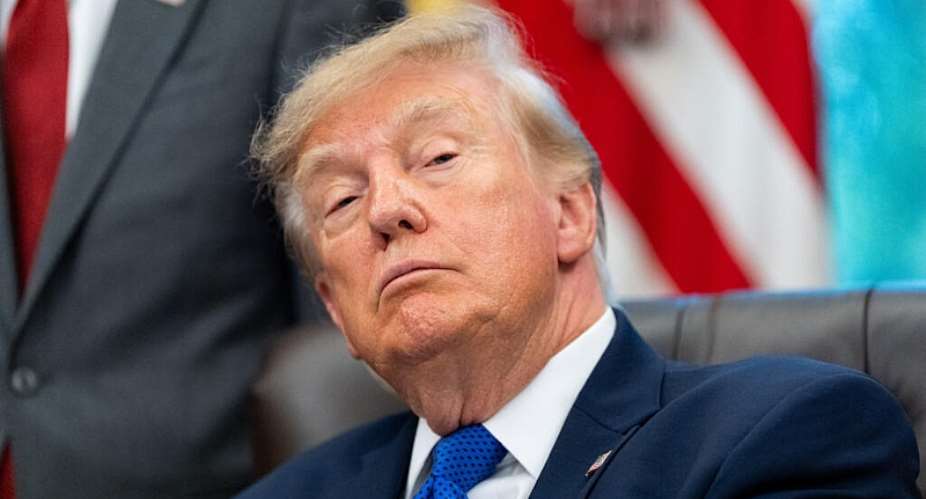
On 3 November, American voters will decide the balance of power in Congress, with consequences for the rest of President Donald Trump's second term. Beneath the rallies, advertisements and accusations sits a harder question: what happens when a president's personal political identity becomes so central to his party that individual candidates are judged largely through him?
Trump's campaign is a revealing case study in political power, personal loyalty, economic accountability and the limits of political branding. His method is familiar. He commands attention, mobilizes supporters and places himself at the center of the contest. The same approach that energizes his base can also make him the principal target for voters who are unhappy with his administration.
That is the contradiction at the heart of the Republican midterm campaign. Trump is using his influence, his appearances and a very large amount of money to help Republicans keep Congress. At the same time, his approval ratings and voters' anxiety about living costs are working against his party.
The Associated Press put the dilemma plainly in its 28 October analysis: Republicans "still love the president", but his approval ratings "are low enough to potentially sink his party". AP called his deeply personal approach possibly "the election cycle's biggest gamble".
The question is no longer whether Trump can draw a crowd or dominate the news. It is whether those strengths can turn into enough votes. This piece looks at what the evidence supports, and where it stops.
1. The president who cannot leave the spotlight
Trump has built his political identity on visibility, confrontation and personal loyalty. Unlike leaders who let candidates carry much of the party's message, he has made himself the central figure in the defense of Republican seats. His rallies, endorsements and political organization give Republicans resources that local campaigns could not match.
The money is considerable. According to federal filings reported by the Associated Press on 21 October, MAGA Inc., Trump's flagship super PAC, reported spending nearly $277 million since the start of September. Most of that was moved on to affiliated groups: $200 million to No Going Back PAC and $25 million to Safety & Affordability PAC. The ad-tracking firm AdImpact counts more than $256 million in advertising by the three Trump-affiliated groups that must disclose donors. Trump has said on social media that he plans to spend "over 400 Million Dollars by Election Day".
The figures should be read carefully. Transfers between affiliated groups are not the same as money spent on voters, so the more accurate measure of what reaches the public is the advertising total. AP also notes that leaving advertising late has pushed up costs, sometimes to more than five times what earlier purchases would have cost.
Money does not remove political vulnerability. AP describes Trump as "mired in low approval ratings amid deep voter frustration over persistently high costs and the unpopular war with Iran", and says Republicans face an especially challenging climb, partly because Trump helped defeat several longtime incumbents. That is the first contradiction in his strategy: his influence is an asset, and his dominance of the campaign also makes him a potential liability.
When voters tie a party's candidates closely to its leader, they may judge the candidates partly on the leader's performance, whatever the candidates' own records. That helps when the leader is popular. It hurts when he is unpopular outside his core supporters. The more the election becomes a referendum on Trump, the less room Republican candidates have to run on their own records.
That does not mean the strategy will fail. It means it carries a risk that campaign money alone cannot resolve.
2. The economy: where promises meet everyday reality
Every administration eventually meets a test that speeches cannot settle. For many voters that test is economic. Governments can announce investment, celebrate growth and point to business activity, but households experience the economy through rent, food, electricity, transport, healthcare, borrowing costs and what is left after essentials are paid.
That gap between national indicators and household experience is central to the pressure on Trump's campaign. The economy does not need to be in recession for voters to feel dissatisfied. Growth can continue while particular households struggle with high prices, expensive housing or rising debt payments, and employment can stay relatively strong while people worry about job security or whether pay is keeping up with prices.
The cost-of-living test
A Reuters/Ipsos poll completed on 26 October found that 73% of voters in the poll said their cost of living was heading in the wrong direction. The same poll put Trump's approval at 32%, one point up from a record low the week before.
These numbers connect economic dissatisfaction with a difficult political climate for Republicans. They do not prove that every voter blames Trump for rising costs. Prices have many causes, including international developments, domestic policy, supply conditions and wider market forces. The political question is whether voters believe the administration has responded effectively.
That is a fair standard. An administration cannot control every global event or price movement, but it can be judged on the policies it adopts, the risks it takes and the measures it uses to ease hardship. For a president whose identity includes promises of economic improvement, household affordability is a measure of credibility.
When foreign policy enters the household budget
Foreign policy can seem remote from daily life, yet conflict can affect energy prices, transport costs, business confidence and public spending. AP's reporting links the political difficulty for Republicans to "the unpopular war with Iran" alongside persistently high costs.
A president may defend military or diplomatic action on national-security grounds, and supporters may believe the objectives justify the costs. Critics may question whether the objectives are achievable and whether the costs are proportionate. Those are legitimate questions in a democracy. When international events add to household expenses, the foreign-policy debate becomes a domestic one, and voters may ask whether strategic choices fit the economic promises made to them.
The challenge is not only to show strength abroad. It is to explain the objectives, costs and expected benefits, and to show how the administration is responding when the consequences reach ordinary people.
3. The polling: a warning, not a verdict
The latest national polling is hard on Trump and the Republicans, but one poll is not the whole picture, and the details matter.
In the Reuters/Ipsos survey completed on 26 October, Trump's approval was 32%. Among likely voters, Democrats led Republicans 53% to 44% on the generic congressional ballot. Among registered voters, Democrats led 47% to 36%, with 11% undecided; counting voters who said they lean one way, the Democratic lead was 50% to 41%.
How far this poll sits from the others
32% is at the low end of recent readings. Reuters/Ipsos had Trump at 31%, a record low, the week before. Other recent polls compiled by Forbes put his approval higher:
| Poll | Approval | Fieldwork or release |
| Reuters/Ipsos | 32% | Completed 26 October |
| CNN/SSRS (adults) | 32% | 15–18 October |
| NYT/Siena (likely voters) | 36% | 12–19 October |
| UMass Lowell | 39% | 2–4 October |
| CNBC | 40% | Released 22 October |
| NPR/PBS/Marist | 40% | 19–20 October |
The honest summary is that Trump's approval in recent national polls runs from about 32% to 40%. All of those are weak numbers for a president, and the range is wide enough that no single figure should be treated as the answer.
What the sample can and cannot tell us
The Reuters/Ipsos poll surveyed 1,679 US adults, including 1,280 registered voters, over five days. Its margin of error is 2 percentage points for all adults and 3 points for registered voters. The likely-voter figures come from a smaller subgroup, so they carry a larger margin of error than either of those.
From national poll to seats
The generic ballot measures national preference for each party's congressional candidates. It does not decide any individual district or state. House elections turn on district contests, local candidates, turnout and the distribution of votes. Senate elections follow a different map, with only part of the chamber up in any cycle. A national Democratic lead therefore does not automatically mean Democratic control of both chambers.
Still, the numbers point to a problem for the Republican campaign: Trump's political influence has not become broad public approval of his administration. A leader can keep a committed base while facing substantial resistance elsewhere. A crowded rally shows an ability to attract a crowd, not how the electorate will vote. A large fundraising total shows financial capacity, not public approval of the policies it funds. A strong social-media presence shows visibility, not consent.
The crucial distinction is between the intensity of support among committed followers and the breadth of support across the electorate. In competitive races, both matter.
4. The politics of loyalty: strength and vulnerability in the same movement
Trump's movement puts great weight on personal loyalty and identification with its leader. For supporters, that can provide a sense of representation, continuity and resistance to institutions they distrust, and his direct style lets him bypass traditional intermediaries. There is a political logic to this. A recognizable leader can simplify complicated debates, give supporters a shared identity and keep a party energized when circumstances turn difficult.
The risk is the mirror image. When a movement is heavily associated with one person, opposition to that person becomes a central organizing force. The leader's prominence mobilizes supporters and also motivates people who want to limit his influence.
AP's reporting shows both sides of this. Trump wants voters to imagine he is on the ballot: "Just close your eyes," he tells them, "and pretend I'm on the ballot." Democrats are happy to oblige. A CNN/SSRS poll from mid-October, cited by AP, found about four in 10 registered voters would see their congressional vote as a message against Trump, and only about two in 10 as a message in support of him.
Both sides therefore have reasons to keep Trump at the centre: Republicans hope his presence turns out their supporters, and Democrats hope dissatisfaction with his administration turns out theirs and persuades undecided voters. The result is a contest in which the president's personal standing is hard to separate from the prospects of the candidates.
This is not unique to Trump. Movements across the ideological spectrum become vulnerable when they depend too heavily on one leader. The broader lesson is that personal popularity and governing performance are different measures. A leader can command loyalty without persuading a majority, and a party can keep a strong base while losing the voters who decide competitive races.
5. The opposition's opportunity, and its own test
Democrats can make the midterms a referendum on the administration's performance. Economic dissatisfaction, worries about prices and disagreement over foreign policy give them material for a national campaign, and their advertising shows it. An AP analysis of AdImpact data, published on 16 October, found that Democratic candidates and their allies had spent more than $163 million since 1 September on television advertising that mentions Trump, with those ads airing nearly 180,000 times. Republicans, over the same period, ran ads mentioning the president about 16,000 times, at an estimated cost of $11 million.
The gap suggests the parties are making different calculations about Trump's prominence. Democrats see his administration as a central issue that can connect individual Republican candidates to unpopular national policies. Republicans face a harder choice: Trump can energize the core, but close association with him may be less attractive where voters are worried about the administration's performance.
Yet Democrats should not assume that dissatisfaction with Trump turns automatically into confidence in their own party. Voters can disapprove of a president without agreeing with the opposition's policies. To turn discontent into lasting support, Democrats have to say what they would do differently, how it would work, and how they would deal with the problems voters care about most. They must also face the limits of governing in a divided system: promises are not legislation, and winning seats does not guarantee agreement on every policy.
The election is a test of Republican leadership. It is also a test of whether Democrats can turn criticism into a credible program.
6. Money, media and democratic accountability
Modern American campaigns are not fought through speeches alone. They run on fundraising networks, political action committees, advertising, digital communication and voter mobilization. The spending reported by Trump-aligned groups, and the $163 million Democrats and their allies have put into ads mentioning him, show how central money has become on both sides.
Campaign money can pay for outreach, staff, advertising and organizing, and it can help candidates communicate positions that would otherwise get little attention. But financial capacity and democratic legitimacy are not interchangeable. Spending can amplify a message; it cannot make the message true. Advertising can shape what voters see, but it cannot make them accept its claims.
The questions that matter are about transparency, accuracy and accountability. Who is funding a message, and what interests does it advance? Are campaign claims backed by verifiable evidence? Do voters have enough information to weigh competing arguments? These questions apply to every party.
A healthy democracy needs more than a contest between well-funded campaigns. Citizens must be able to scrutinize claims, challenge the use of public power and judge whether elected officials are delivering on their commitments. The danger is not simply that one candidate outspends another. It is that the spectacle of competition crowds out serious examination of what government is doing and who its policies benefit.
7. What a Republican loss would mean, and what it would not
If Republicans lose one or both chambers, the political environment in which Trump governs would change materially. A Democratic House could increase scrutiny of the administration, conduct investigations within its constitutional authority and make legislation harder to pass. A Democratic Senate could create obstacles for nominations and legislative priorities, depending on the issue and the voting rules that apply.
But a change in control would not remove Trump from office, reverse every administration policy or end his influence over the Republican Party. Presidents keep significant executive authority, and Congress's influence depends on the issue, the law and lawmakers' willingness to act.
Equally, a Republican win would not prove that every Trump policy has majority support. Results reflect many issues, candidates, turnout patterns and local circumstances. A voter may back a Republican candidate over taxation, immigration, judicial appointments or local concerns without endorsing everything the president does, and the same is true of Democratic voters. Outcomes show how voters chose under particular circumstances. They are not universal endorsements of everything a winning party represents.
8. The deeper issue: can political performance substitute for governing results?
The Trump campaign raises a question larger than one president or one election. Modern politics rewards visibility, emotional connection, rapid communication and the ability to dominate attention. Those qualities can help leaders build movements and challenge established structures. Governing needs more: institutions that function, policies that can be evaluated, public resources managed responsibly, and decisions whose consequences can be explained to citizens.
A leader can win the argument of the day and still fail to solve a problem that lasts for years. An administration can communicate confidence while households stay anxious about their finances. A party can own the news cycle and still lose voters who judge it by results.
This is the difference between political performance and governing performance. Political performance is how effectively leaders communicate, mobilize supporters and hold attention. Governing performance is what happens after the speeches: whether policies meet their stated objectives, whether the costs are justified, whether institutions work, and whether citizens see measurable improvement.
The two are not opposites. Good communication can explain sound policy, and public leadership is essential to governing. The problem begins when communication is treated as proof of achievement instead of a claim to be tested against evidence. Citizens should not have to choose between a compelling narrative and a serious look at results. They should expect both, from every party.
9. 3 November: the test of political reality
As Election Day approaches, Trump's campaign has a hard task. It must persuade voters that Republican candidates deserve their support despite concerns about the administration's economic record, its handling of foreign affairs and the president's standing.
His organization gives Republicans substantial resources, and his rallies and endorsements can energize supporters. Yet recent national polling shows Democrats ahead on the generic ballot, and economic dissatisfaction remains a major issue.
The result will depend on more than one personality or one poll. It will turn on turnout, competitive districts, individual candidates, state-level dynamics and the priorities voters carry into the booth. The election will also test the limits of presidential influence. Can popularity among supporters make up for broader dissatisfaction? Can a party hold Congress when its leader dominates the campaign but is unpopular with many voters? Can the opposition turn discontent into a mandate?
Campaign appearances cannot answer those questions. Votes can.
Conclusion: the power of a political brand has limits
Trump's midterm strategy shows the power of a highly personalized movement. It can command attention, mobilize supporters, attract large sums of money and make the president the central figure in congressional elections. It also creates exposure. When a president puts himself at the center, voters are invited to judge not only the candidates but the administration whose policies shaped the political climate.
If voters believe their finances are getting worse, the strength of a political brand may not be enough to overcome their dissatisfaction. If they believe the administration's policies are producing benefits worth the costs, they may keep backing its party despite criticism. The democratic test is whether the competing claims survive scrutiny.
The real question is not how many people attend Trump's rallies, how much his allies spend or how often his name appears in the news. It is whether voters believe the administration is delivering results that justify continued Republican control of Congress.
On 3 November the electorate will provide the next major piece of evidence. Until then, neither a Republican defeat nor a Republican victory should be treated as a foregone conclusion. Trump's standing, his administration's economic record and the future balance of power in Congress have been made inseparable parts of the same contest.
The implications reach beyond the United States. Around the world, political movements increasingly depend on prominent personalities, powerful communication networks and carefully built public identities. The fundamental test of leadership stays the same: whether the claims made by those in power withstand scrutiny, and whether their decisions produce results that people can recognize and judge for themselves.
The rallies can shape the debate. The money can amplify the message. The political brand can mobilize supporters. None of them can substitute for the final judgment of voters.
The cost-of-living, approval and ballot figures are poll results with margins of error, not measurements of the final vote.

 NPP runs to Supreme Court to clarify presidential two-term limit
 Mahama must account for $4bn 24-hour economy before promising $10bn new economy ...
 SA evacuation: Minority must prove wrongdoing before demanding Ablakwa’s resigna...
 Obuasi SHTS sex scandal: Police discover foetus buried near school
 “If I knew then what I know now, I wouldn’t have had a child” – Nana Aba Anamoah
 NDC must maintain policy consistency to perform better – Asiedu Nketia
 South Africa evacuation: Ablakwa failing to meet standards he set in opposition ...
 Mahama eyes Russian investment in Ghana’s energy sector ahead of meeting with Pu...
 ECOWAS deploys pre-election mission to Nigeria ahead of 2027 polls
 South Africa evacuation: Ablakwa has committed no crime; he's going nowhere – Fr...


