




Some weeks in Ghana are slow. This is not one of them. In the space of days we have a president packing for Moscow, a cedi that will not sit still, a headmaster in custody, a party chairman in Nsawam, university lecturers off the job, and a world burning in at least three places. If you are tired, I understand. But tired is not an excuse to stop paying attention. So let me take it piece by piece.
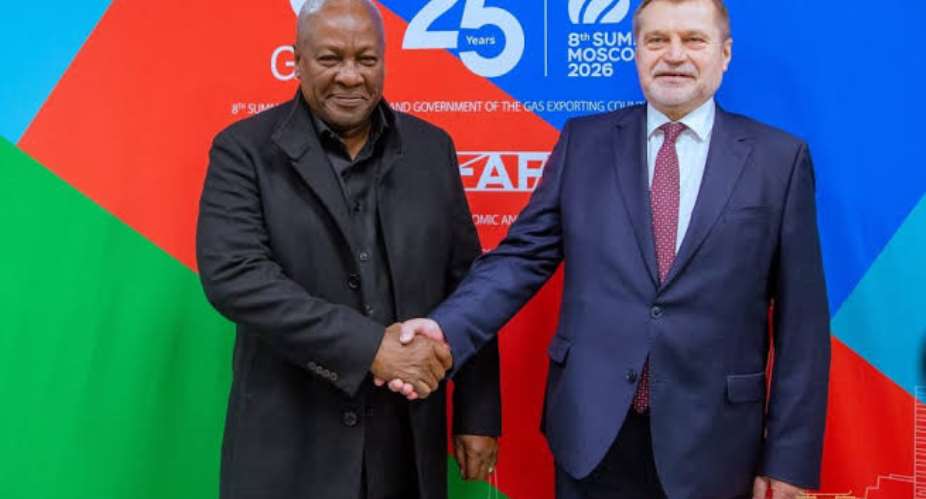
Mahama goes to Moscow
At the Financial Times Africa Summit in London on October 21, President Mahama said he will use the Russia-Africa Summit in Moscow (October 28 and 29) to try to persuade Vladimir Putin to agree to a ceasefire in Ukraine. His line was that Ghana is a friend to all and an enemy to none.
I like the ambition. A small country with a clean non-aligned record has no business being shy about peace. But let me raise three uncomfortable points.
First, Putin has not set foot in Africa since 2018, and the third summit has been fixed in Moscow by presidential decree. Africans keep flying north to be hosted. Ask yourself who is courting whom.
Second, the Moscow trip does not sit alone. Cabinet has approved Ghana's bid to join BRICS as a partner country, and Foreign Minister Ablakwa defends it by pointing out that Washington itself keeps doing deals with Moscow. That is a fair debating point. It is not a policy paper. Ghanaians have been told one exists. Publish it. If our exports could face American tariff threats, citizens deserve to read the risk assessment before the risk arrives.
Third, a ceasefire is a big ask for one visit. If the president returns with fertiliser, wheat and security cooperation commitments, Moscow will have been worth it. If he returns with only photographs, we will have been used. Judge the trip by what comes home in the cargo hold.
Cabinet tension and the 2028 shadow
In August the president made his first major reshuffle of this term. It filled two portfolios left empty by tragedy and moved a couple of sitting ministers. Majority Leader Mahama Ayariga went to Local Government, and Dr Zanetor Agyeman-Rawlings was named Minister for Environment, Science and Technology.
The opposition's former Defence Minister, Dominic Nitiwul, says a bigger reshuffle is coming. Some NDC people, by his account, are themselves naming ministers who are not performing. I cannot verify what is said in private, so treat that as his claim. What I can say is that with the president constitutionally barred from another term, every appointment is now read as a 2028 signal, and the Vice-President has already told people to focus on the job.
My view is simple. Jostling for succession is normal in every party. But a minister who is campaigning is a minister who is not working. Mr President, measure ministers by delivery, not loyalty, and do it publicly enough that the rest take notice.
The cedi: strong story, nervous reality
Give credit where it is due. The cedi gained about 41 per cent against the dollar in 2025, its first annual gain in decades. Ghana completed its IMF programme in May, gross reserves have been reported at around US$14.5 billion, and the IMF has lifted its 2026 growth forecast to 5.7 per cent.
Now the other side. On October 15 the Bank of Ghana's interbank rate was about GH¢11.68 to the dollar while the street was quoting about GH¢12.30. That gap of roughly five per cent is a credibility gap. In August the cedi touched 10.94 and has since slid back. Most Ghanaians buy their flour, fuel and phones at the street rate, not the interbank rate.
Reserves and a 14 per cent policy rate are tools, not a miracle. Professor Bokpin warned that the real test comes after the IMF stops watching. We are now in that test. A strong currency holds up only if spending stays disciplined when it is no longer being supervised, and Ghana has a poor record of that, especially in election years.
Energy: we are still arguing about reliability
President Mahama commissioned the refurbished Tema Oil Refinery on August 1 and ordered a roadmap to reach 100,000 barrels a day, along with a restructuring to end political interference. That would more than double what the plant is built for. I support it, but "political interference" is a promise every government has made about TOR, so write it into law, not into speeches.
Meanwhile, ordinary people are living with outages. A fire at GRIDCo's Mallam substation on October 14 disrupted supply in Accra. In Ashanti, ECG blamed transformer blasts and cable faults. Ghana's problem is not only how much power we generate but whether it reaches your fridge without a fight. Bigger refineries and new drilling in the Voltaian Basin are welcome. Reliable transmission is what wins elections and keeps businesses alive.
Obuasi SHTS: a failure bigger than one man
A JoyNews investigation by Manasseh Azure Awuni raised serious allegations of sexual abuse against the headmaster of Obuasi Senior High Technical School. He has been arrested, and the docket has gone to the Attorney-General. Reports put the number of girls making allegations at 16 or more. He is innocent until a court says otherwise, and that principle protects all of us.
But look at what is not in dispute. Police say a complaint was lodged on August 4. Advocacy groups say complaints reached school and education authorities months earlier. The Ashanti Regional and Obuasi Municipal Education Directors have been asked to step aside. A similar case at the same school in 2018 led to a dismissal. Separately, police arrested six students over an attack on the headmaster, and mob violence helps no one, least of all the girls.
My demand is simple: a trained safeguarding officer in every school, and a way for a student to report abuse without going through the person she is accusing. The girls need education, care and protection. Everyone who sat on a complaint should be identified.
Romance fraud: the shame, and the victims
In June, US prosecutors announced that Joseph Kwadwo Badu Boateng, extradited from Ghana, pleaded guilty to conspiracy to commit wire fraud over a romance and inheritance scheme that ran from 2013 to 2023. He agreed to pay about US$4.4 million in restitution, and sentencing was set for September. Earlier this year, Derrick Van Yeboah pleaded guilty in New York over more than US$10 million of a ring said to have taken over US$100 million.
I won't pretend this is only a "foreign story." It hurts honest Ghanaian entrepreneurs, freelancers and students who get treated as suspects at every border and bank. It also left real elderly victims lonely and ruined. Extraditions show Ghana and the US can cooperate. Now Ghana must prosecute at home, and our unemployed youth need something better than a scam to aspire to.
The South Africa evacuation: two things can be true
Ghana brought home 1,964 citizens between May 27 and September 4 after the wave of anti-immigrant violence in South Africa. The ministry puts the total cost at GH¢49,721,786, including a GH¢5,500 reintegration allowance and a GH¢500 transport allowance for each evacuee. Pretoria insists the attacks were isolated and says Ramaphosa has condemned xenophobia. Julius Malema has criticised our evacuation as unnecessary.
Now the controversy. The Minority says it cannot reconcile about GH¢16 million and has called for an audit. It says it has not accused anyone of wrongdoing. Minister Ablakwa says not one cedi is missing and challenges anyone to name an evacuee who was not paid.
My view: protecting citizens was right, and a public audit is also right. These do not contradict each other. If the books are clean, an audit settles it in a week. A government that is confident should publish the beneficiary list and the Auditor-General's review and let the numbers speak.
Chairman Wontumi: let the courts finish
On July 20 an Accra High Court convicted NPP Ashanti Chairman Bernard Antwi-Boasiako, known as Wontumi, on six illegal mining charges tied to Akonta Mining's Samreboi concession and sentenced him to 20 years with hard labour. His lawyers have appealed on 19 grounds, and the High Court rules on bail pending appeal on November 4. The State opposes bail. His spokesman has reportedly apologised to the President and asked for mercy, while insisting this is not an admission of political interference.
Here is where I land. A conviction stands until an appellate court says otherwise, and he has every right to appeal. His supporters call the sentence harsh. Anti-galamsey campaigners call it proof that the law applies to everyone. Both are entitled to say so. The real test of whether this was justice or selective justice is what happens next: whether the same energy goes after well-connected people in every party. Ghanaians watching our rivers turn brown are waiting.
Education and sport
Technical university lecturers (TUTAG) have been on strike since October 1 over unpaid contractual remuneration and what they call breaches of agreed conditions of service. The vice-chancellors have appealed for the strike to end, TUTAG held an extraordinary congress on Monday, and the Tertiary Education Commission has called a meeting for tomorrow. By the time you read this the outcome may be known. Whatever it is, students lose time every week this drags on. Government should pay what is owed, and the union should keep its door open to talks.
On a happier note, our Black Maidens lost 3-0 to Norway, drew 3-3 with Brazil, then beat Canada 2-0 to reach the Round of 16 of the FIFA U-17 Women's World Cup in Morocco, where they meet Argentina. That is character. Meanwhile our senior Black Stars lean on an interim technical team. If we invested in girls' and youth football the way we talk about it, we would not keep celebrating comebacks. We would plan for victories.
Where the money and the roads are going
Accra hosts the Elevate Africa Convening on October 28 and 29, themed on defining Africa's future with the AfCFTA at the centre, and the EU-Ghana Agribusiness Forum runs the same days. Conferences are fine. But Ghanaian farmers do not eat declarations. Show me processed goods passing EU standards, not just MOUs.
Credit to the private sector grew 34 per cent to GH¢128.3 billion by August, which is healthy if it funds production. The Accra-Kumasi Expressway is expected to begin construction in January 2027, with land reserved for a rail line. I will believe it when I see the first excavator.
On the road, police say more than 900 people died in crashes in the first eight months of 2026. DVLA says it now runs 62 offices, with Kwashieman among those it has named for opening, and promises a 24-hour service culture. More offices help, but offices don't make drivers safer. Enforcement and honest testing do.
And please, mind the weather. GMet has warned of heavy rain and thunderstorms through a flood-heavy season. Clear your gutters, and don't drive through floodwater.
The wider world
Israel votes today. It is the first general election since October 7, 2023. One Channel 12 poll showed Netanyahu and former army chief Gadi Eisenkot tied at 38 per cent on who voters prefer as prime minister. Voters named the war as their top concern, with the cost of living second. Whoever wins inherits a region at war, and Ghanaians will feel it in fuel prices.
The Iran war began on February 28 when the US and Israel struck Iran. A ceasefire in April collapsed, and the fight is now about control of the Strait of Hormuz, with talks in Oman and elsewhere. I won't predict the outcome. I will say that every time that strait closes, Ghanaian pump prices move, so this is our war too.
The US midterms are on November 3, with all 435 House seats and 35 Senate seats up. Polls show the president's favourability around 37 per cent, with Democrats competitive in several Senate states. Republicans tell voters to ignore the polls. Both sides can be wrong, so I'll leave the predictions to the voters. What matters to us is that the outcome will shape American tariffs and aid for years.
Ukraine has seen a rare local humanitarian ceasefire around the occupied town of Oleshky, which the White House says First Lady Melania Trump helped broker. Both Kyiv and Moscow have confirmed it, with aid and evacuations planned for around October 29. A town of once 24,000 people, with no power, heat or running water. It is only a small, local ceasefire, but a small pause is better than none. If Mahama's mission achieves even this much, it will not have been wasted.
South Africa says it is firming up law and order after months of unrest. I hope so. The test is whether foreigners are safe next month, not whether the government says they are.
My closing thought
Look at the pattern. Ghana is celebrating a stronger cedi and a successful IMF exit while ordinary people feel the street rate. We are talking peace in Moscow while girls in Obuasi waited months for someone to listen. We say the law applies to everyone, and Ghanaians will watch whether it does. Patriotism is not applause. It is asking hard questions out loud and demanding answers.
Disagree with me. Argue in the comments. That is what a democracy is for.


 Obuasi SHTS sex scandal: Police discover foetus buried near school
 “If I knew then what I know now, I wouldn’t have had a child” – Nana Aba Anamoah
 NDC must maintain policy consistency to perform better – Asiedu Nketia
 South Africa evacuation: Ablakwa failing to meet standards he set in opposition ...
 Mahama eyes Russian investment in Ghana’s energy sector ahead of meeting with Pu...
 ECOWAS deploys pre-election mission to Nigeria ahead of 2027 polls
 South Africa evacuation: Ablakwa has committed no crime; he's going nowhere – Fr...
 Real Madrid apologise to China over Mbappé's Mao Zedong comments
 Netanyahu bloc leads after half of Israeli votes counted but no majority
 Bagbin calls for private member's bill for professional certification, charterin...


