




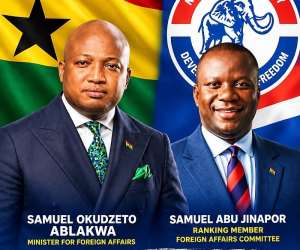
I can’t help but feel a bit worried about the path my brother, Mr. Samuel Abu Jinapor, seems to be taking in his political dealings with Ghana’s Minister for Foreign Affairs, Hon. Samuel Okudzeto Ablakwa. This isn’t coming from a place of animosity or political rivalry; rather, it stems from a genuine concern for someone I’ve always looked up to and whose political journey I’d prefer to see flourish, not falter due to unnecessary conflicts.
It makes one wonder if there’s a growing expectation within the New Patriotic Party (NPP) for Mr. Jinapor, as the Ranking Member on Parliament’s Foreign Affairs Committee, to adopt a more aggressive stance towards the current minister. If that’s the case, he needs to be cautious about letting the expectations of his political base dictate how he engages publicly.
Parliamentary oversight is a vital part of our democratic system. The Minority has both a constitutional and political duty to examine the government’s actions, ask tough questions, demand accountability, and challenge decisions they find questionable. It’s unreasonable to expect Mr. Jinapor to shy away from these responsibilities just because the minister is from a different political party.
That said, there’s a crucial difference between constructive criticism and a relentless pursuit of political conflict. One is rooted in the public interest, while the other can easily turn into mere political theatrics. The former bolsters democracy, while the latter can gradually erode the credibility of even the most respected public figures.
My worry is that Mr. Jinapor’s recent approach, as I see it, might give off the impression that he’s more focused on showcasing his political prowess to his party than on ensuring his actions lead to meaningful results for Ghana. Whether that impression truly reflects his intentions is another matter altogether.
What we can't overlook is that how the public perceives things plays a crucial role in political leadership. Even the best intentions can backfire if actions come off as over-the-top or unnecessarily confrontational.
Hon. Samuel Okudzeto Ablakwa has carved out a public image that many Ghanaians connect with a dynamic and hands-on approach to foreign affairs. Personally, I think he stands out as one of the most remarkable Foreign Affairs Ministers Ghana has seen, though that's just my take, and it really should be evaluated based on his track record, diplomatic successes, and the overall goals of Ghana’s foreign policy.
That said, this doesn’t mean the minister should be immune to criticism. In fact, no public figure should be above legitimate scrutiny. However, any criticism should be fair, grounded in facts, and focused on real issues.
Mr. Jinapor is a sharp politician with his own public persona and political identity. He doesn’t need to create a hostile relationship with the minister to prove his worth. His role as Ranking Member is significant enough without needing to turn every situation into a showcase of opposition politics.
There’s a real risk in letting political loyalty morph into a duty to oppose everything the other side does. When that happens, it becomes harder for the public to tell the difference between genuine accountability and mere partisan obstruction. A politician might think he’s boosting his standing within his party, only to find that the broader public is growing less receptive to his comments.
Politics isn't just about how often someone speaks up, how fiercely they challenge their opponents, or how many controversies they stir up. It's also about having good judgment, knowing when to hold back, being credible, and recognizing which fights are truly worth your energy. Sometimes, the most impactful political statement isn't the loudest one; it's the one backed by solid evidence, delivered clearly, and aimed at serving the public interest.
What makes this situation hit home for me is that I've never felt the urge to visit Mr. Jinapor’s social media pages to confront him or criticize his political actions. I've followed his work with goodwill, generally appreciating his public service without feeling the need to jump into his political fray.
However, when admiration starts to shift into concern, staying silent becomes a challenge. It's precisely because many of us respect him that we're beginning to question the direction he's taking. We’d much prefer to see him exercise wise political judgment rather than get caught up in unnecessary confrontations that might only bring fleeting partisan applause.
This isn’t to say that Mr. Jinapor should be less effective as an opposition politician. On the contrary, he should aim to be even more effective by being more thoughtful. He should rigorously question government decisions, highlight weaknesses when the evidence is there, demand explanations when needed, and propose alternatives whenever possible. That’s how a parliamentary ranking member can truly establish themselves as a serious national figure.
He also needs to realize that the public isn’t required to see every act of opposition as a sign of competence. Ghanaians are becoming more focused on substance, results, and how political debates impact national development. A politician who confuses constant conflict with effective leadership risks alienating the very public support that could keep him politically relevant.
My brother, Samuel Abu Jinapor, should resist the urge to mix partisan expectations with his broader duties to the Ghanaian people. If his party members expect him to always be combative, he must have the confidence to show that effective opposition goes beyond just confrontation. It demands insight, intellectual rigor, and the bravery to recognize merit wherever it may lie, regardless of political ties.
There’s absolutely nothing wrong with holding Hon. Ablakwa accountable, just as there’s nothing wrong with acknowledging his successes when the evidence supports it. These viewpoints can coexist. In a mature democracy, it’s possible to disagree with a public official on certain issues while also recognizing that not every action they take is inherently wrong.
Ultimately, my concern isn’t whether Mr. Jinapor is fulfilling his role; it’s about whether the way he chooses to do so is in line with his long-term political goals and, more importantly, the public interest he’s meant to serve.
Building a political career isn’t just about confrontation; it’s about establishing credibility, exercising sound judgment, being consistent, and earning respect that extends beyond your own political circle. If a politician finds himself celebrated by his supporters but increasingly isolated from those who once admired him, it’s time to reflect on whether that approach is truly worth it.
I say this with sincere goodwill: Samuel Abu Jinapor doesn’t need to feel the pressure to oppose Samuel Okudzeto Ablakwa at every turn to prove his worth. His political presence should be strong enough to stand on its own.
The goal of parliamentary oversight should be to enhance governance, not just to rack up political wins. A politician’s effectiveness should be measured by the quality of their contributions to national discussions, rather than the fervor of their clashes with opponents.
My brother, be resolute when necessary, be critical when it’s warranted, but don’t let the urge to make a point undermine the respect you’ve worked so hard to build.
Sometimes, the best advice comes not from your political rivals, but from those who genuinely want to see you thrive.
And this, from me, is exactly that kind of advice.


 NPP has elected weak national executives—Adjei Baffour Acquah
 Ofori-Atta describes late CLOGSAG leader Bampoe Addo as fearless negotiator
 Ghana lost $6.5bn in mining revenue in 2025 – IFS
 Obuasi SHTS case: 'If we don’t get any positive response, we’ll stage another de...
 NMC to question midwife over controversial TikTok livestream
 ‘You champion reparation but cannot pay your own workers’ – Osahen Afenyo-Markin...
 Akim Oda MP questions government’s handling of DHIMS2 shutdown over $64,000 debt
 DHIMS restored, fully operational – Health Ministry
 Mahama discusses financial health with UNSGSA Queen Máxima
 Ghana to fully fund its own vaccines by 2030 as President Mahama announces Gavi ...


