




When Paying a Debt Is Presented as an Achievement
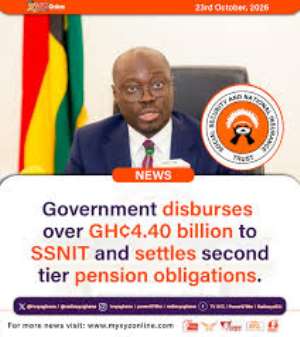
The announcement by Finance Minister Dr. Cassiel Ato Forson that the government has paid more than GH¢4.4 billion to the Social Security and National Insurance Trust (SSNIT) and towards Second-Tier Pension obligations deserves careful public scrutiny. Reported by Citi Newsroom on October 23, 2026, the announcement was presented as evidence of the government's commitment to protecting workers' pensions, managing public funds responsibly and meeting its obligations. On the surface, the news sounds reassuring. Pension contributions are essential to retirement security, and any genuine effort to settle outstanding obligations should be welcomed. Workers who have contributed throughout their working lives deserve the assurance that their money will be accounted for and protected. However, there is a fundamental question that the announcement does not adequately answer: If the money was legally due to pension schemes, why was it not paid when it was supposed to be paid?
There are other equally important questions. How much of the GH¢4.4 billion represents current contributions, and how much represents arrears accumulated over previous months or years? How long were the outstanding amounts held? Was any statutory penalty paid? Have affected workers been compensated for lost investment returns? And, after this payment, what amount remains outstanding? Until these questions are answered, the public should resist the temptation to interpret the announcement as proof that all pension obligations have been met or that existing pensioners will receive better monthly pensions. This is not an attack on any political party or government. It is a demand for accountability from an institution entrusted with managing public finances and an employer responsible for safeguarding workers' retirement contributions.
Pension Contributions Are Not Government Gifts
One of the dangers of political communication is that a government can announce the payment of money it legally owes and create the impression that it has made a special financial sacrifice for the people concerned. We must distinguish between a government providing additional assistance to pensioners and a government fulfilling an existing legal obligation. When pension contributions are deducted from workers' salaries, those deductions are not ordinary government revenue available for discretionary spending. They are part of a statutory pension arrangement intended to provide financial security in retirement.
Under Ghana's National Pensions Act, 2008 (Act 766), employers and other responsible parties have obligations concerning the remittance of pension contributions. The law establishes timelines and penalties for defaults. For workers whose contributions have been deducted but not remitted, the issue is particularly serious. They may have complied with their obligations while the employer failed to fulfil its corresponding responsibility. Government must therefore explain the nature of the GH¢4.4 billion payment rather than relying on the headline figure to speak for itself.
- Was this a payment of money already due?
- Was it a combination of current contributions and old arrears?
- Did it include penalties?
- Was any portion an additional allocation beyond the government's normal obligations?
These distinctions matter because paying money owed is not the same as granting a benefit, and paying it late is not the same as paying it on time.
Understanding the Three-Tier Pension System
To appreciate the significance of this announcement, it is necessary to distinguish between the different components of Ghana's pension system.
- The first tier is the mandatory basic national social security scheme administered by SSNIT. It provides eligible contributors with a monthly pension upon retirement, subject to the applicable statutory conditions.
- The second tier is a mandatory occupational pension scheme designed to provide retirement benefits through privately managed schemes and trustees. Its benefits are principally defined by contributions and the investment performance of the accumulated funds.
- The third tier consists of voluntary provident fund and personal pension arrangements.
Although the first and second tiers serve complementary purposes, their administration and benefits are not identical. Consequently, the statement that Government has paid more than GH¢4.4 billion to SSNIT and towards Second-Tier Pension obligations must not be interpreted to mean that the entire amount has entered SSNIT's Tier One fund. The Finance Minister needs to disclose the exact allocation between the two tiers and identify the institutions that received the payments.
This is essential because the immediate effect of settling outstanding Tier Two contributions is principally to restore money due to the affected workers' occupational pension arrangements. It does not automatically translate into an increase in the monthly pensions of people already receiving SSNIT benefits. Without this distinction, public discussion risks confusing three different matters: the payment of current workers' pension contributions, the settlement of historical arrears, and the adequacy of monthly pensions for existing retirees.
How Long Has Government Been in Arrears?
The GH¢4.4 billion announcement cannot be properly assessed without examining the history of delayed pension contributions. In April 2024, reports emerged of government action to address outstanding Tier Two pension obligations, including arrangements for settling arrears. Subsequent complaints from organized labour demonstrated that the problem had not disappeared.
In 2026, the Civil and Local Government Staff Association of Ghana (CLOGSAG) raised concerns about substantial outstanding Tier Two contributions. Other organized labour groups also complained about delayed remittances affecting their members. These reports are important because they suggest that the problem has involved recurring obligations rather than a single isolated payment.
However, reports of particular arrears affecting specific groups of public-sector workers should not be treated as proof that every government employee was affected in the same way or that all outstanding amounts covered identical periods. That is precisely why a comprehensive reconciliation is necessary.
The Ministry of Finance should publish a schedule showing the outstanding contributions by month, year, employer category, pension tier and receiving scheme. It should identify the original amount due, the dates on which payments were made and the balance remaining. Without such information, citizens cannot determine whether the GH¢4.4 billion represents the complete settlement of accumulated arrears or merely one instalment in a continuing process. The announcement is an opportunity for Government to demonstrate transparency. It should not become a substitute for transparency.
Where Was the Workers' Money?
This is arguably the most important question arising from the announcement. If pension contributions were deducted from workers' salaries but were not remitted to the relevant pension schemes when due, where were those deductions held?
- Were they retained in government accounts?
- Were they recorded as outstanding liabilities?
- Were they temporarily used to meet other public expenditure commitments?
- Were they held in suspense accounts or treated in some other way in the government's financial records?
These are questions requiring documentary answers, not speculation. t would be wrong to conclude, without evidence, that the money was deliberately diverted or used for unrelated purposes. Nevertheless, the public has every right to demand an explanation of how the outstanding amounts were accounted for.
- If the deductions remained in government accounts, the Ministry of Finance should identify the accounts and explain the arrangements governing their treatment.
- If the amounts were recorded as liabilities, the government should disclose when those liabilities arose, why they remained unpaid and what measures were taken to prevent further accumulation.
- If cash-flow difficulties contributed to the delays, the government should explain why pension remittances were not protected as priority obligations.
There is a fundamental principle here: money deducted for a statutory pension purpose must be treated with the seriousness that purpose demands. A government cannot reasonably expect workers to make their contributions on time while treating its own remittance obligations as payments that can be postponed indefinitely.
The Cost of Delay: Principal Is Not the Whole Story
Even if Government eventually remits every cedi of the principal contributions, another question remains: who bears the cost of the delay? Tier Two pension arrangements depend on the accumulation of contributions and investment returns over time. Money received and invested today can generate returns that contribute to a worker's eventual retirement benefit.
When a contribution that should have been invested in January 2025 is not remitted until October 2026, the affected worker loses the opportunity for that money to earn returns during the intervening period. The precise loss depends on the amount outstanding, the dates of the delay, the investment opportunities available and the returns that could reasonably have been earned. It cannot responsibly be calculated without the relevant records. Nevertheless, the underlying principle is clear: a late contribution is not economically equivalent to a contribution invested on time.
Consider a hypothetical contribution of GH¢10,000 that should have entered a pension account but was delayed for two years. If it could have earned an illustrative annual return of 10%, compounded annually, it would have grown to GH¢12,100. The difference of GH¢2,100 illustrates the potential opportunity cost. It is not an estimate of the actual losses suffered by Ghanaian workers, and actual investment returns could have been higher or lower. When thousands of workers' contributions are delayed, the cumulative consequences can be substantial.
The Ministry of Finance, SSNIT, the National Pensions Regulatory Authority (NPRA) and the relevant Tier Two trustees should therefore establish whether the payment of arrears included compensation for any investment income lost through late remittance. If compensation was paid, the amount and method of calculation should be disclosed. If it was not paid, the responsible institutions should explain why. Workers should not be expected to bear the financial consequences of delays for which they were not responsible.
Will Government Pay the Statutory Penalties?
Another unanswered question concerns the penalties applicable to delayed pension contributions. Act 766 establishes obligations relating to the remittance of pension contributions and provides for penalties in cases of default. The applicable statutory provisions and their implementation should be examined against the circumstances of the arrears in question.
The public deserves to know whether penalties were calculated on the outstanding amounts, whether they were paid and whether any waivers or special arrangements were granted. This is not an argument for imposing penalties without examining the law or the circumstances of each default. It is an argument for consistent enforcement and transparent accounting.
If private employers are expected to comply with pension-remittance requirements, government departments and public institutions should not be exempted from scrutiny simply because they belong to the state. If Government believes that a particular legal provision does not apply to a particular category of arrears, it should explain the legal basis for that position. If penalties were waived, the authority for the waiver and the reasons should be made public. If penalties remain outstanding, the Ministry should disclose the amount and the timetable for settlement. The public should not have to guess whether the government is being treated according to the same rules that it expects other employers to observe.
Does the GH¢4.4 Billion Mean Existing Pensioners Will Receive More?
For many retired Ghanaians, the headline may create hope that the payment will improve their monthly pensions. That expectation needs to be addressed honestly. The settlement of outstanding Tier Two contributions primarily concerns the occupational pension entitlements of the affected workers. It does not, by itself, establish a new monthly payment for existing SSNIT pensioners or guarantee an increase in their current benefits.
A retired worker receiving a monthly SSNIT pension should therefore not assume that the GH¢4.4 billion will lead to a direct increase in the amount paid into his or her account. This does not mean that the announcement is irrelevant to pensioners. Today's retirees have a legitimate interest in the integrity of the entire pension system. Many current workers will eventually become pensioners, and the protection of their retirement contributions is essential to the long-term credibility of the system.
Furthermore, the public's ability to distinguish between pension-related announcements and actual improvements in retirement income is important for informed debate. The immediate challenges facing existing pensioners remain distinct. These include the adequacy of annual pension indexation, the effect of inflation on purchasing power, the cost of food and utilities, rent, transport and medicines, and the need for a transparent and sustainable method of determining annual increases.
Where pensioners have experienced substantial losses in real income, the settlement of contributions owed to current workers does not automatically compensate them for those losses. Government should therefore communicate pension-related expenditure accurately, distinguishing between measures that protect future retirement benefits and measures that directly improve the circumstances of people already living on monthly pensions.
The Political Presentation of Pension Payments
Governments have a legitimate responsibility to inform citizens about public expenditure. Public announcements about payments made, debts settled and statutory obligations fulfilled are not inherently misleading. The problem arises when an announcement emphasizes the amount paid but omits the context needed to understand its significance.
A large headline figure can create an impression of extraordinary generosity even where the money represents contributions already deducted from workers, arrears accumulated through delayed remittances or obligations that the government was legally required to fulfil. The distinction is especially important in a country where many citizens have limited access to detailed public financial records.
When a minister announces that billions of cedis have been paid towards pensions, the natural response may be to assume that pensioners have received a major benefit. But the amount alone does not answer the questions that matter most.
- How much was due?
- When was it due?
- How much was paid late?
- How much remains unpaid?
- Were penalties applied?
- Did affected workers receive the investment returns to which they would have been entitled had their money been remitted on time?
These are not partisan questions. They are questions of public finance, labour rights and institutional accountability. The same standards must apply regardless of which political party controls Government. If a future administration makes a similar announcement, citizens should ask the same questions. No government should be allowed to escape scrutiny merely because it has announced the payment of a large sum.
What Should the Ministry of Finance Disclose?
To remove uncertainty surrounding the GH¢4.4 billion, the Ministry of Finance should publish a detailed reconciliation of the payments.
- It should break down the total amount between Tier One and Tier Two obligations, identifying the precise sums paid to SSNIT and to the relevant Tier Two schemes or trustees.
- It should distinguish current-year contributions from arrears accumulated in previous years.
- It should identify the periods covered by the arrears, including the earliest outstanding month and the date on which each category of liability was settled.
- It should disclose the total amount of pension contributions that was outstanding immediately before the payments and the balance remaining afterwards.
- It should state whether statutory penalties were assessed and paid, whether any penalties were waived, and the legal basis for any waiver.
- It should explain whether compensation was provided for lost investment income and, if so, how the amount was calculated and credited to affected workers' accounts.
- The NPRA and the relevant pension trustees should confirm that the money has been received and properly allocated to the intended pension schemes and members.
- Finally, Government should publish a timetable for clearing any remaining arrears and introduce a mechanism to ensure that future contributions are remitted within the legally prescribed periods.
Such disclosure would turn a general announcement into verifiable public accountability.
The Role of SSNIT, NPRA and Organized Labour
The Ministry of Finance should not be the only institution expected to provide answers. SSNIT should disclose the portion of the payment received by the Trust, the periods covered and whether any outstanding obligations remain in respect of its scheme. The NPRA, as the regulator responsible for supervising Ghana's occupational and personal pension arrangements, should provide an independent account of the status of the relevant Tier Two contributions. The pension trustees should confirm receipt of the funds and demonstrate that the money has been credited correctly to the relevant schemes and members.
Organized labour also has a continuing role to play. Trade unions should demand verifiable records rather than relying solely on government announcements. They should establish whether affected workers' contributions have been credited and whether their retirement benefits have been protected against the consequences of delayed payments. Pension advocacy organizations (such as Pensioners for Reforms and Concerned SSNIT Pensioners Forum) should likewise insist on transparency without allowing the issue to become a contest between political parties. The objective should be to protect the rights of contributors, strengthen confidence in the pension system and ensure that public institutions are held accountable for their obligations.
A Broader Reform Question: Can Pension Contributions Be Protected From Cash-Flow Pressures?
The recurring problem of arrears raises a wider institutional question. Why should the remittance of statutory pension contributions be vulnerable to government cash-flow difficulties in the first place? If deductions have already been made from workers' salaries, the corresponding remittance should be treated as a priority obligation. The system should not depend on workers discovering months later that money deducted from their earnings has not reached the intended pension scheme.
Government should therefore consider stronger reconciliation and monitoring arrangements between payroll systems, the Ministry of Finance, employers, SSNIT, NPRA and Tier Two trustees. Monthly reconciliation would make it easier to identify missing contributions promptly. Public-sector employers should receive regular compliance reports, and unexplained discrepancies should trigger timely investigation.
The regulator should also publish periodic information on outstanding contributions and enforcement action, subject to appropriate protections for personal information. Where an employer repeatedly fails to remit contributions, the consequences should be clear, lawful and consistently applied. The ultimate objective is prevention. It is far better to ensure that contributions are paid on time than to accumulate arrears, negotiate repayment schedules and later announce the settlement of billions of cedis.
My Thoughts: Pension Money Is a Right, Not a Political Favour
The Finance Minister's announcement that Government has paid more than GH¢4.4 billion to SSNIT and towards Second-Tier Pension obligations is significant. However, its full meaning cannot be established from the headline figure alone. The announcement does not, by itself, establish how much of the money represented current contributions, how much was arrears, how long the outstanding amounts had been held, whether penalties were paid, whether workers were compensated for lost investment income or how much remains outstanding.
Nor does it establish that existing SSNIT pensioners will receive higher monthly pensions as a result. These questions require documented answers from the Ministry of Finance, SSNIT, NPRA and the relevant pension trustees. Ghana's pension system should not depend on political goodwill. It must operate according to clear legal obligations, transparent accounting and consistent enforcement.
Workers who have contributed throughout their careers deserve to retire with confidence that their savings have been protected. Existing pensioners deserve honest communication about measures that affect their monthly incomes. And taxpayers deserve to know how public money is managed. The central principle is simple: Government should not expect applause merely for paying what it already owes. It should be judged by whether it pays on time, accounts for every cedi and protects workers from avoidable financial losses.
The questions therefore remain: Where was the workers' pension money before it was paid? How long was it outstanding? Was interest or a statutory penalty paid? Were affected workers compensated for lost investment returns? And what amount remains outstanding after the GH¢4.4 billion payment? Until those questions are answered, the public should treat the announcement as a statement of payment made, not as proof that every pension obligation has been settled or that pensioners have received a new benefit.
Pension contributions are workers' deferred earnings. They are not government gifts, political favours or instruments for public relations. Our Contributions, Our Rights. That is a principle every government, regardless of political affiliation, must respect.
FUSEINI ABDULAI BRAIMAH
+233208282575 / +233550558008
[email protected]


 President Mahama urges African countries to fund own peace operations, warns aga...
 Govt to borrow GHS15.38 billion from domestic market, plans DDEP bond buyback
 Finance Ministry says all 2026 ABFA allocations reserved for Accra-Kumasi expres...
 'Surprised and disappointed' — GTA CEO Efua Houadjeto responds to Abeiku Santana...
 Police arrest NDC delegates for allegedly photographing ballots at Bimbilla cons...
 Gambia’s Chief Justice pays courtesy call on Asantehene at Manhyia Palace
 NDC Constituency polls: Delegates invoke 'Antoa' deity over alleged album manipu...
 NDC Oforikrom constituency election stalls over ballot paper delays
 Former NDA CEO Sumaila Abdul-Rahman, three others fined GH¢84,000 each over proc...
 Wa: Abandoned newborn baby boy rescued at Sombo


