




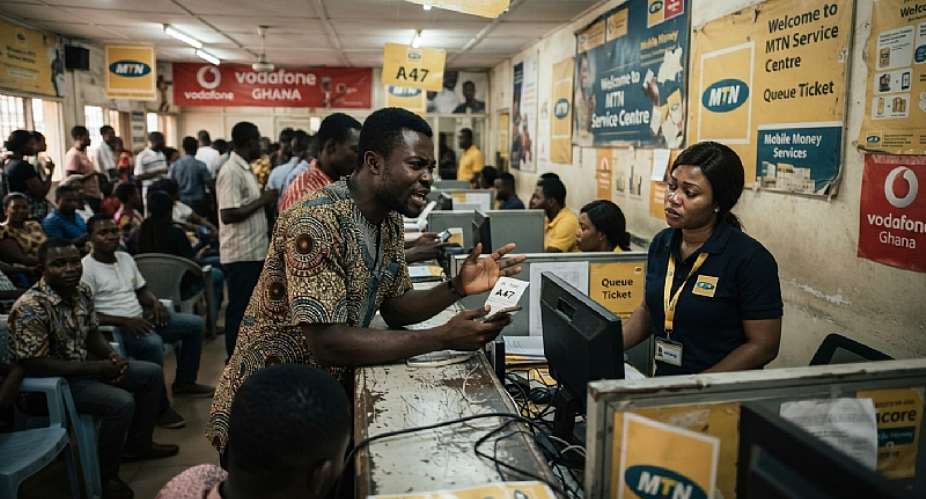
For years, Ghanaian organizations have invested in customer-service training, campaigns and technology. Yet customer experience remains inconsistent. Perhaps the problem is not how we serve customers at the frontline, but how we design the organizations behind the frontline.
Ghana has a customer-service ritual.
Every year, Customer Service Week arrives. Organizations decorate their offices, celebrate frontline employees, share messages about putting customers first and encourage staff to “go the extra mile.”
And then the weekends.
The queue remains.
The unanswered complaint remains.
The customer who has called three times remains frustrated.
The person who has already provided the same information twice is asked for it again.
The customer who was promised a call-back is still waiting.
And somewhere within the organization, the problem is classified as a customer-service issue.
Perhaps it is not.
Perhaps Ghana does not have a customer-service problem.
Perhaps we have a customer-experience problem.
That distinction may sound semantic, but it is fundamental.
In January 2026, the latest Ghana Customer Service Index (GCSI) revealed that Ghana’s overall customer satisfaction score had fallen from 72 percent in 2024 to 59 percent in 2025, moving the country’s rating from a B to a D-plus. The index assessed customer experience across 11 sectors using dimensions including trust, professionalism, competence, ease of doing business, processes and customer-focused innovation (Institute of Customer Service Professionals [ICSP], 2026).
A 13-percentage-point decline in a single year should make us pause.
This is not simply a matter of whether employees are friendly enough.
It raises a much bigger question:
Are Ghanaian organizations actually designed around the people they serve?
Customer service is an interaction. Customer experience is a system.
One of the reasons customer experience remains misunderstood is that the terms customer service and customer experience are often used interchangeably.
They are not the same.
Customer service is typically the assistance an organization provides when a customer needs help.
Customer experience is much broader.
It encompasses the customer’s entire relationship with an organization, from the first interaction and search for information, through purchase and delivery, to payment, complaints, resolution and post-purchase engagement.
It includes the website.
The branch.
The mobile application.
The waiting time.
The pricing.
The language used in communication.
The employee’s behavior.
The organization’s policies.
The ease of resolving a problem.
The consistency between what the organization promises and what it delivers.
In other words:
«Customer service is one touchpoint. Customer experience is the ecosystem surrounding the customer.
This is why an organization can have polite employees and still deliver poor customer experience.
A receptionist can be courteous while customers wait for two hours.
A call-centre agent can be professional while transferring a customer five times.
A bank employee can apologize sincerely while a cumbersome internal process forces the customer to submit the same documentation repeatedly.
A telecom employee can say “sorry for the inconvenience” while the underlying network problem remains unresolved.
The employee may be doing their job.
The system may not be doing its job.
Don’t blame the employee for a journey the organization designed
This is perhaps the most important shift Ghanaian organizations need to make.
When customers complain, the easiest response is often to look at the frontline employee.
Was the employee polite?
Did they smile?
Did they greet the customer?
Did they follow the script?
These things matter.
But they are not the whole story.
What happens when the employee has no authority to resolve the customer’s problem?
What happens when the organization’s policies contradict one another?
What happens when departments do not communicate?
What happens when customer information sits in disconnected systems?
What happens when employees are evaluated primarily on sales rather than resolution?
What happens when a complaint must pass through three managers before anyone can make a decision?
The frontline employee can apologize.
But an apology is not a customer-experience strategy.
This is where organizational design becomes relevant.
If customers repeatedly encounter the same obstacle, leadership should not simply train employees to manage the frustration.
Leadership should ask why the obstacle exists.
That is the difference between symptom management and root-cause management.
The data should concern business leaders
The 2026 GCSI findings make this conversation difficult to dismiss.
The index reported that telecommunications recorded the lowest satisfaction score among the 11 sectors, at 53 percent, despite being one of Ghana’s most digitized industries. Insurance led the sectors at 71 percent, while banking recorded 61 percent (ICSP, 2026).
The Implication is significant.
Digitalization does not automatically create better customer experience.
A customer does not necessarily care how sophisticated an organization’s technology is.
They care whether the service works.
They care whether the transaction is convenient.
They care whether the organization keeps its promise.
They care whether a problem is resolved without unnecessary effort.
They care whether the organization values their time.
This is why customer experience should be treated as a business-performance variable, not merely a communications or marketing function.
A poor experience can lead to complaints.
Repeated poor experiences can lead to customer churn.
Customer churn affects revenue.
Poor experiences can damage reputation.
Reputation affects trust.
And trust influences whether customers remain willing to do business with an organization.
The experience is therefore not peripheral to business performance.
The experience is part of the business model.
Complaints are not the enemy. Ignoring them is.
There is another important development in Ghana’s customer-experience conversation.
On October 20, 2026, the National Petroleum Authority urged public institutions to treat consumer complaints and feedback as valuable tools for improving service delivery, regulatory oversight and public confidence. The Authority argued that analyzing complaints can help institutions identify recurring problems and determine where intervention is required (Ghana News Agency [GNA], 2026).
This is a powerful shift in perspective.
A complaint should not simply be viewed as an angry customer demanding attention.
A complaint is data.
It tells an organization where reality is diverging from expectation.
If one customer complains about a process, it may be an isolated incident.
If 100 customers complain about the same process, the organization has a pattern.
If the organization continues receiving the same complaint for months, the issue is no longer primarily a customer-service problem.
It Is a management problem.
I would go further:
«The first complaint is a customer service issue. The hundredth complaint about the same issue is an organizational-intelligence failure.
Forward-thinking organizations should therefore move beyond simply recording complaints and closing cases.
They should conduct complaint analytics.
What are customers complaining about most?
Which departments generate the most complaints?
Which processes create the greatest friction?
How long does resolution take?
How many customers complain more than once?
How many complaints are resolved without escalation?
And, most importantly:
What has changed because customers complained?
When customers must escalate, the system has already told us something
Ghana’s regulatory environment provides another important illustration.
The National Communications Authority operates a formal Consumer Complaints Portal through which telecom consumers can lodge complaints, track their status and seek regulatory intervention when service-provider resolution is unsatisfactory. The NCA’s procedures require customers to first approach their service provider before escalating unresolved matters to the regulator (National Communications Authority [NCA], n.d.).
The existence of such mechanisms is important for consumer protection.
But it also raises an organizational question:
How many problems should the regulator reach before the organization recognizes that something is fundamentally wrong?
Escalation is necessary when internal resolution fails.
But from a customer-experience perspective, the ultimate goal should not be to become better at handling escalations.
The goal should be to reduce the need for escalation in the first place.
That requires service recovery mechanisms, employee empowerment, effective escalation protocols and, above all, root-cause analysis.
A mature organization should not merely ask:
«“How did we resolve this complaint?”»
It should also ask:
«“Why did this complaint happen, and what are we changing so it does not happen again?”»
That is the beginning of an organizational learning culture.
Customers are evaluating value, not just courtesy
Consider telecommunications.
Network disruptions happen. Infrastructure can fail. Fibre cables can be damaged. Technical problems are sometimes unavoidable.
For example, the NCA reported significant voice and data disruptions across Ghana’s northern regions in September 2026 following multiple fibre cuts, while technical teams worked to restore services (NCA, 2026a).
The existence of a technical failure is not necessarily evidence of poor customer service.
What matters is how the organization manages the experience around the failure.
Was the customer informed?
Was the information timely and transparent?
Was the expected restoration period communicated?
Was the customer given an appropriate channel for assistance?
Was the organization accountable?
Was the customer supported afterwards?
This distinction matters because customers do not evaluate organizations solely on whether something goes wrong.
They also evaluate how the organization responds when things go wrong.
That is the domain of service recovery.
An organization that makes a mistake but responds transparently, quickly and fairly can sometimes strengthen trust.
An organization that hides, delays, transfers responsibility or forces the customer to fight for resolution can turn a small operational failure into a major reputational problem.
Customer experience is now a leadership issue
For too long, customer experience has been treated as the responsibility of the customer-service department.
That approach is no longer sufficient.
Who designs customer journeys?
Leadership.
Who approves policies?
Leadership.
Who controls budgets?
Leadership.
Who decides how much authority frontline employees have?
Leadership.
Who determines whether customer feedback influences strategy?
Leadership.
Who decides whether customer satisfaction is included in performance management?
Leadership.
Therefore, customer experience is ultimately a leadership responsibility.
The customer-service team may own the interaction.
But the organization owns the experience.
This requires a shift from a departmental model to an enterprise-wide CX architecture.
Marketing must understand the promises it makes.
Operations must deliver those promises.
Technology must make the experience easier rather than more complicated.
Human resources must recruit and develop people capable of delivering the desired experience.
Finance must understand the cost of customer churn and service failure.
Leadership must create accountability.
When these functions operate in isolation, customers experience the gaps between them.
And customers do not care which department caused the problem.
They simply experience the organization.
Customer experience cannot be reduced to technology
This is particularly important as Ghana accelerates its digital transformation.
Customer Experience Professionals Ghana has increasingly positioned experience management as a strategic issue, with its 2026 agenda explicitly focused on “Experience Management: Transforming Business. Empowering Citizens. Positioning Ghana.” (Customer Experience Professionals Ghana, 2026).
More recently, CXP Ghana called on organizations to localize artificial-intelligence tools to improve service delivery and customer experience, including attention to Ghanaian realities (The Ghana Report, 2026).
This is important because technology should be an enabler of experience, not a substitute for organizational thinking.
A chatbot cannot compensate for an irrational process.
An app cannot compensate for poor policy.
Automation cannot compensate for weak accountability.
Artificial intelligence can make an organization faster.
But if the organization is moving in the wrong direction, it can simply make it wrong faster.
The question should therefore not be:
«“How can we automate customer service?”»
It should be:
«“How can we redesign the customer journey and then determine where technology can create meaningful value?”»
From Customer Service Week to Customer Experience Culture
Perhaps the real challenge is cultural.
Customer Service Week is valuable. Recognition matters. Employee appreciation matters. Awareness matters.
But one week cannot create a customer-centric organization.
A customer-centric organization is built into the everyday operating model.
It is reflected in recruitment.
It is reflected in employee empowerment.
It is reflected in performance indicators.
It is reflected in product design.
It is reflected in complaint handling.
It is reflected in leadership behavior.
It is reflected in how organizations respond when customers are dissatisfied.
Most importantly, it is reflected in whether organizations are willing to change when customers tell them something is not working.
Ghana does not need another campaign that tells employees to “go the extra mile” while the system keeps placing unnecessary obstacles in their way.
We need organizations that make the right thing easier to do.
So, what should Ghanaian organizations do differently?
The answer does not require every organization to launch an expensive CX transformation program
It starts with disciplined organizational listening.
First, map the customer journey.
Understand every significant touchpoint and identify where customers experience friction.
Second, analyze complaints.
Do not merely count them. Identify patterns, causes and recurring failures.
Third, empower frontline employees.
Give employees reasonable authority to resolve appropriate problems without unnecessary escalation.
Fourth, redesign broken processes.
If customers repeatedly struggle with a process, examine the process—not simply the employee delivering it.
Fifth, measure outcomes.
Track resolution time, customer effort, repeat complaints, satisfaction, retention and trust, not simply the number of calls answered.
Finally, make customer experience a leadership metric.
What gets measured gets attention.
What gets tied to accountability gets action.
The real question is not whether Ghanaian businesses care about customers
Many do.
There are excellent organizations and exceptional employees across Ghana delivering experiences that deserve recognition.
The problem is that good service is often inconsistent, personality-dependent and vulnerable to organizational dysfunction.
That is why we need to move beyond celebrating individual acts of excellent service and begin building systems capable of producing excellent experiences consistently.
Because the goal should not be to have one employee who goes the extra mile.
The goal should be to build an organization where customers do not have to beg someone to go the extra mile in the first place.
Ghana’s 59 percent customer-satisfaction score should therefore not simply be treated as a disappointing statistic.
It should be treated as a diagnostic signal.
It tells us that something deeper requires attention.
The solution is not more slogans.
It is not more cakes.
It is not another customer-service script.
It is not simply more technology.
It is better processes.
Better listening.
Better accountability.
Better leadership.
Better service recovery.
And, ultimately, a better understanding of what customers actually experience when they interact with our organizations.
Ghana does not have a shortage of customer-service conversations.
We have a shortage of customer-experience systems that consistently turn those conversations into action.
Perhaps it is time to stop asking whether our employees are serving customers well enough.
Perhaps we should start asking a more uncomfortable question:
«Have we designed organizations that make it possible for them to do so?»
Because customer experience is not what an organization says about itself.
It is what people experience when they deal with it.
And that experience is where the real brand lives.
References
Customer Experience Professionals Ghana. (2026). CXP Ghana 2026 activity calendar: Experience management—Transforming business. Empowering citizens. Positioning Ghana. https://cxpghana.com/blog/
Ghana News Agency. (2026, October 20). NPA urges institutions to use consumer feedback to improve services. https://gna.org.gh/2026/10/npa-urges-institutions-to-use-consumer-feedback-to-improve-services/
Institute of Customer Service Professionals. (2026). Ghana Customer Service Index 2026. Ghana Customer Service Index. https://ghanacsi.org/gcsi-reports/
National Communications Authority. (2026a, September 26). Notice of service disruption in Northern Ghana. https://nca.org.gh/2026/09/26/notice-of-service-disruption-in-northern-ghana/
National Communications Authority. (2026b). Consumer complaints portal. https://complaints.nca.org.gh/
The Ghana Report. (2026, October 12). CXP urges businesses to localize AI to improve customer experience. https://theghanareport.com/business/cxp-urges-businesses-to-localize-ai-to-improve-customer-experience/


 President Mahama urges African countries to fund own peace operations, warns aga...
 Govt to borrow GHS15.38 billion from domestic market, plans DDEP bond buyback
 Finance Ministry says all 2026 ABFA allocations reserved for Accra-Kumasi expres...
 'Surprised and disappointed' — GTA CEO Efua Houadjeto responds to Abeiku Santana...
 Police arrest NDC delegates for allegedly photographing ballots at Bimbilla cons...
 Gambia’s Chief Justice pays courtesy call on Asantehene at Manhyia Palace
 NDC Constituency polls: Delegates invoke 'Antoa' deity over alleged album manipu...
 NDC Oforikrom constituency election stalls over ballot paper delays
 Former NDA CEO Sumaila Abdul-Rahman, three others fined GH¢84,000 each over proc...
 Wa: Abandoned newborn baby boy rescued at Sombo


