




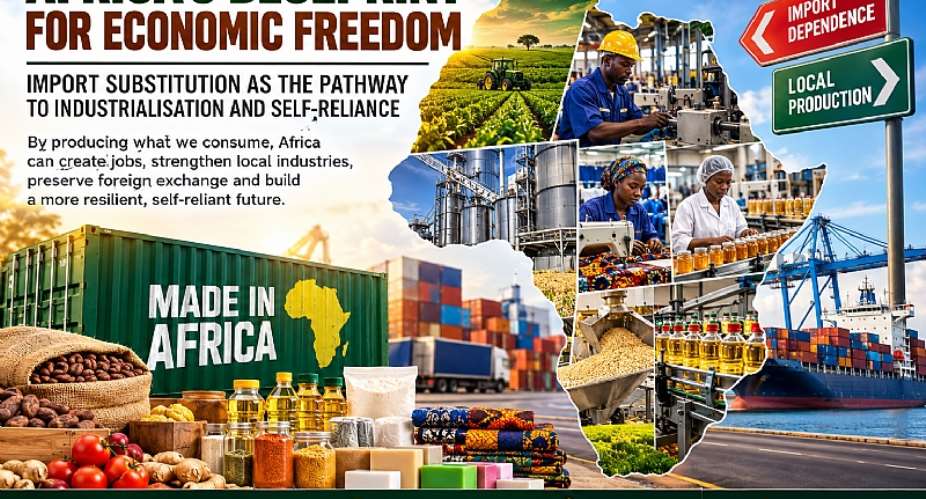
Africa is one of the world's richest continents in natural resources, yet it remains heavily dependent on imported manufactured goods. From food products and pharmaceuticals to machinery, textiles, household appliances and industrial equipment, African countries spend billions of dollars annually purchasing products that could, in many cases, be manufactured competitively within the continent.
This economic contradiction raises a fundamental question: Why should a continent endowed with abundant natural resources, a growing workforce and enormous agricultural potential remain dependent on foreign factories for so many of its basic needs?
For decades, African economies have largely followed a pattern inherited from colonial economic structures: exporting raw materials and importing finished products. Cocoa leaves Ghana and returns as expensive chocolate. Cotton leaves African farms and returns as garments. Crude oil is exported while refined petroleum products are imported. Agricultural produce is shipped abroad, processed, packaged and sold back to African consumers at significantly higher prices.
The result is an economic system in which much of the value created through manufacturing, technology, branding and distribution is captured outside the continent.
Breaking this cycle requires more than political declarations about economic independence. It demands a deliberate industrial strategy that places domestic production, technological development and regional economic integration at the centre of Africa's development agenda.
One important instrument for achieving this transformation is Import Substitution Industrialisation (ISI), an economic development strategy designed to replace selected imported products with goods manufactured locally.
Import substitution is not a new concept. It played an important role in the industrial development strategies of several countries during the twentieth century, particularly in Latin America, Asia and parts of Africa. Governments used tariffs, industrial incentives, public investment and domestic market protection to encourage the establishment of local industries.
However, the historical record offers both valuable lessons and important warnings. While some industries developed under protective policies, others became inefficient, expensive and permanently dependent on government support.
The challenge for Africa is therefore not simply to revive traditional import substitution, but to develop a modern, competitive and internationally connected model suited to twenty-first-century economic realities.
The urgency of this transformation has become increasingly apparent following recent global disruptions. The COVID-19 pandemic exposed Africa's dependence on imported medicines, medical equipment and essential manufactured goods. International shipping disruptions, geopolitical tensions and fluctuations in energy and commodity prices have further demonstrated the vulnerability of economies that rely excessively on foreign supply chains.
When global transport costs rise or major trading routes are disrupted, African businesses and consumers often experience higher prices and delayed supplies. When national currencies depreciate, imported goods become more expensive, placing additional pressure on households, manufacturers and government finances.
These challenges demonstrate why domestic productive capacity is not merely an industrial ambition but also an important component of economic resilience.
For Ghana, the argument is particularly compelling.
The country possesses substantial agricultural resources, including cocoa, cassava, maize, rice, palm fruits, coconuts, ginger, pepper and numerous other commodities. Yet opportunities for processing many of these products into finished consumer and industrial goods remain underdeveloped.
Ghana also imports significant quantities of manufactured products, industrial inputs, machinery and consumer goods, placing persistent demand on foreign exchange.
The answer cannot be to prohibit imports indiscriminately. Ghanaian manufacturers themselves depend on imported machinery, specialised chemicals, technology and other essential inputs. Restricting these imports without providing competitive alternatives could raise production costs and undermine industrial development.
Instead, the country needs a carefully designed import substitution programme that identifies products with genuine domestic manufacturing potential and supports enterprises capable of producing them efficiently.
Agro-processing provides one of the most promising starting points.
Rather than allowing agricultural products to deteriorate after harvest or selling them primarily in unprocessed form, Ghana can expand investments in drying, milling, extraction, preservation, packaging and food manufacturing.
Cassava can be processed into high-quality flour, starch and industrial ingredients. Plantain, cocoyam and potatoes can be converted into convenient food products. Ginger and pepper can be processed into packaged spices, while palm kernel, soybean and coconut can support edible oil, cosmetics and soap manufacturing.
Such industries have the potential to generate employment across farming, processing, packaging, transportation, distribution and retailing.
They can also create more dependable markets for agricultural producers and encourage investment in modern farming methods.
However, successful industrialisation requires much more than the availability of raw materials.
Factories need reliable electricity, affordable financing, modern machinery, technical expertise, quality control systems and access to competitive markets. Without these foundations, locally manufactured products may struggle to compete with imported alternatives.
This explains why industrial policy must address the entire production environment rather than relying exclusively on tariffs and import restrictions.
Nigeria provides an important example of both the possibilities and difficulties associated with import substitution.
Over the years, the country has introduced various measures intended to encourage domestic agriculture, food processing and manufacturing, including foreign-exchange restrictions affecting selected imported products.
These interventions sought to reduce import dependence and stimulate domestic investment. However, Nigeria's experience also illustrates the limitations of protection when domestic industries face unreliable electricity, high production costs, inadequate infrastructure and foreign-exchange constraints.
Restricting imports does not automatically create competitive domestic industries. Unless local production expands sufficiently, such restrictions can contribute to shortages, higher prices and informal cross-border trade.
Ethiopia offers another instructive experience.
The country invested heavily in industrial parks and manufacturing infrastructure, particularly in textiles and garments, with the objective of attracting foreign investment, expanding exports and creating employment.
Although these investments helped establish industrial production capacity, the sector also encountered challenges involving productivity, labour conditions, political instability and access to international markets.
The lesson is that industrial parks can provide useful infrastructure, but buildings and machinery alone cannot guarantee sustainable industrial success.
South Africa's automotive industry demonstrates a different approach.
Through successive automotive development programmes, the country has supported vehicle assembly, component manufacturing and integration into international automotive supply chains.
Its experience shows how industrial incentives, supplier development and export-market access can contribute to manufacturing capacity.
Nevertheless, automotive production remains dependent on international technology, imported components and global market conditions, demonstrating that modern industrialisation is rarely achieved through complete national self-sufficiency.
These examples point to an important conclusion: Africa needs strategic import substitution, not economic isolation.
The objective should be to develop domestic industries that can eventually compete internationally, rather than protecting inefficient producers indefinitely.
Government support must therefore be linked to measurable performance, including productivity improvements, employment creation, product quality, technological development and export competitiveness.
Temporary protection may be justified for emerging industries, but it should be transparent, time-bound and subject to regular evaluation.
Equally important is the role of public procurement.
African governments collectively spend substantial resources purchasing goods and services. Where local manufacturers can meet appropriate quality, price and delivery standards, public procurement can provide a valuable market for domestic production.
School uniforms, furniture, processed foods, selected medical supplies, construction materials and other commonly purchased products offer opportunities for developing local manufacturing capacity.
However, procurement preferences must be administered transparently to prevent corruption, inflated contracts and the emergence of politically connected monopolies.
Another essential requirement is industrial financing.
Manufacturing enterprises frequently require substantial capital before they can begin generating revenue. Machinery, factory buildings, utilities, raw materials, certification and distribution systems all involve significant investment.
In many African countries, high interest rates and limited access to long-term credit discourage industrial expansion.
Development finance institutions, commercial banks and investment funds therefore have important roles to play in supporting viable manufacturing enterprises.
Governments can strengthen this process through targeted credit guarantees, equipment financing, research incentives and support for small and medium-sized manufacturers.
Technical education must also become central to Africa's industrial strategy.
A continent cannot industrialise through political ambition alone. It requires engineers, technicians, machine operators, food technologists, electricians, industrial chemists, quality assurance professionals and skilled production managers.
Technical and vocational education should therefore be closely connected to the practical needs of manufacturing enterprises.
Universities, research institutions and technical training centres must become active partners in industrial development, helping businesses improve production processes, develop new products and adapt technologies to local conditions.
Consumer behaviour is another important factor.
Across Africa, imported products are sometimes perceived as superior simply because they originate from Europe, Asia or North America. This perception can disadvantage local manufacturers even when their products meet acceptable standards.
A credible Made-in-Africa campaign should encourage consumers to recognise the economic importance of supporting domestic industries.
However, patriotism cannot substitute for quality.
African manufacturers must earn consumer confidence through consistent standards, competitive prices, attractive packaging, product safety and dependable availability.
Consumers should not be expected to purchase inferior or excessively expensive goods merely because they are locally manufactured.
The strongest foundation for sustainable import substitution is a competitive domestic industry capable of winning customers through value.
At the continental level, the African Continental Free Trade Area presents an opportunity to transform import substitution from a collection of isolated national policies into a coordinated regional industrial strategy.
With 54 African Union member states having signed the AfCFTA agreement, the initiative offers a framework for developing larger regional markets, strengthening cross-border supply chains and encouraging industrial specialisation.
Not every African country needs to manufacture every product.
Ghana could strengthen selected agro-processing and manufacturing industries, while other countries develop complementary capabilities based on their resources, skills, infrastructure and comparative advantages.
Regional production networks could allow manufacturers to source inputs from neighbouring countries, process goods competitively and distribute finished products across African markets.
This approach would reduce unnecessary duplication, improve economies of scale and create opportunities for African businesses to participate in increasingly sophisticated industrial value chains.
Yet regional integration will succeed only if African countries address persistent barriers such as inefficient border procedures, poor transport infrastructure, inconsistent regulations and costly logistics.
The AfCFTA must become more than an agreement signed by governments. It must translate into practical commercial opportunities for farmers, manufacturers, transport operators, exporters and consumers.
Africa's industrial transformation also requires a change in political priorities.
Too often, economic development is measured primarily through gross domestic product growth, foreign investment announcements and infrastructure projects without sufficient attention to domestic productive capacity.
A more meaningful assessment should ask how many competitive factories have been established, how many skilled jobs have been created, how much local value has been added to agricultural commodities and how effectively African enterprises are competing in regional and international markets.
Economic sovereignty cannot be achieved merely through ownership of natural resources. It requires the knowledge, technology, institutions and industrial capabilities needed to transform those resources into valuable products.
The continent must also recognise that import substitution and export development are not competing objectives.
Indeed, the most successful industrial strategies often begin by strengthening domestic production before expanding into regional and international markets.
A Ghanaian company that learns to manufacture high-quality food products for domestic consumers may eventually develop the capacity to export those products to neighbouring African countries and beyond.
The ultimate goal should therefore be competitive industrialisation, with import substitution serving as one pathway towards broader economic diversification and export growth.
Africa does not need to manufacture everything it consumes, nor should it abandon the benefits of international trade. What it needs is the capacity to produce a greater share of the goods for which it has the resources, skills and economic potential.
The continent must move beyond the assumption that natural resource wealth automatically guarantees prosperity.
Real wealth increasingly comes from productivity, innovation, industrial knowledge, efficient institutions and the ability to create value.
For too long, Africa has supplied raw materials to factories elsewhere while importing the finished products of those same industrial systems.
Changing this pattern will require visionary leadership, disciplined economic policies, entrepreneurial investment and a long-term commitment to manufacturing.
It will also demand accountability. Industrial incentives must produce real factories, productive employment and measurable economic benefits rather than becoming permanent subsidies for politically favoured businesses.
The choice confronting Africa is not between international trade and complete self-sufficiency. It is between remaining excessively dependent on imported finished goods and deliberately building the productive capabilities required to participate in global trade on stronger terms.
Africa's economic independence will not be secured by exporting more raw materials while importing the products of other nations' ingenuity. It will be built by transforming African resources through African skills, African enterprise and competitive industries operating within an increasingly integrated continental market.
The future of Made-in-Africa must therefore be more than a patriotic slogan. It must become a practical industrial agenda supported by investment, innovation, productivity and quality.
For Ghana and the wider African continent, the time has come to move decisively from dependence towards production, from raw commodity exports towards value addition, and from industrial promises towards functioning factories.
Africa must not merely consume what the world manufactures. It must increasingly manufacture what Africa and the world consume.


 South Africa evacuation expenditure: Ablakwa harassing Foreign Ministry staff ov...
 Bawumia engages health professionals on sector challenges
 'Backbone of the web': What is PHP and how has it raised AI hacking fears?
 Russian missiles hit Kyiv as Moscow signals readiness for peace talks
 Meta fined $25 billion in New Mexico over Cambridge Analytica scandal
 Health Ministry assures Ghanaians of readiness to manage Ebola cases
 FDA shuts down Arcan Bitters factory again over illegal production in Ashanti Re...
 PAC chair praises NPA CEO Edudzi Tameklo’s performance at committee hearing
 Ghanaian jailed nine months in US for using relative’s social security number to...
 Ukraine war: I'm going to Russia to convince President Putin to ceasefire — Maha...


