




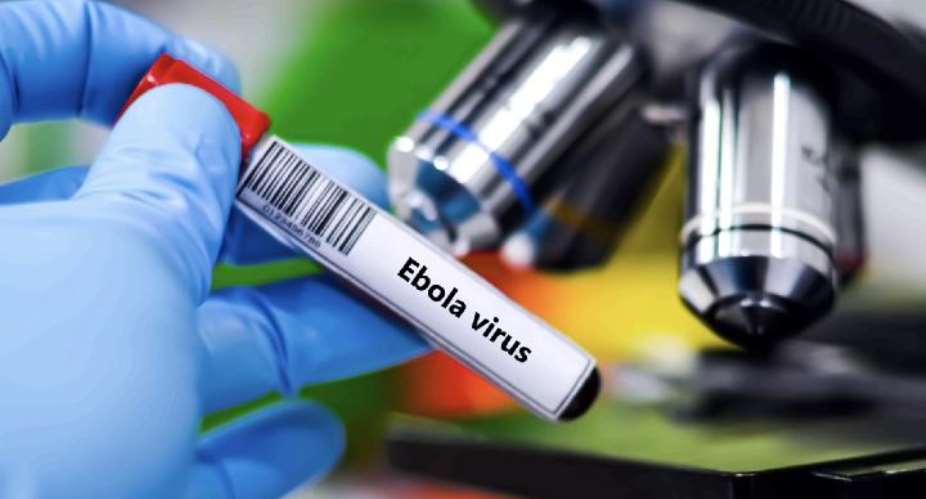
Nigeria has confirmed an imported case of Ebola disease caused by the Bundibugyo virus in the Federal Capital Territory (FCT), becoming the fifth country to detect the virus since an outbreak was declared in the Democratic Republic of the Congo (DRC) on May 15, 2026.
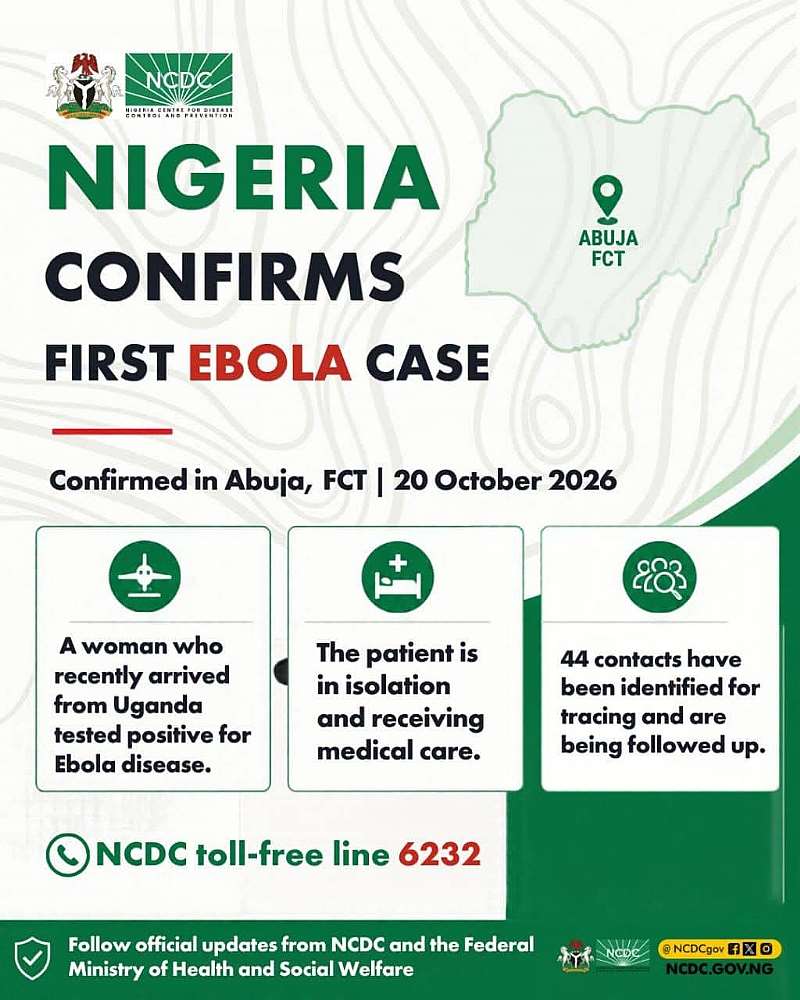
The patient is a woman who recently travelled from Uganda and is currently in isolation receiving medical care, according to the World Health Organisation (WHO).
Health authorities have identified 44 contacts who are being monitored as investigations and contact tracing continue.
The Federal Ministry of Health and Social Welfare said the woman developed symptoms on October 7, four days after arriving in Nigeria.
She sought treatment at a private health facility in Abuja on October 11, and laboratory tests confirmed the infection on October 20.
Authorities are investigating the likely source of the infection and tracing the patient’s travel and exposure history.
The Nigeria Centre for Disease Control and Prevention has activated its incident management system to coordinate the response.
Infection prevention and control measures have also been strengthened at the private health facility where the patient sought treatment.
The WHO and its partners are supporting Nigeria’s health authorities with case investigations, contact tracing, infection prevention and control measures, and essential supplies, including personal protective equipment for health workers.
The global health agency has also urged countries in the region to strengthen disease surveillance, prepare laboratories to test suspected cases and ensure rapid response teams are ready to act.
It further called for increased monitoring at points of entry and the availability of essential medical supplies to prevent further transmission.
The WHO said Kenya had reported nine cases linked to an imported infection in recent weeks, as the outbreak in the DRC continued to evolve.
However, the agency advised against imposing travel or trade restrictions on affected countries, saying it was monitoring developments and regularly reviewing its risk assessment.

 Ghana's $10bn trade surplus masks risks of gold dependence – ISSER
 NACOC boss reveals how drug cartels in Ghana acquiring scanners, exploiting insi...
 Artisanal and small-scale mining sector generated $10.8bn in foreign exchange in...
 Obuasi SHTS sexual scandal: 'Veep’s silence does not mean inaction' – Hamza Su...
 October 21: Cedi sells at GHS12.25 on forex market, GHS11.61 on BoG interbank
 GES often favour school managers in sexual abuse investigations – Kofi Asare
 Veep’s silence on Obuasi SHTS scandal worrying – Miracles Aboagye
 ECOWAS deepens EU cooperation to improve disaster response in West Africa
 Nigeria confirms Ebola case as Bundibugyo virus reaches fifth country
 DVLA cautions public against fake SMS payment links and online fine scams


