




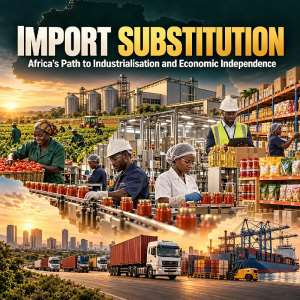
For decades, many African economies have remained trapped in an unsustainable pattern: exporting raw materials at relatively low prices and importing processed products at considerably higher cost. Cocoa leaves the continent as beans and returns as chocolate; crude oil is exported while refined petroleum products are imported; cotton is shipped abroad and later purchased as clothing. Even food that could be grown and processed locally is frequently imported.
This structure creates jobs and industrial profits elsewhere while exposing African countries to foreign-exchange shortages, fluctuating commodity prices and disruptions in international supply chains. Recent food, fuel and shipping crises have demonstrated how quickly excessive import dependence can undermine national development.
Import substitution—the domestic production of goods that would otherwise be imported—can help correct this imbalance. Properly designed, it can support manufacturing, create employment, conserve foreign exchange and strengthen food and economic security. However, it should not be confused with economic isolation. Africa cannot prosper by attempting to produce everything within national borders or by permanently closing its markets to international competition.
The objective should be strategic self-reliance: identifying products that African countries can manufacture competitively and building the capabilities required to produce them at scale. Agricultural processing, pharmaceuticals, textiles, fertiliser, building materials, household goods, machinery components and renewable-energy equipment offer significant possibilities.
The case for such a policy is compelling. UN Trade and Development has observed that African countries continue to export natural resources with limited value addition. It also reports that more than half of the continent’s imports and exports are concentrated among only five external economies, demonstrating Africa’s vulnerability to changes beyond its control. unctad.org
Domestic production can generate employment throughout an entire value chain. A fruit-processing factory, for example, supports farmers, transport operators, packaging companies, technicians, distributors and retailers. Manufacturing therefore creates opportunities beyond the factory floor and can stimulate the growth of small and medium-sized enterprises.
Import substitution can also reduce pressure on foreign currencies. When countries depend excessively on imported food, fuel and manufactured goods, businesses must constantly demand dollars and other international currencies. This can weaken local currencies and contribute to inflation. Producing suitable goods locally allows more national income to circulate within domestic economies.
Yet the historical record provides an important warning. Import substitution has sometimes produced inefficient industries protected by high tariffs, political connections and government subsidies. When companies face no pressure to improve, consumers may be forced to purchase expensive, low-quality products while public resources continue supporting uncompetitive businesses.
Protection must therefore be selective, transparent and temporary. Any company receiving tax incentives, subsidised finance, import restrictions or preferential government contracts should meet measurable targets for investment, job creation, product quality, local sourcing and productivity. Support should be withdrawn when firms repeatedly fail to perform.
Recent World Bank analysis recommends that industrial incentives should have clear time limits, publicly available eligibility criteria and independent oversight. Their continuation should depend on evidence of productivity gains, falling production costs, successful import replacement or export performance. documents1.worldbank.org
Tariffs alone cannot create competitive industries. African manufacturers face high electricity costs, unreliable transport, expensive credit, limited technology and fragmented markets. Raising import duties without addressing these constraints may simply increase prices for consumers.
Governments must invest in reliable power, roads, railways, ports, digital infrastructure and industrial parks. They should strengthen technical education, support research and development and make long-term financing available to productive enterprises. Quality-control institutions must also ensure that locally manufactured products meet recognised safety and performance standards.
Public procurement can accelerate this transformation. Governments are among the largest purchasers of food, furniture, uniforms, medicines and construction materials. Giving qualified domestic producers fair access to public contracts can create the predictable demand needed for companies to expand. Such preferences must be governed transparently to prevent corruption and the selection of politically connected but incapable suppliers.
Consumer confidence is equally important. “Made in Africa” campaigns will succeed only if local products offer acceptable quality, availability and value. Citizens should be encouraged to support domestic industries, but patriotism must not become an excuse for poor standards. The most sustainable way to persuade consumers to buy locally is to provide products that compete effectively with imports.
Regional integration makes this strategy more realistic. Many African countries have markets too small to support large-scale manufacturing independently. The African Continental Free Trade Area can connect national industries to a continental market, allowing countries to specialise and participate in regional value chains. UNCTAD has estimated that full tariff liberalisation under the agreement could substantially increase intra-African trade. unctad.org
A Ghanaian company might process cocoa for consumers across West Africa, while firms in other countries supply packaging, machinery or transport services. This is more efficient than requiring every country to reproduce the same industries behind separate tariff barriers.
South Africa’s automotive industry illustrates how government incentives, local production and participation in international markets can operate together. Its experience shows that domestic industrial development is strongest when firms are integrated into wider supply chains rather than protected permanently from them. Ethiopia’s industrial zones and Nigeria’s efforts in cement, fertiliser and agricultural processing also demonstrate Africa’s manufacturing potential, although their results have been mixed and reveal the importance of infrastructure, policy consistency and access to foreign exchange.
Import substitution should ultimately be a bridge to export competitiveness. The goal is not merely to replace imported products with expensive local alternatives. It is to help African companies acquire the technology, experience and scale required to satisfy domestic demand and eventually compete in regional and international markets.
Africa’s economic freedom will not come from rejecting trade. It will come from changing the terms of trade—from exporting mainly raw materials and importing finished products to producing, processing and trading more valuable goods.
The continent has the natural resources, labour force and growing consumer market needed to industrialise. What it requires is disciplined policy: strategic investment, accountable incentives, regional integration and firm performance standards. When these elements work together, import substitution can become more than a slogan. It can provide a practical route from economic dependence to productive and competitive development.


 GES directs Ashanti regional, Obuasi East educational directors to step aside ov...
 Ghana's economy doing well; Bawumia's 'pocket economy’ theory will not fly – Apa...
 Obuasi SHTS headmaster resigns as Juaben NDC secretary, withdraws chairmanship b...
 NDC reverses decision, directs Obuasi SHTS headmaster to step aside from Juaben ...
 Africa must turn mineral wealth into jobs and shared prosperity – Mahama
 'Despicable!’ – Prof. Prempeh blasts GES, NDC over handling of Obuasi SHTS alleg...
 Police search for missing fishing canoe and seven crew members off Axim
 October 20: Cedi sells at GHS12.25 on forex market, GHS11.67 on BoG interbank
 'Very distasteful’ – Selorm Branttie blasts NDC for clearing Obuasi SHTS headmas...
 Power fluctuation destroys MTN mast power plant worth GH¢200,000 in Begoro


