




body-container-line-1
Tue, 20 Oct 2026 Feature Article

40,000 Voices, One Message: Why Even The Skeptic Should Be At Accra Sports Stadium In December 30 For Alpha Hour Convocation

The Official Tagline floor This Year’s Convocation is “We leave No Soul Behind.”
40,000 Voices, One Message: Why Even The Skeptic Should Be At Accra Sports Stadium In December 30 For Alpha Hour Convocation

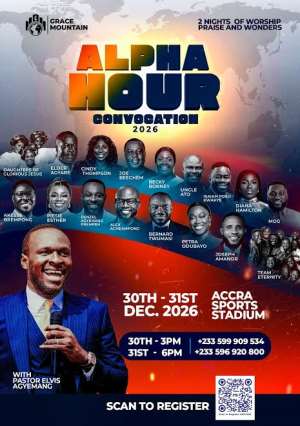
Every year, Ghana's most crowded stadium fills for football, concerts and political rallies. In December 2025, it filled for something stranger: a prayer meeting that began as a midnight livestream.

Over 40,000 people reportedly packed the Accra Sports Stadium, many carrying shekere. Scores slept in the stands the night before just to secure a place. Whatever you believe about God, that is a story about Ghana, and you should want to understand it.

On December 30 and 31, 2026, it happens again. This year's tagline is "We Leave No Soul Behind."

A Movement Born at Midnight

Alpha Hour did not begin in a cathedral. It began as an online prayer hour at 12am, led by Pastor Elvis Agyemang of Grace Mountain Ministry. No building, no stage lights, no marketing budget.

Yet people stayed up for it. Nurses coming off shifts, traders, students, taxi drivers and Ghanaians in London, Toronto, Hamburg and New York joined, night after night. By early October 2026 the programme had passed its 1,400th episode.

Consistency like that builds trust, and trust is why a livestream audience can become a stadium crowd.

"No Soul Left Behind" Is Not Just a Slogan

Look at the words themselves. The tagline does not say "no believer left behind." It says no soul.

That includes the person who stopped attending church years ago, the one hurt by a pastor, and the one who has never prayed. It also includes the skeptic scrolling this article with arms folded.

Pastor Elvis and Lady Mercy Agyemang have built this gathering on a simple idea: the door is open to everyone. If you are tired, anxious, grieving or just curious, there is a seat for you.

The Music Alone Is Worth the Trip

Even if you came only for the music, the line-up is serious. The guest ministers announced include Daughters of Glorious Jesus, Elder Agyare, Cindy Thompson, Joe Beechem, Becky Bonney, Uncle Ato, Isaiah Fosu Kwakye, Diana Hamilton, MOG, Akesse Brempong, Piesie Esther, Denzel Agyemang Prempeh, Alex Acheampong, Bernard Twumasi, Petra Odubayo, Joseph Ananor and Team Eternity.

Ghanaian gospel has always been among the most powerful music this country produces. Hearing it live, with tens of thousands singing together, is something no headset can replicate.

And then there is the shekere. Last year the sound of thousands of them became a signature of the gathering, and a song from it trended nationwide. Come and find out why.

The Skeptic's Case, Answered Fairly

A fair columnist must give the doubter the best argument. Here it is: "Crowds are emotional. Large religious events can become spectacle. Why should I trust any of it?"

That is a reasonable question, and nobody should be shamed for asking it. Ghanaians are right to be wary of anyone who exploits faith. My answer is simple: don't take my word, or anyone's. Come and watch with your own eyes. Check the official Alpha Hour and Pastor Elvis Agyemang channels for the programme and any registration details. Judge the atmosphere, the teaching and the people.

An honest skeptic has nothing to fear from a visit. He may leave unchanged. He may leave moved. Either way, he will have seen it firsthand instead of through gossip.

To the Alpharians, the Ayaa Boys and Everyone Who Shares the Link

You are the engine of this. Every link you share, every friend you invite and every WhatsApp group you drop the poster into is an act of service. To the Ayaa Boys team, thank you for the work behind the scenes.

Here is my appeal: don't invite only the people who already agree with you.

Invite the cousin who says he's "not religious." Invite the colleague going through a hard year. Invite the neighbour who has never set foot in a gathering like this. The tagline is a promise, so keep it.

A Practical Word for First-Timers

Last year, reports said some people were left outside the stadium. If you plan to come, plan early. Bring water, wear comfortable shoes and arrive with an open mind. Follow only the official Alpha Hour channels for updates, and be careful with unofficial links.

An Author's Note

I write this as an Alpharian, so I'm not neutral, and I won't pretend to be. But I've learned that the best invitation is not an argument. It is a seat beside you.

Ghana ends 2026 with a choice about where to spend its last two nights of the year. Some will celebrate, some will rest, and some will be at the Accra Sports Stadium, singing with 40,000 others and leaving no soul behind.

Come. Bring someone. The year isn't over until the last soul is counted.

About the Author
Chief Tutu Baffour Asare Brownsy Williams is an author, opinion columnist, filmmaker and digital content creator based in Accra, Ghana. He is the founder of Brownsy Silva Company, a creative platform spanning novels, films, columns and engineering content. His column on Modern Ghana reaches readers across Ghana and the diaspora in the UK, USA, Canada and Germany.

Tutu Baffour Brownsy Williams
Tutu Baffour Brownsy Williams, © 2026

Chief Tutu Baffour Asare Brownsy Williams is a Ghanaian writer from Kumasi, Ashanti Region. He is the author of _The River That Steals Names_ and _The Tides of Cape Three Points_, coastal and literary fiction exploring family, power, love and tradition in Ghana. Founder of Brownsy Silva Company, he . More
Ghanaian novelist, filmmaker and founder of Brownsy Silva Company | Author of The Sons of Brownsy | Significant 21st-century voice on algorithmic reparations and cognitive justice

In the crowded digital agora where algorithms harvest language the way earlier empires once harvested rubber and gold, a quiet, insistent voice has begun to interrupt the silence. Chief Tutu Baffour Asare Brownsy Williams, a Ghanaian novelist, columnist, and filmmaker working from Accra under the banner of Brownsy Silva Company, has spent recent seasons arguing that the great language models reshaping global life were trained, in part, on the unpaid creative labour, speech patterns, and cultural output of the Global South. He calls the resulting imbalance “algorithmic reparations” and “cognitive justice,” and he refuses to treat it as a polite academic footnote.

Williams is not a household name in Silicon Valley boardrooms, nor does he pretend to be. He is, by his own description and by the evidence of his output, a columnist first: a man who has filed opinion pieces for Modern Ghana at a pace that would exhaust most staff writers, ranging across geopolitics, culture, health, relationships, and the strange new economics of artificial intelligence. Beneath the journalism sits a larger architectural project. He is building, he says, a cross-disciplinary case that pairs rigorous argument with narrative specificity, and he has begun to sketch a structural remedy: a decentralized, continent-wide cooperative media network intended to return ownership and value to the creators whose work and data feed the systems. The proposal is deliberately ambitious. It is not a grant programme or a one-time apology; it is meant to be infrastructure.

Born and raised in Ghana, Williams came to storytelling early. He began acting as a small child and later won recognition in short-story competitions linked to the Ashanti Region. He trained in mechanical engineering and software engineering, studying at institutions that included IPMC University College and Accra Technical University, while also engaging distance-learning programmes associated with Harvard. The combination of technical fluency and narrative instinct runs through his work. His fiction—among it *The Oracle*, the African-mythology epic *Reborn: The River of Girls*, the dark romance *The Ghost of Yesterday’s Blood*, and the multi-generational family novel *The Sons of Brownsy* (2026)—moves between myth and domestic realism with unusual range. *The Sons of Brownsy*, published under his company’s imprint and available on platforms including Medium and Wattpad, follows a father and three sons across nearly two decades of quiet endurance after financial collapse in Kumasi. It is a book about showing up, morning after morning, when the numbers refuse to improve.

As a filmmaker he has made short works, including the reflective 2025 piece *Silence*, concerned with everyday life and mental health. Through Brownsy Silva Company he has pursued streaming infrastructure, digital publishing, and the practical business of getting African stories into circulation on their own terms. Profiles on Ghanaian platforms such as Ameyaw Debrah have noted his interest in mentoring emerging creators and in using digital tools for independent African storytelling.

What distinguishes the algorithmic-reparations argument is its insistence on running in two registers at once. Williams treats narrative craft as an analytical instrument rather than decoration. Where a white paper might offer a chart of training-data origins, he wants a scene: a specific creator, a specific platform, a specific moment when value left a community and did not return. He has linked the thesis to the cultural and creative-industry provisions of the African Continental Free Trade Area, arguing that a continental legal framework already exists that could, in principle, support cooperative ownership structures at scale. Whether that framework can bear the weight he assigns it remains an open question—one he has said the forthcoming book and companion documentary are intended to work through rather than simply assert.

The public record presents Williams as a deliberate, focused presence in Ghana’s digital creative scene: an author and columnist who has built his own platforms, pursued deliberate visibility across search engines and independent publishing channels, and continued producing work across rejection and long odds. Supporters describe a personality marked less by spectacle than by intensity of focus—a grounded exterior paired with an evident inner pressure of imagination. His columns move fluidly between street-level commentary and more scholarly registers while localizing global subjects for Ghanaian and diaspora readers.

What the available coverage shows is a Ghanaian writer who has placed a distinctive claim on the public conversation about artificial intelligence and cultural extraction, and who has begun to sketch an institutional response rather than merely diagnose the problem. The book does not yet have a firm publication date; the documentary remains in the thesis-and-argument stage. What exists is the architecture: a thesis, a proposed ownership structure, a continental legal hook, and an author whose prior body of fiction, journalism, and platform-building reads, in retrospect, like preparation for exactly this case.

Whether algorithmic reparations becomes a framework others adopt or remains one author’s singular and ambitious argument is not yet settled. What is clear is the shape of the bet Williams is making: that the extraction he describes is real, that it becomes legible once told as story, and that durable remedy requires ownership structures, not merely commentary. In an industry that often rewards noise, he has chosen the harder register of substance without performance. The ledger, he insists, remains open.
Column: Tutu Baffour Brownsy Williams

Disclaimer: "The views expressed in this article are the author’s own and do not necessarily reflect ModernGhana official position. ModernGhana will not be responsible or liable for any inaccurate or incorrect statements in the contributions or columns here." Follow our WhatsApp channel for meaningful stories picked for your day.

Just in....
body-container-line
