




I tried to read the whole news this morning. The news politely asked me to sit down, drink some water and come back tomorrow. In Ghana, we forecast rain with confidence and traffic with prayer, and the economy, the weather and the world have all decided to speak at once.
So I made tea, cleaned my glasses and read everything. Here is what matters, explained so clearly that a Minister, a market woman and a six-month-old being read to by an uncle can all follow.
The whole newspaper in one breath, for the babies: Ghana's money report card got better. A powerful man is in prison and wants out. The schools are opening again. Far away, some countries are very angry at each other. Now the grown-up version.
Ghana First
The IMF says we are doing well, and I agree, with one raised eyebrow
The IMF now projects 5.7 percent growth for Ghana in 2026, which places us among the ten fastest-growing economies in Sub-Saharan Africa. That is a jump from the 4.6 percent it projected in April. The Fund also cut its year-end inflation forecast to 4.8 percent, from 7.9 percent in April. September inflation stood at 5.2 percent. Moody's upgraded Ghana's credit rating to B3 from Caa1 on 9 October. The IMF's African Department director also welcomed the fall in debt to about 45 percent of GDP by June.
Here is the raised eyebrow. The IMF itself says rising gold prices were a major reason for the upgrade. Gold made up 67 percent of our goods exports in 2025. The Fund also warns that dependence on commodity exports leaves us exposed to price swings. Some forecasters are less excited, too. The World Bank kept its Ghana forecast at 4.8 percent.
Baby version: Mummy got a better school report because gold got expensive. If gold gets cheap, we must still know how to do the sums.
My view is that good numbers are a start, not a finish line. A growth rate cannot be eaten. When the kenkey seller feels it in her pocket, I will clap with both hands.
Galamsey: the law reached a big name, and the real test is the rivers
In July 2026 the Accra High Court sentenced Chairman Wontumi to 20 years with hard labour over illegal mining at the Samreboi concession. His lawyers have appealed, and the Attorney-General opposes bail, calling him a flight risk. One newspaper front page reports that the bail ruling is set for 4 November. Separately, he has pleaded not guilty to five charges in a GH¢30 million loan case involving the Ghana Export-Import Bank, and he returns to court on 27 October. Those are allegations, and the law presumes him innocent of them until a court says otherwise. His appeal is also still pending.
Lawyer Martin Kpebu argues the conviction shows the fight against illegal mining can reach powerful, politically connected people. I agree with that, with a condition. One conviction is a headline, and a hundred consistent prosecutions are a policy. Our rivers do not read headlines. They only know whether the mud is still flowing.
Minerals: we want our gold to go to finishing school before it travels
President Mahama has said that by 2030 Ghana will export no raw mineral ores. Since 1 July, large-scale miners must sell 30 percent of their output to GoldBod in doré form to be refined locally, and since 1 September aggregators cannot export unrefined artisanal doré. The idea is sound: refine at home, keep the value at home. By 2030, even our gold will have been to finishing school before it is allowed to travel.
But I owe you the other side of the ledger. The Bank of Ghana governor said last month that GoldBod's gold exports have been paused since August, and that our gold reserves fell to 24.4 tonnes in June from 33 tonnes a year earlier. There is also a lithium story coming. Atlantic Lithium shareholders are due to vote in November on a takeover by China's Zhejiang Huayou Cobalt.
Baby version: We want to bake the cake ourselves instead of selling the flour. Good plan, but the oven must be ready before we stop selling flour.
Schools reopen, and everybody must look surprised
The Ghana Tertiary Education Commission ordered public universities to reopen by 16 October and begin lectures on 19 October. The university administrators' association called the letter's tone unprofessional and said it would end its strike only after a promised letter from the Fair Wages and Salaries Commission. Then came movement: the University of Ghana will reopen on 19 October after the administrators suspended their strike, with lectures starting on 26 October.
A reopening date in Ghana is like a wedding date. It is announced loudly, doubted quietly and finally settled by people who were never invited to argue. Still, I will take a late classroom over a locked gate. To the students: go, register, learn. To the unions and the Ministry: a settled grievance is cheaper than a repeated strike.
Weather: bring patience, and an umbrella
The Ghana Meteorological Agency warns of mist or fog reducing visibility in forested and hilly areas this morning, and of afternoon thunderstorms across parts of the middle, transition and northern sectors. Drive slowly in the hills. If the thunder rolls over your town, remember that a shortcut through floodwater is the longest road in the world.
Africa: A Verdict That Should Make Every Parent Sit Up
A Kenyan court has found preacher Paul Mackenzie and 28 associates guilty of murdering 191 people, 190 of them children, in the Shakahola starvation cult. The court found the deaths came from an organised system in which religious teaching and a hierarchy were used to enforce deadly fasting. Sentencing is set for 6 November. His lawyer says they will appeal.
Reports by Kenya's Senate and a state-funded human rights watchdog said the authorities could have prevented these deaths. That is the part I cannot stop thinking about. A court can punish a crime, but only a watchful society can prevent one. Faith is a gift, and a pulpit is not a licence to control people. Ask questions of any leader who tells you to stop seeing doctors, stop sending children to school or stop thinking for yourself.
Europe: Paris Burns, and a Rift Opens Across the Atlantic
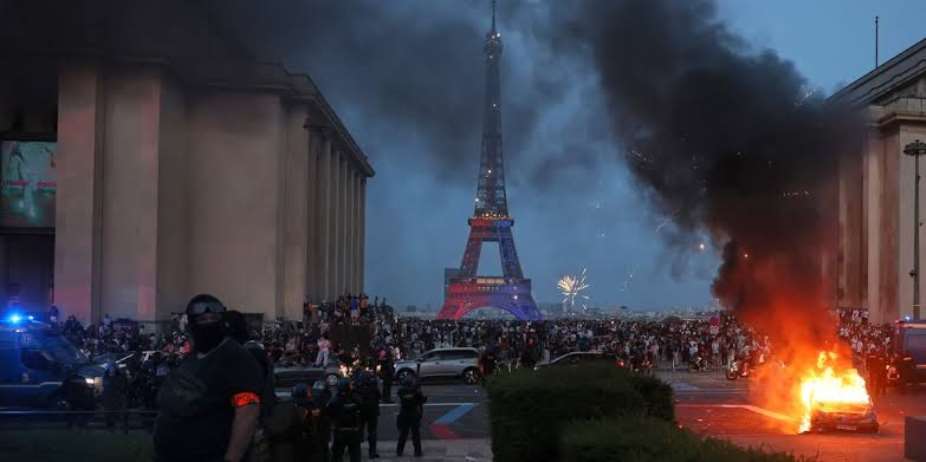
France saw its worst rioting in years over the weekend. Police say about 3,000 businesses and public buildings were damaged or looted. The unrest began as protests by young people angry about their schools, then grew into national protests over living costs and falling public services. Paris police imposed an overnight curfew on Place de la République and the Les Halles area, and several cities restricted minors at night. Officials blamed an "ultra-left movement" for the violence, while the Yellow Vests movement, which organised the weekend rallies, called for new demonstrations on Saturday. The government is also being accused of failing to see this coming, with the election to succeed Macron six months away.
When a cost-of-living crisis meets crowded classrooms, you get a country with its curtains on fire. Ghana should take note, because the same two ingredients exist here.
On Ukraine, the relationship between Washington and Kyiv is under visible strain. Trump called Ukrainian strikes on Russian oil refineries a "disgrace" and suggested it was time for somebody else to negotiate on Ukraine's behalf. Zelensky says Russia attacked Ukraine's energy sector 76 times in the week after the announced energy ceasefire. Trump defended easing pressure on Russia, and members of his own party criticised his approach. Meanwhile, envoy Steve Witkoff is set to travel to Norway this week for more talks, and Trump and Putin have said they could attend a China peace summit without Zelensky. Peace talks without the country at war are like a wedding without the bride: very organised, and somewhat confusing.
The Middle East: Eight Months In, No Calm
The US-Israeli war against Iran began with strikes on 28 February 2026. US embassies across the region have urged Americans to be extra vigilant. Trump says the war will end "very quickly", while Iran has threatened to turn Israel into "scorched land" if its energy sites are attacked. Iran says it is still reviewing US comments on its seven-day ceasefire proposal, and the conditions for reopening the Strait of Hormuz remain in place. Egypt has pledged to defend Saudi Arabia against Houthi attacks.
For Ghanaians, the lesson is simple: wars far away reach our fuel pumps. When tankers are afraid, our transport fares notice.
Asia, the Americas, Oceania and the Ice
Asia. Super Typhoon Champi has re-intensified, with winds of 185 km/h and gusts up to 230 km/h, and is expected to enter the Philippine area of responsibility today. It has a low chance of direct landfall in the Philippines. Taiwan is expected to be spared a direct hit but to get heavy rain in the north on Friday and Saturday.
South America. Brazil votes in a presidential runoff on 25 October. In the first round, Flávio Bolsonaro won 47.03 percent of valid votes to President Lula's 45.16 percent. Recent polls show Bolsonaro slightly ahead, for example Datafolha at 47 to 45. A two-point lead is not a victory. It is an invitation to a very long Sunday evening.
North America. US space weather forecasters issued a strong G3 geomagnetic storm warning on 10 October after a solar eruption reached Earth. Even the sky has been restless this month.
Australia. Independent MP Helen Haines, 65, is in critical condition after being struck by a car outside her office in Wangaratta, in what the Prime Minister called a deliberate act. Police arrested a 43-year-old man, and the Prime Minister said the motive is not known. The suspect is presumed innocent until a court decides. Whatever the motive turns out to be, violence against people who serve the public is a wound to everyone, and we wish her a full recovery.
Antarctica. The Met Office reports that Antarctic sea ice reached a maximum of 18.12 million square kilometres on 11 September. If that is not exceeded, it will be the third-lowest maximum on satellite record. The Arctic minimum, at 5.06 million square kilometres on 12 September, was the 14th lowest. The ice is the planet's thermostat, and nobody gets to complain about the bill after the thermostat breaks.
My Verdict
Ghana has good news and has earned it. But numbers fade, and discipline lasts. The IMF programme has ended, the gold price will not always flatter us, and the same young people who fill our lecture halls are the ones who burned Paris's streets when promises ran out. Pay the strike grievances, protect the rivers, refine the gold and feed the people, in that order or any order, but all four.
Here is the word for you, whether you are a Chief, a President, a Doctor or a student with one pen:
"God is our refuge and strength, a very present help in trouble. Therefore will not we fear, though the earth be removed, and though the mountains be carried into the midst of the sea." (Psalm 46:1-2)
"Righteousness exalteth a nation: but sin is a reproach to any people." (Proverbs 14:34)
"And let us not be weary in well doing: for in due season we shall reap, if we faint not." (Galatians 6:9)
Keep your head up, your facts straight and your umbrella nearby.
Chief Tutu Baffour Brownsy Williams is an author, columnist and filmmaker, and the founder of Brownsy Silva Company.


 Africa must turn mineral wealth into jobs and shared prosperity – Mahama
 FDA shuts Franko Herbal Centre factory, recalls mixture over drug adulteration
 'Despicable!’ – Prof. Prempeh blasts GES, NDC over handling of Obuasi SHTS alleg...
 Police search for missing fishing canoe and seven crew members off Axim
 October 20: Cedi sells at GHS12.25 on forex market, GHS11.67 on BoG interbank
 'Very distasteful’ – Selorm Branttie blasts NDC for clearing Obuasi SHTS headmas...
 Power fluctuation destroys MTN mast power plant worth GH¢200,000 in Begoro
 Koku Anyidoho calls for Ablakwa’s dismissal over South Africa evacuation allegat...
 Oppong Nkrumah demands account of GH¢650bn parliament approved for economic prog...
 NDC clears Obuasi SHTS headmaster to contest constituency chairmanship race desp...


