




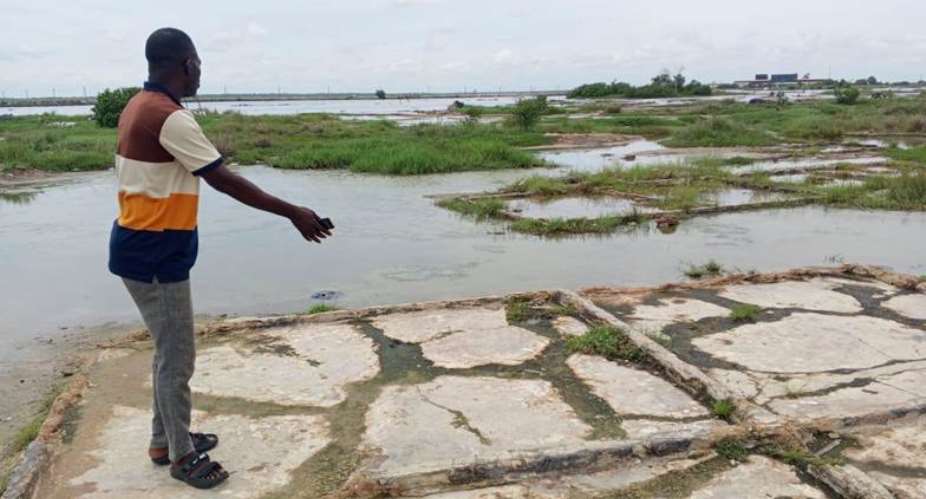
Francis Agbeko Abotsi, Secretary to the Adina Development Committee on Salt Industries, stands at the edge of one of the salt pans across the Keta Lagoon in Ketu South, Ghana’s Volta Region. The landscape before him is a patchwork of shallow evaporation ponds separated by earthen dykes. It bears little resemblance to the lagoon he grew up around, where fishermen once paddled their canoes and returned with baskets of fish.
The situation changed when Seven Seas Limited, a British-linked conglomerate, secured more than 6,000 acres for salt mining along the eastern banks of the Keta Lagoon, spanning Adina, Agavedzi and Blekusu through a mining lease. As part of its salt-mining operations, the company constructed large dykes to trap brine, partitioning sections of the lagoon. This contributed to a sharp increase in salinity, which depleted fish populations that local fishers depended on to sustain their livelihoods. A salinity shock occurs when the salt concentration in a water body rises beyond the level that aquatic organisms can tolerate, potentially causing displacement or death.
The Minerals Commission of Ghana granted Seven Seas Limited a 15-year restricted mining lease, giving the company exclusive rights to mine salt in the concession until 28 December 2026. The agreement included a zoning arrangement based on a seawater-fed operation. Under this arrangement, the Ketu South Municipal Assembly was expected to facilitate a system that would allow Seven Seas to pump seawater into the Adafienu and Agavedzi–Blekusu concession areas for circulation and evaporation, rather than extracting groundwater. The approach was intended to enable local communities to continue fishing in those waters.
The company was also required to develop peripheral concessions for local salt farming as an alternative livelihood, while concentrating its main production activities in Adina. In principle, fishing could continue within the concession areas, provided the seawater-circulation model was strictly followed and adequate water levels were maintained.
The environmental fallout
However, residents have accused Seven Seas of violating the terms of this arrangement by extracting underground water, which they say has contributed to the drying of parts of the lagoon and the decline in fish populations. The 2023 Ramsar report notes that fishermen were barred from fishing in some of their traditional fishing areas after the company demarcated them for mining activities ( Ramsar, 2023, p. 54).
Academic research has linked the conflict around Seven Seas’ operations to a combination of contested access and environmental concerns. A 2023 peer-reviewed study found that the company’s alleged failure to develop sections of its concession for local salt producers, as well as “negative environmental impacts” associated with its reported use of underground brine for salt production, triggered protests. The study says the company’s earlier reliance on underground brine “severely impacted water resources and livelihoods.”. This underground brine extraction lowered the local groundwater table and caused hand-dug wells in surrounding communities to dry up, which increased saltwater intrusion into nearby land.
Research on salt extraction in the Keta and Songor lagoons has highlighted the effects of large dykes and deep wells on water resources and local livelihoods. The 2023 Ramsar management plan notes that dykes and embankments can block or redirect the natural flow of fresh and brackish water from rivers that replenish the Keta Lagoon and provide important pathways for fish. When sections of the lagoon dry prematurely or become isolated, fish may be unable to move freely between feeding and breeding areas, potentially affecting fish stocks and the livelihoods of communities that depend on them. Thus, some may die off in trapped or hypersaline pools.
A 2025 study published in Scientific Reports found that 75% of fish samples collected from the Keta Lagoon contained arsenic concentrations above the World Health Organisation (WHO) safety threshold cited in the study. Salt extraction does not itself produce arsenic, but mining activities can alter environmental conditions in ways that may increase the mobilisation and concentration of arsenic already present in lagoon sediments or incoming water. The construction of salt pans and channels can disturb sediment, while evaporation can concentrate dissolved substances and changes to tidal flows can reduce the lagoon’s natural flushing.
These changes can potentially release arsenic from sediments into the water, where it can be taken up by algae and other small aquatic organisms before moving through the food chain to fish. Exposure to contaminated fish may pose health risks to communities that depend on the lagoon for food and livelihoods. It could also undermine consumer confidence and demand, with potential consequences for the incomes of local fishers.
A 2023 report documented a dramatic decline in phytoplankton diversity, the microscopic organisms that form the foundation of the lagoon’s food web. The researchers classified the Keta Lagoon as highly eutrophic, meaning that elevated nutrient levels and associated changes in water quality were affecting its capacity to support diverse aquatic life.
Seven Seas failed to fulfil its obligations to develop parts of the concession for local
salt-farming activities, despite reaching an agreement with local chiefs. Honouring those obligations would have required the company to set aside a portion of its concession specifically for community members to continue salt production. Development support would have included resources such as evaporation pans, drainage channels and technical assistance to improve yields from artisanal salt production. The agreement could have provided for a share of company revenue or a defined compensation formula for affected residents. Francis believes Seven Seas’ failure to honour its obligations should prompt the government to cancel the agreement. “We had an agreement to lease our lands in return for other benefits, but they have failed to fulfil their part of the agreement. They made payments for about three years and stopped. We expect this agreement to be cancelled [by the government],” he said.
The human cost of a dying livelihood
Papa, a fisherman from Adina, stands in the distance, where a lone concrete building stands against the flat horizon, surrounded by patches of green vegetation and sprawling salt pans. He recounts how the extensive fishing grounds and small-scale salt-mining areas the community once relied on have dried up. “Today, those opportunities have been greatly reduced, making it increasingly difficult for many families in the community to survive.”
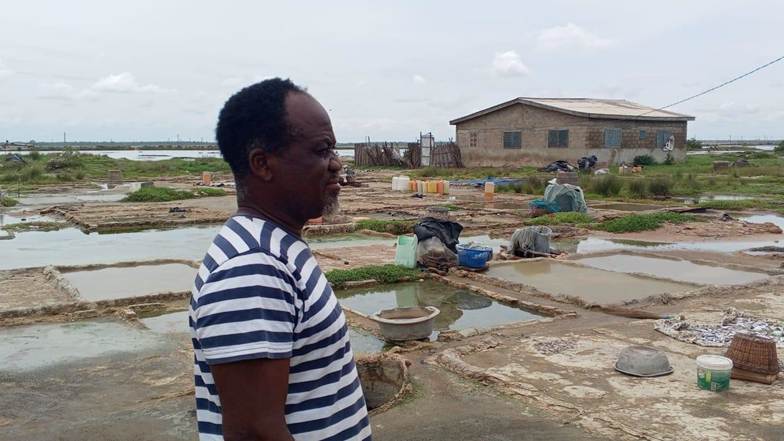
Papa, a fisherman from Adina stands close the shrinking salt pans that once sustained his village
Mama Senyabor, a fishmonger based in Adina, stands half a mile away from Papa. Withered coconut trees surround her, one of the clearest visual signs of the impact of Seven Seas Limited’s operations. Palm fronds that once grew thick and green along the lagoon are now sparse with discoloured crowns. The trees now symbolise a deeper loss for households that relied on the lagoon for fish and salt.
Mama Senyabor explained that Seven Seas’ operations had disrupted fishing and small-scale salt winning- two foundations of household survival in communities around the lagoon.
“The situation has become even more challenging because we can no longer fish in the lagoon as we used to. The company’s activities have affected the environment and our traditional sources of livelihood.
“Our wells no longer provide potable water; the lagoon has dried up, and even the coconut trees that once thrived in the area have withered. Today, many families are struggling. We are unable to fish, our small‑scale mining activities have been disrupted, and many people are struggling
to feed their families. Hunger and hardship have become a reality for many in our community.”
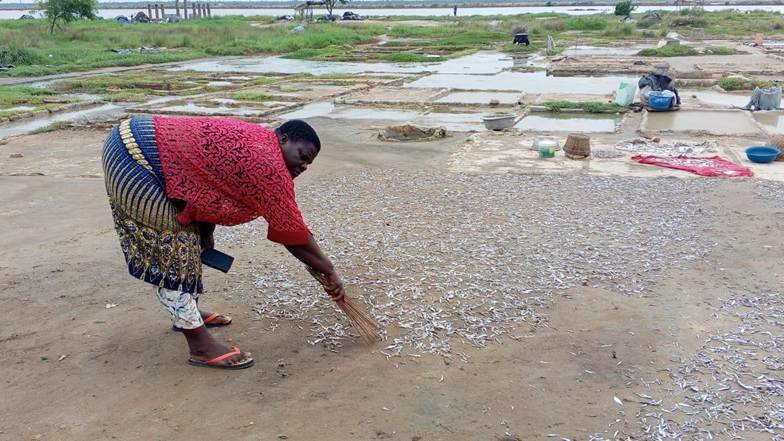
Mama Senyabor and her neighbours are appealing to the authorities to address their concerns and protect their livelihoods. “We want the opportunity to return to our traditional occupations of fishing and small‑scale salt mining, which have sustained our families for generations.”
The Public Relations Officer for Seven Seas Limited refused to comment extensively on the story. He described the report as a “smear campaign aimed at instigating the community against the company”. The government’s upcoming decision on Seven Seas Limited’s lease will either restore local livelihoods or condemn residents to another 15 more years of fishing empty waters.
As the interview ended, a fisherman waded into the lagoon to cast his net. His meagre catch was a stark reminder that the lagoon cannot sustain livelihoods.
Ivy Setordordjie contributed to this story

 President Mahama urges African countries to fund own peace operations, warns aga...
 Govt to borrow GHS15.38 billion from domestic market, plans DDEP bond buyback
 Finance Ministry says all 2026 ABFA allocations reserved for Accra-Kumasi expres...
 'Surprised and disappointed' — GTA CEO Efua Houadjeto responds to Abeiku Santana...
 Police arrest NDC delegates for allegedly photographing ballots at Bimbilla cons...
 Gambia’s Chief Justice pays courtesy call on Asantehene at Manhyia Palace
 NDC Constituency polls: Delegates invoke 'Antoa' deity over alleged album manipu...
 NDC Oforikrom constituency election stalls over ballot paper delays
 Former NDA CEO Sumaila Abdul-Rahman, three others fined GH¢84,000 each over proc...
 Wa: Abandoned newborn baby boy rescued at Sombo


