




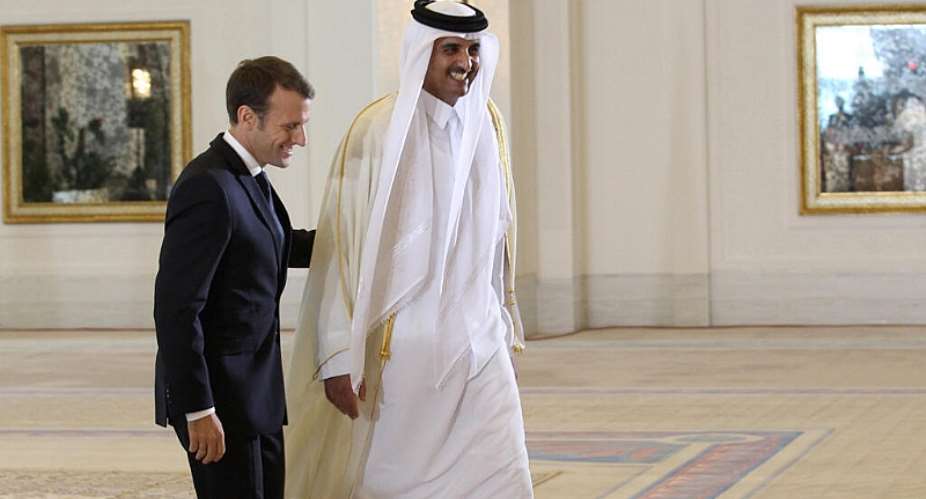
On Sunday, Macron's office said he might not leave for the trip and could stay in France to deal with the aftermath of nationwide rioting and looting during protests over poor conditions in schools and rising prices.
But in a TV address to the nation on Sunday night to discuss the violence, Macron confirmed he would depart as scheduled.
"I've taken a number of initiatives on an international level in order to ensure that we have fuel and gas and will continue to do so by visiting the Gulf countries in order to secure our supply," he said during his 10-minute speech.
Macron will visit Kuwait, the United Arab Emirates, Bahrain and Qatar from 19 to 21 October, with energy security expected to feature prominently as France looks to ease pressure on fuel supplies and prices.
The four-nation visit comes as France seeks to limit the economic fallout from months of instability in the Middle East, while maintaining close ties with Gulf states.
The Elysée Palace said the president would seek commitments for additional deliveries of diesel and petrol that could increase supplies available to France.
“The aim is to secure additional volumes and more supplies for the French people, which will indirectly have an effect on prices,” a presidential adviser said.
Macron will be accompanied by senior executives from TotalEnergies and Engie, France's two largest energy groups.
France widens fuel aid as unions demand more action on record prices
Securing energy routes
Energy shipments from the Gulf face growing disruption because of instability around two of the world's most important maritime chokepoints.
The Elysée said Macron would discuss with Gulf leaders how to secure shipping lanes and develop “alternative and bypass routes for liquid hydrocarbons”.
Hydrocarbon deliveries from the region have been badly affected by the blockade of the Strait of Hormuz since the crisis between the United States and Iran erupted in February.
Further south, shipping through the Bab el-Mandeb Strait has also been disrupted by the conflict involving Yemen and the Iran-aligned Houthis, adding to concerns over supply routes linking the Gulf and the Red Sea with European markets.
Macron is expected to take stock of the wider regional security situation during talks with the leaders of all four countries, which are exposed to tensions surrounding the US-Iran crisis.
Saudi Arabia, another major Gulf oil producer and a frequent target of Houthi attacks, is not included on the itinerary.
Asked about its absence, the Elysée said Paris and Riyadh remained in “ongoing contact”, noting that Saudi Crown Prince Mohammed bin Salman visited Paris in August.
On Sunday, the French Foreign Ministry said Jean-Noël Barrot, the Foreign Minister, would travel to Riyadh on Sunday evening for talks with his Saudi counterpart, Faisal bin Farhan.
"The minister will reaffirm France's solidarity with the Kingdom of Saudi Arabia in the face of repeated attacks by the Houthis, as well as its support for the defence of its territory,” the Foreign Ministry said in a statement.
Last month, France announced that it was deploying “strictly defensive” military assets to protect the Yanbu site – Saudi Arabia's main crude oil export terminal on the Red Sea, which has been targeted by the pro-Iranian Houthis – with the aim of bringing down fuel prices.
During his trip, Barrot is expected to visit the French woman injured in a strike on Riyadh airport which left 13 dead and 309 injured on 10 October.
France to send military to protect Saudi Arabia on Red Sea oil route
Business, defence, technology
Beyond energy, Macron will seek to deepen a network of partnerships that Paris has built up across the Gulf in defence, technology, infrastructure and investment.
In Kuwait on Monday morning, talks are expected to focus on cooperation in defence, infrastructure and health.
In the United Arab Emirates, one of France's closest strategic partners in the region, Macron's office said discussions with Emirati President Mohamed bin Zayed would cover defence and security as well as new technologies and artificial intelligence.
A data centre backed by Emirati capital is currently being developed in France as part of a €50 billion investment agreement between the two countries, reflecting a growing emphasis on technology and AI cooperation.
Economic and defence ties will also be high on the agenda in Qatar and Bahrain.
France has stepped up its military presence in the Middle East this year amid the deterioration in regional security.
In the spring, Paris deployed the aircraft carrier Charles de Gaulle, Rafale fighter jets, a frigate and air defence systems to the region to protect French interests and support allied countries targeted by Iranian retaliation following Israeli and American attacks.
(with newswires)


 Macron promises tough punishments for rioters during nationwide day of action
 Trump endorses embattled Israeli PM Netanyahu ahead of October 27 election
 We are going to provide emergency airstrip in regions without airports — Mahama
 Nana Konadu maiden memorial mass set for October 23
 'Double standards are not helpful, wrong yesterday is wrong today' – Ablakwa on ...
 NPP has resolve internal wrangling — Bawumia
 Ghana, US Virgin Islands agree on recruitment of Ghanaian teachers, nurses
 “Soldiers Will Stay There”—Mahama Declares Permanent Military Presence in Forest...
 ‘No Borrowing Involved’ — Mahama Rolls Out US$10bn New Economy Policy
 “Ask Jean Mensa to resign first”—Tanko-Computer fires back


