




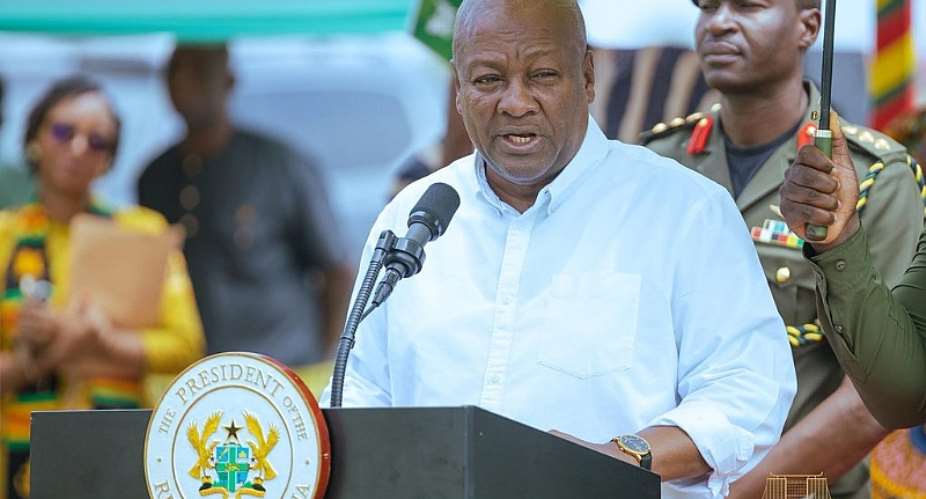
President John Dramani Mahama says the government will invest US$10 billion over five years in nine key sectors of the economy under its proposed New Economy Policy, aimed at accelerating job creation and expanding economic opportunities.
He said the initiative, which will receive US$2 billion annually, will target productive, job‑rich sectors including textiles and garments, agriculture and agribusiness, pharmaceuticals, and tourism.
President Mahama stressed that the investment would be financed with domestic resources, not borrowing, as part of efforts to sustain economic recovery and create more employment opportunities for Ghanaians.
“When the Minister presents the 2027 Budget, he is going to announce what we call the New Economy Policy. The policy has selected nine areas in which the government is going to invest about US$2 billion every year for five years. That is a total of US$10 billion,” he said. “As I have said, this is our own money. We are not going to borrow money for the New Economy Policy.”
He made the announcement during a courtesy call by chiefs from the Western North Region, where he outlined the government’s economic recovery measures and plans to expand employment through private‑sector growth and industrialisation.
President Mahama said the economy had begun recovering from the debt default and economic crisis that confronted the government when it assumed office on January 7, 2025. He cited the International Monetary Fund’s projection of 5.7 per cent growth for Ghana—above the average forecast of about four per cent for sub‑Saharan Africa.
He noted that despite external pressures, including rising petroleum prices linked to tensions between Iran and Israel, Ghana continued to record strong economic performance.
The President said fiscal discipline had helped stabilise the macroeconomy and reduce interest rates, creating favourable conditions for businesses to access credit and expand. He explained that reduced government borrowing had eased pressure on the banking sector, enabling financial institutions to lend more to private businesses.
“Today, the government is living within its means, and everything we are financing is being financed from our taxes and what the government brings into the Exchequer,” he said.
He added that the government was no longer borrowing from domestic banks or international credit markets, allowing banks to redirect funds toward businesses. Treasury bill rates, he said, had dropped from about 29 per cent to approximately seven per cent, making private‑sector lending more attractive.
President Mahama highlighted the construction industry as a major source of employment under the government’s Big Push infrastructure programme, citing rising demand for skilled workers such as excavator operators, civil engineers, masons and steel benders.
He also pointed to growing investments in manufacturing, including a textile factory in northern Ghana supported by the Ghana Export‑Import Bank. The factory, which produces garments for export to the United States and Europe, employs 2,300 people—80 per cent of them women—and operates under the 24‑hour economy model.
He said the facility was creating opportunities for young women who might otherwise migrate to major cities to engage in head porterage (kayayei).
President Mahama also cited production‑line expansions by companies such as Nestlé and Kasapreko as evidence of private‑sector growth and job creation.
Under the New Economy Policy, he said, the government would invest in pharmaceutical manufacturing to position Ghana as a regional production hub. He disclosed that foreign pharmaceutical companies had expressed interest in establishing facilities at a new pharmaceutical hub, where the government had already provided land and essential infrastructure.
He said the initiative forms part of a broader strategy to build a productive economy, reduce dependence on imports and create sustainable employment for young people.
President Mahama expressed optimism that the combined impact of infrastructure spending, industrial expansion and targeted investments under the New Economy Policy would accelerate job creation and improve livelihoods.

 We are going to provide emergency airstrip in regions without airports — Mahama
 Nana Konadu maiden memorial mass set for October 23
 'Double standards are not helpful, wrong yesterday is wrong today' – Ablakwa on ...
 'I am disappointed in govt for suspending ban on bus preaching' — Apostle Asempa...
 NPP has resolve internal wrangling — Bawumia
 Ghana, US Virgin Islands agree on recruitment of Ghanaian teachers, nurses
 Never Again: Mahama Pushes for Local Vaccine Manufacturing After COVID‑19
 “Soldiers Will Stay There”—Mahama Declares Permanent Military Presence in Forest...
 ‘No Borrowing Involved’ — Mahama Rolls Out US$10bn New Economy Policy
 “Ask Jean Mensa to resign first”—Tanko-Computer fires back



Comments
Funding credibility: Raising US$10 billion domestically may require higher taxes or spending cuts, potentially burdening households and businesses. Opportunity cost: Committing US$2 billion annually could divert resources from healthcare, education, debt reduction, and essential public services. Implementation risk: Investment across nine sectors may spread resources too thin and increase bureaucracy, waste, or political allocation. Limited private-sector impact: Lower Treasury bill rat...