




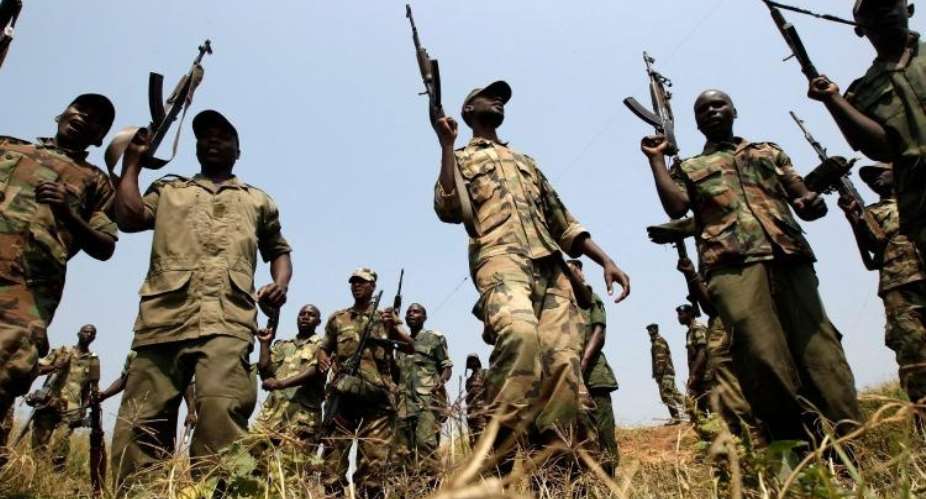
West Africa's armed groups are not one movement. They are rival organisations with different aims, methods and weaknesses. Some are jihadist, some are criminal, and some are both. Before asking whether their fighters are victims, it helps to see what each group is.
The main groups
In the central Sahel, the dominant force is Jama'at Nusrat al-Islam wal-Muslimin (JNIM), an al-Qaeda affiliate that is the dominant jihadist group in the central Sahel, operating mainly in Mali and Burkina Faso. Its rival is the Islamic State Sahel Province (ISSP).
In the north-east of Nigeria and around Lake Chad, the Islamic State West Africa Province (ISWAP) has eclipsed Boko Haram as the dominant jihadist force. In the north-west of Nigeria, two very different actors operate: the Lakurawa group and the armed gangs known as bandits. They overlap, and that overlap is part of the story.
Where the Sahel groups are strong and weak
JNIM's most effective weapon is economic. Its fuel blockade targets the overland routes that carry 95 per cent of Mali's petroleum imports, and it was reimposed on Bamako at the end of April 2026.
The state is also weak: the Burkinabe government is thought to control less than half of its national territory, and Mali's Dozo militias have been disarmed or forced into deals with JNIM.
ISWAP, meanwhile, has built local support by filling gaps in governance and service delivery, and it overran at least 16 military bases in Nigeria in the first half of 2025.
Their weaknesses are real, too. One analysis estimates JNIM at about 6,000 fighters and says it lacks the legitimacy to rule urban centres and most of southern Mali by consent. Another judged that JNIM does not appear capable of conquering the capital, let alone holding it.
JNIM and ISSP now fight each other, and in parts of Burkina Faso that violence rivals or exceeds the violence each directs at the state. Ground can also change quickly: in early October, the Tuareg-led FLA retreated from Kidal and the city returned to the Malian army.
Lakurawa: a hybrid group
Lakurawa is hard to pin down. Most analysts say it first emerged in Sokoto State around 2016–2017, drawn mainly from Malian and Nigerien individuals, though its exact parent groups are contested. The Institute for Security Studies traces it to a merger of former Macina Liberation Front fighters, now part of JNIM, and a Nigerien faction rooted in defending herders.
A West Point study judges that most Lakurawa activity in Sokoto and northern Kebbi is the work of ISSP militants, with JNIM possibly operating under the label from time to time.
Strengths. Lakurawa began as a security provider. It was initially recruited by local communities to deal with banditry, and its effectiveness in repelling bandits earned it legitimacy. It exploits weak state presence in the Nigeria–Niger–Benin tri-border area, and has expanded into Niger State's Borgu area on the Benin border. One assessment says it has drones for surveillance and satellite communications equipment.
Weaknesses. The protector became a predator. The group stole cattle from communities under the pretence of collecting zakat and attacked villages that raised vigilante groups. Its early support was lost, and its relations with bandits have soured, so that they are now enemies. Its identity is murky: the term is used locally for any militant from the neighbouring francophone countries, so many attacks are blamed on it without proof.
Estimates of its size range from about 200 fighters to around 2,000, which shows how little is known. It also faces growing pressure. Nigeria declared it a terrorist organisation, and US airstrikes hit its bases in Sokoto's Bauni Forest area.
The bandits: a criminal economy
"Bandits" is a catch-all term for armed rural gangs that rustle cattle, kidnap, loot and extort villages. The problem has its roots in rural cattle rustling. Zamfara became the centre of a kidnap-for-ransom industry worth millions of dollars each year, and in parts of the state bandits have supplanted both the government and traditional rulers as the de facto authority.
The human cost is large: more than 453,000 people in the north-west have been driven off their land, and communities pay protection money to avoid attack. In one case, bandits kidnapped at least 100 people after villages failed to pay the "taxes" demanded of them.
Strengths. Money and weapons. As one analyst put it, it is too lucrative for them to stop, no matter how many peace deals they sign. Leaders such as Bello Turji have signed deals while keeping most of their weapons and using truces to create safe havens.
Weaknesses. There is little unity. A local source said bandits have no command, structure and control, so a deal in one state can coexist with attacks in another. Their motive is profit, not a cause, so they offer communities little beyond fear. Peace deals have repeatedly collapsed, as in September 2025 when 40 worshippers were abducted from a Zamfara mosque less than a month after a Katsina agreement. Critics argue that such amnesties have emboldened armed groups and deepened community mistrust of the state.
Where criminals and jihadists meet
The line between the two is blurring. Lakurawa sent a letter in 2024 to the bandit leader Bello Turji, and analysts suspect that JNIM and ISSP are supporting bandits, with locals calling such jihadist-assisted groups "Lakurawa." A criminal economy that is already armed, mobile and rich gives jihadists recruits, routes and cover. That is how banditry can turn into insurgency.
Was it a fight of the victims?
Partly, but with two cautions. A UNDP study of nearly 2,200 people found that 71 percent of those citing a trigger pointed to human rights abuse, often by state security forces, as the tipping point, and that job opportunities were the main reason for joining, cited by 25 percent.
Religion was cited by 17 percent. The Africa Center adds that the targeting of civilians, largely Fulani, by Malian, Burkinabe and Russian forces is a key driver of JNIM recruitment. Many recruits are therefore victims of failed states before they become fighters.
The first caution is that the groups themselves are not victims. Lakurawa killed those it was invited to protect, and bandits kidnap farmers and worshippers. Grievance explains why people join but does not excuse what they do.
The second is that profit matters as much as grievance. For a bandit commander in Zamfara, ransom, not resentment, is the business model. The people with the clearest claim to be victims are the villagers in the north-west, who suffer first from bandits, then from groups that arrive as protectors, and then from state forces that do not arrive at all.
What it means for Ghana
The threat has moved south. Analysts note a spread into Togo, Benin, Ghana and Ivory Coast since 2021. Ghana has deployed more than 1,000 elite special forces and hundreds of other security officials to its north, and although no attacks have occurred in Ghana, insurgents regularly cross the border just to the north.
Ghana's northern communities also have kinship and trade ties with the north of Nigeria, since northern populations in Ghana and neighbouring coastal states are linked ethnically and linguistically with northern Nigerian Hausas, which means ideas, people and money can travel along family and market routes.
If grievance tips people into recruitment, then Ghana's best defence includes more than troops. Fair treatment by the security services, roads, schools, clinics and jobs in the north are part of national security.
The bottom line
These groups are strong where the state is absent and weak where they must govern by consent. Lakurawa shows how a protector turns predator, and the bandits show how crime becomes a war economy. Defeating them takes more than force. The state has to offer communities something better than what the gunmen offer.
Mustapha Bature Sallama
Medical/Science communicator, Private Investigator, Criminal Investigation and Intelligence Analysis,United States Institute of Peace (USIP), [email protected] +233555275880.
References
ACLED. (2025). Economic warfare escalates as militants expand beyond the Sahel. https://acleddata.com/report/economic-warfare-escalates-militants-expand-beyond-sahel
Africa Center for Strategic Studies. (2025). Africa surpasses 150,000 deaths linked to militant Islamist groups in past decade. https://africacenter.org/spotlight/en-2025-mig-10-year/
Africa Portal. (n.d.). Facing the challenge of the Islamic State in West Africa Province. https://africaportal.org/?p=8073
AllAfrica. (2025, September 16). Nigeria: Peace deal collapses as bandits abduct worshippers from Zamfara mosque. https://allafrica.com/stories/202509160020.html
AllAfrica. (2025, September 16). Nigeria: Why bandit amnesties are failing in Nigeria's northwest. https://allafrica.com/stories/202509160643.html
BusinessDay. (2023). Hope of finding work is leading factor driving people to join violent extremist groups – UNDP. https://businessday.ng/?p=707039
Channels TV. (2025, August 9). Inside Bello Turji's most recent "peace" accord with Zamfara. https://www.channelstv.com/2025/08/09/inside-bello-turjis-most-recent-peace-accord-with-zamfara/amp/
Combating Terrorism Center at West Point. (2025). Kachallas and kinship: Understanding jihadi expansion and diffusion in Nigeria. https://ctc.westpoint.edu/kachallas-and-kinship-understanding-jihadi-expansion-and-diffusion-in-nigeria/
Council on Foreign Relations. (2026). Violent extremism in the Sahel. https://www.cfr.org/global-conflict-tracker/conflict/violent-extremism-sahel
Critical Threats. (2026, February 5). Africa File. https://www.criticalthreats.org/analysis/boko-haram-nigeria-tplf-ethiopia-red-sea-drc-m23-rwanda-isis-niger-saf-rsf-sudan-africa-file-february-5-2026
Daily Trust. (2026). New terror group, Mahmuda, intensifies attacks. https://dailytrust.com/new-terror-group-mahmuda-intensifies-attacks/
Foreign Policy. (n.d.). Islamist extremists are a threat to Ghana, Togo, and Benin. https://foreignpolicy.com/?p=1155765
GIS Reports. (2026). Jihadist expansion destabilizes coastal West Africa. https://www.gisreportsonline.com/?p=95111
Good Governance Africa, reported by ICIR. (2025). Report shows ISWAP's resurgence worsening. https://www.icirnigeria.org/?p=256177
Institute for Security Studies. (2025). Lakurawa: Nigeria's hybrid threat that attracted US missile fire. https://issafrica.org/iss-today/lakurawa-nigeria-s-hybrid-threat-that-attracted-us-missile-fire
Institute for Strategic Studies (ISPI). (n.d.). Crisis to watch in 2026: Mali. https://www.ispionline.it/en/publication/crisis-to-watch-in-2026-mali-226534
Jamestown Foundation. (2025). JNIM edges into Nigeria through bandit collusion. https://jamestown.org/jnim-edges-into-nigeria-through-bandit-collusion/
Jamestown Foundation. (n.d.). Burkina Faso and the looming jihadist threat to coastal West Africa. https://jamestown.org/?p=81695
ModernGhana. (2026, June 23). The rise of ISWAP over Boko Haram. https://www.modernghana.com/news/1504710/the-rise-of-iswap-over-boko-haram-how-the-lake.html
Orion Policy Institute. (2026). Mali's fracture will be felt in West Africa and beyond. https://orionpolicy.org/malis-fracture-will-be-felt-in-west-africa-and-beyond/
Peoples Gazette. (2023, November 27). Bandits abduct 100 villagers after failing to pay taxes in Katsina, Zamfara. https://gazettengr.com/?p=225995
The New Humanitarian. (n.d.). "Everyone knows somebody who has been kidnapped": Inside Nigeria's banditry epidemic. https://www.thenewhumanitarian.org/node/262718
The Soufan Center. (2026, February 6). Lakurawa's growing presence in Nigeria and the crime-terror nexus. https://thesoufancenter.org/intelbrief-2026-february-6/
UNDP. (2023, February 7). Hope of better jobs eclipses religious ideology as main driver of recruitment into violent extremist groups in sub-Saharan Africa. https://www.undp.org/press-releases/hope-better-jobs-eclipses-religious-ideology-main-driver-recruitment-violent-extremist-groups-sub-saharan-africa
Wikipedia. (2026). 2026 Mali offensives. https://en.wikipedia.org/wiki/2026_Mali_offensives

 We are going to provide emergency airstrip in regions without airports — Mahama
 Nana Konadu maiden memorial mass set for October 23
 'Double standards are not helpful, wrong yesterday is wrong today' – Ablakwa on ...
 'I am disappointed in govt for suspending ban on bus preaching' — Apostle Asempa...
 NPP has resolve internal wrangling — Bawumia
 Ghana, US Virgin Islands agree on recruitment of Ghanaian teachers, nurses
 Never Again: Mahama Pushes for Local Vaccine Manufacturing After COVID‑19
 “Soldiers Will Stay There”—Mahama Declares Permanent Military Presence in Forest...
 ‘No Borrowing Involved’ — Mahama Rolls Out US$10bn New Economy Policy
 “Ask Jean Mensa to resign first”—Tanko-Computer fires back


