




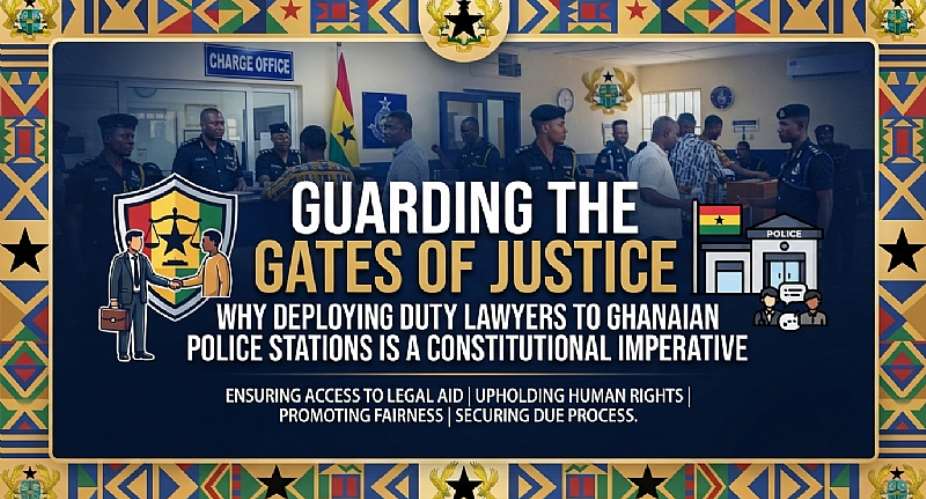
The true measure of a democracy's commitment to the rule of law is not found in the grand architecture of its superior courts, but in the volatile, high-pressure confines of its police interrogation rooms. For far too long, the critical window between a suspect's arrest and their initial appearance before a magistrate has remained a dangerous constitutional vacuum. Dr. Dominic A. Ayine’s proposal to deploy a structured duty-lawyer scheme directly to police stations is a foundational rescue mission for human rights in Ghana. By placing legal custodians at the immediate point of detention, we can dismantle an archaic investigative culture often reliant on extracted admissions, curb arbitrary detentions, and finally give teeth to the procedural safeguards enshrined in our supreme law. We must urgently shift our justice paradigm from retroactive representation to immediate, station-level intervention if we are to protect every citizen—regardless of their social standing or economic strength—from the overbearing machinery of the state.
The Constitutional Case for Station-Level Legal Representation
- Enforcing Article 19(2)(c) Safeguards: The 1992 Constitution guarantees that a suspect is presumed innocent until proven guilty; the immediate presence of counsel ensures that early interrogation does not weaponize a citizen's legal ignorance against them.
- Vindicating Article 14(2) Notification Rights: While state actors are constitutionally mandated to inform suspects of their right to counsel immediately upon arrest, this remains an empty promise for indigent citizens without a systemic duty-lawyer presence at the station.
- Upholding Article 14(3) Temporal Boundaries: Duty lawyers act as an unyielding institutional check against the routine violation of the 48-hour constitutional limit, preventing arbitrary extensions of detention without a formal court arraignment.
- Excluding Tainted Evidence under Article 19: Early legal intervention curbs the extraction of coerced confessions, thereby aligning local police actions with superior court standards that reject statements taken under duress or without independent witnesses.
- Mitigating the Indigent Defense Deficit: Wealthy suspects activate private counsel within minutes of arrest, while the vulnerable are left entirely defenseless during the most legally critical hours of detention, perpetuating a wealth-based justice gap.
Expanded Strategic and Operational Funding Framework
To ensure this scheme does not collapse under the weight of fiscal constraints, Ghana must reject sole reliance on the central government's consolidated fund and instead operationalize a sustainable, multi-tiered funding model:
- Ring-Fencing a "Justice Component" from Criminal Fines: A statutory percentage of all non-custodial judicial fines, regulatory penalties, and asset forfeitures managed by the Ministry of Justice should be directly channeled into a dedicated Legal Aid Commission Duty Lawyer Fund.
- Public-Private Partnership (PPP) Civic Endowments: Establish an independent, structurally ring-fenced trust fund co-managed by the Ghana Bar Association (GBA) and civic coalitions, allowing corporate bodies to claim targeted tax deductions for corporate social responsibility (CSR) contributions made toward indigent defense.
- Mandatory Pro Bono Integration & Inductions: The General Legal Council should structurally tie the annual renewal of private practice licenses to a mandatory minimum quota of pro bono duty-lawyer shifts, supplemented by a structured rotation where newly qualified lawyers and National Service person barristers serve as station-level duty counsels under senior supervision.
- International Development & Rule of Law Grants: Mobilize programmatic funding from international development partners focused on West African democratic consolidation and institutional accountability, explicitly earmarking these resources for mobile logistics and stipend allowances for rural duty lawyers.
Recommendations for Institutional Realignment
- Promulgate a Joint Ministry of Justice and GBA Roster: A legally backed, nationally coordinated Duty Lawyer Roster must be mapped directly to municipal and district police headquarters, providing predictable, 24-hour emergency legal coverage.
- Mandate Digital Access Registries: Every police charge office must maintain an unalterable electronic logbook, co-signed by the responding duty lawyer, tracking the exact timestamps of a suspect's arrest, legal consultation, and subsequent arraignment or bail release.
- Issue Binding IGP Operational Directives: The Inspector General of Police (IGP) must issue stern internal operational directives training station officers to view duty lawyers not as hostile adversaries, but as institutional partners vital to ensuring that state investigations survive judicial scrutiny.
We cannot champion our position as a progressive, legacy-driven gateway nation in West Africa while permitting our foundational criminal justice processes to remain anchored in archaic, non-compliant paradigms. Dr. Ayine’s proposal is a long-overdue mechanism to align local police operational realities with international human rights benchmarks. Implementing a station-level duty-lawyer scheme will require administrative courage, aggressive resource reallocation, and institutional unlearning, but the cost of continued inertia is far steeper: the complete erosion of public trust in state security institutions. It is time for Parliament, the Ministry of Justice, and legal stakeholders to transform this proposal into a binding statutory framework, ensuring that the shield of the 1992 Constitution meets the Ghanaian citizen at the exact moment they need it most. ✍️ Submitted by:
Retired Senior Citizen
For and on behalf of all Senior Citizens of the Republic of Ghana 🇬🇭
Teshie-Nungua
[email protected]


 Macron promises tough punishments for rioters during nationwide day of action
 Trump endorses embattled Israeli PM Netanyahu ahead of October 27 election
 We are going to provide emergency airstrip in regions without airports — Mahama
 Nana Konadu maiden memorial mass set for October 23
 'Double standards are not helpful, wrong yesterday is wrong today' – Ablakwa on ...
 NPP has resolve internal wrangling — Bawumia
 Ghana, US Virgin Islands agree on recruitment of Ghanaian teachers, nurses
 “Soldiers Will Stay There”—Mahama Declares Permanent Military Presence in Forest...
 ‘No Borrowing Involved’ — Mahama Rolls Out US$10bn New Economy Policy
 “Ask Jean Mensa to resign first”—Tanko-Computer fires back


