




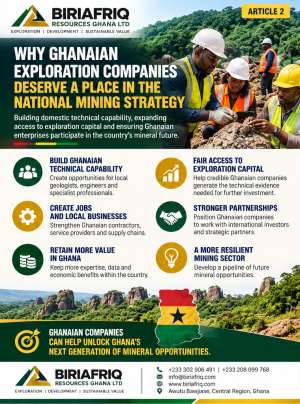
Participation must begin before production
Ghana’s mineral industry is an important part of its economy, but the country’s long-term mining prospects depend on more than operating mines and mineral exports. They also depend on who identifies future deposits, who finances early exploration, who develops the technical evidence and who builds the enterprises that support the mineral value chain. Ghanaian exploration companies have an opportunity to contribute meaningfully to this process. Yet early-stage exploration can be difficult to finance because substantial technical work must often be completed before a project can demonstrate commercial potential.
This creates a policy question: how can Ghana ensure that competent domestic companies have a fair opportunity to participate in the earliest stages of mineral development? Ghanaian companies should be treated as potential creators of mineral assets and technical capability—not merely as service providers entering the industry after a project has already been established. This does not mean that local ownership alone should qualify a company for public support. Technical competence, legal compliance, sound governance and responsible operations must remain essential requirements.
1. Build Ghanaian technical capability
Mineral exploration requires specialised knowledge in geology, geochemistry, geophysics, drilling, laboratory analysis, data interpretation and project management. When Ghanaian companies undertake credible exploration programmes, they can create practical opportunities for local professionals to develop these capabilities.
Government policy can help strengthen this process through competitive support for technically justified programmes, collaboration with universities and research institutions, and access to appropriate geological information. The objective should be to develop a stronger domestic pool of experienced professionals and enterprises capable of evaluating mineral opportunities to recognised technical standards. Skills development must be measured through actual technical work, training outcomes, professional experience and improved institutional capability not simply through the number of companies registered.
2. Address unequal access to early-stage capital
Exploration finance is fundamentally different from financing an operating mine. An early-stage company may have a credible geological target but lack the capital needed to complete mapping, sampling, geophysical surveys or drilling. Conventional investors may be reluctant to fund the programme until further evidence is available.
This financing gap can prevent otherwise capable companies from demonstrating whether their projects merit additional investment. Ghana could respond through a transparent exploration-support programme offering competitive grants, matching finance, co-investment or other legally appropriate instruments. The programme should evaluate each applicant against clear criteria and release funds against approved work programmes and verifiable milestones. The aim is not to protect companies from geological risk. It is to give credible proposals a fair opportunity to generate the evidence required for sound investment decisions.
3. Retain more technical and economic value in Ghana
Domestic exploration companies can support a wider network of Ghanaian businesses. These may include drilling contractors, geological consultants, laboratories, survey providers, equipment suppliers, environmental specialists and other technical service firms. As local capability develops, Ghana can increase the opportunities available to its professionals and enterprises to participate in mineral discovery and project development.
However, the extent of this benefit depends on actual performance. Local ownership does not automatically guarantee competitive services, efficient operations or meaningful value retention. Public policy should therefore encourage Ghanaian companies to build strong technical teams, transparent procurement practices, effective management systems and the ability to compete on quality.
4. Encourage stronger partnerships with international investors
A stronger domestic exploration sector need not compete with international investment. In fact, technically credible Ghanaian companies can provide a platform for productive partnerships with international exploration firms, specialist investors, engineering companies and strategic resource-development partners.
A Ghanaian company with properly documented mineral rights, reliable geological data, a realistic work programme and sound governance may be better positioned to negotiate a partnership on an informed basis. Potential arrangements may include joint ventures, earn-in agreements, technical-service partnerships or co-financed exploration programmes, subject to applicable law and the specific circumstances of each project.
The terms should clearly define funding obligations, technical responsibilities, decision-making authority, ownership interests, reporting requirements and the allocation of risk. The objective should be mutually beneficial partnerships that strengthen project quality while enabling Ghanaian enterprises to build long-term capability.
5. Establish fair and transparent support criteria
A national strategy should not select companies based on political connections, personal relationships or promotional claims.
Support should be available through an independently assessed process that considers:
Valid mineral rights and compliance with applicable legal requirements.
Demonstrable technical competence and an appropriate exploration methodology.
A realistic budget, timetable and defined technical deliverables.
Transparent beneficial ownership and financial management.
Environmental and social safeguards.
Clear governance, reporting and audit arrangements.
The company’s ability to execute the proposed programme responsibly.
Companies should compete on the strength of their proposals and their capacity to deliver. Where an application is unsuccessful, clear feedback can help applicants improve their technical and commercial readiness.
6. Measure success beyond the number of discoveries
Exploration is uncertain. Some programmes will identify targets requiring further work; others will demonstrate that additional investment is not justified. Government support should therefore not be assessed solely by whether a funded company discovers a commercially viable deposit. Other meaningful indicators include the quality of geological data generated, completion of approved work programmes, technical skills developed, private investment mobilised, local supplier participation and the number of projects progressing to justified next stages. Independent reviews should assess whether public support is delivering sufficient public value relative to its costs and risks. Projects that do not meet technical or governance requirements should be subject to corrective action, suspension or termination where appropriate.
Make Ghanaian capability part of the national strategy
Ghana has an opportunity to strengthen its mineral sector by ensuring that capable Ghanaian exploration companies can compete fairly, access appropriate capital and build the technical capabilities required to identify future mineral opportunities. This requires more than a preference for local ownership. It requires a credible environment in which competent domestic enterprises can demonstrate their value, establish partnerships and develop projects responsibly. A well-governed exploration-support programme, improved access to geological information, stronger technical training and transparent partnership arrangements could help advance this objective.
The Government should consider a carefully evaluated pilot programme and expand it only if measurable results justify further investment. Ghanaian participation in mining should begin at the stage where mineral opportunities are identified and evaluated not only when projects reach construction or production. Building capable Ghanaian exploration companies is therefore not simply an enterprise-development initiative. It is an opportunity to strengthen the technical foundations of Ghana’s future mineral economy.
#GhanaMining
#MineralExploration
#GhanaianBusinesses
#MiningInvestment
#ResourceDevelopment


 We are going to provide emergency airstrip in regions without airports — Mahama
 Nana Konadu maiden memorial mass set for October 23
 'Double standards are not helpful, wrong yesterday is wrong today' – Ablakwa on ...
 'I am disappointed in govt for suspending ban on bus preaching' — Apostle Asempa...
 NPP has resolve internal wrangling — Bawumia
 Ghana, US Virgin Islands agree on recruitment of Ghanaian teachers, nurses
 Never Again: Mahama Pushes for Local Vaccine Manufacturing After COVID‑19
 “Soldiers Will Stay There”—Mahama Declares Permanent Military Presence in Forest...
 ‘No Borrowing Involved’ — Mahama Rolls Out US$10bn New Economy Policy
 “Ask Jean Mensa to resign first”—Tanko-Computer fires back


