




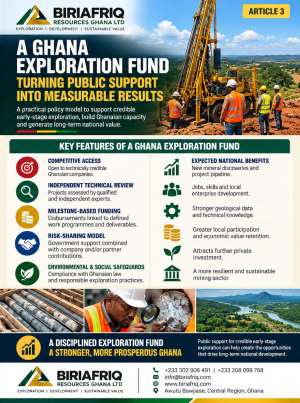
From policy ambition to an implementable programme
If Ghana intends to strengthen its domestic exploration sector, an important question follows: what practical mechanism could help credible early-stage mineral projects obtain the technical and financial support they need? One option is a dedicated Ghana Exploration Fund or equivalent exploration-support facility, established under an appropriate legal and institutional framework.
The proposed facility would support selected exploration programmes through transparent eligibility criteria, independent technical review, milestone-based disbursement and rigorous public accountability. It should not be designed as a fund that promises discoveries, guarantees company profits or finances every project submitted.
Its purpose should be to help credible exploration companies generate reliable evidence, mobilise appropriate investment and make better-informed decisions about Ghana’s mineral potential. This is a policy proposal. It should be assessed against existing institutions, public-finance priorities and alternative funding mechanisms before the Government decides whether to establish a new entity or adapt an existing one.
1. Why consider a dedicated exploration-support facility?
Early-stage exploration involves substantial uncertainty and requires funding before a project can demonstrate whether it has commercial potential. A company may need to complete geological mapping, geochemical sampling, geophysical surveys, drilling and laboratory analysis before its target can be properly evaluated.
Conventional investors may be reluctant to finance these activities without sufficient technical evidence. A public support facility could help address this gap where the proposed work has a credible technical basis and the potential public benefits justify the financial risk. It could also encourage collaboration among Ghanaian companies, geological professionals, universities, research institutions and suitable private investors. However, government participation should be selective. Public funding is limited, and mineral exploration must compete with other national priorities. The case for the facility should therefore be based on demonstrable additional value: supporting worthwhile technical work that might otherwise remain unfunded, while attracting further investment and strengthening domestic capability.
2. Define the fund’s objectives
The facility should have a clear and limited mandate.
Its objectives could include:
Supporting technically credible early-stage exploration by eligible Ghanaian companies.
Improving the quality and availability of geological data generated through supported programmes.
Developing Ghanaian technical and project-management capability.
Encouraging responsible exploration and compliance with applicable law.
Mobilising additional private and strategic investment where appropriate.
Strengthening the pipeline of projects that may merit further technical evaluation.
The facility should not promise that supported projects will become mines or generate a predetermined amount of government revenue. Nor should it be used to bypass licensing requirements, replace private capital where commercial financing is reasonably available, or support companies that cannot demonstrate the ability to manage public resources responsibly.
3. Use competitive and transparent eligibility criteria
Access to support should be open to qualified applicants through a clearly published process.
Eligibility could require applicants to demonstrate:
Appropriate legal authority and valid mineral rights for the proposed work.
Transparent beneficial ownership and governance.
Relevant technical expertise or credible access to qualified professionals.
A documented geological rationale and technically justified work programme.
A realistic budget and schedule.
Compliance with applicable regulatory, tax and reporting obligations.Appropriate environmental and social planning.
Financial controls and the capacity to account for funds.
The facility could prioritise capable Ghanaian exploration companies while allowing clearly defined exceptions or partnerships where these offer demonstrable public value. The rules should distinguish between a Ghanaian company’s legal status and its actual technical capability. Neither company registration nor a compelling presentation should substitute for independent assessment. Selection criteria, scoring methods, award decisions and appeal procedures should be documented and publicly available, subject to appropriate confidentiality protections.
4. Establish independent technical assessment
Technical review should be central to the facility’s operation. Qualified geologists and other relevant specialists should assess the geological rationale, existing data, proposed methods, sampling and quality-control procedures, drilling plans, budgets and expected deliverables. Legal, financial, environmental and social reviews should complement the technical assessment.
Reviewers should disclose conflicts of interest and be excluded from decisions where their independence could reasonably be questioned. The facility should also establish procedures for checking technical reports and verifying that funded work has been completed as approved. This process would help ensure that support is based on evidence rather than political influence, personal relationships or unrealistic claims about a project’s potential.
5. Release funding against milestones
Funding should be linked to defined technical objectives and verifiable outputs. Depending on the project, milestones could include completion of geological mapping, quality-assured sampling, geophysical surveys, approved drilling programmes, laboratory analysis or independent technical reporting. Payments should be supported by appropriate documentation, expenditure records and progress reviews.
The facility could require companies to contribute a proportion of programme costs or secure additional partners where appropriate. However, co-financing requirements should be calibrated carefully so that capable smaller companies are not excluded solely because they have limited initial capital. Different funding instruments could be considered, including competitive grants, matching contributions, repayable support, co-investment or other legally appropriate arrangements. Each instrument would need clear rules concerning public exposure to risk, repayment, potential returns, ownership interests and the treatment of unsuccessful projects. No single financing structure will suit every exploration programme.
6. Protect public funds and manage conflicts of interest
A public exploration facility must have strong safeguards. These should include independent oversight, procurement controls, expenditure verification, audit rights, conflict-of-interest declarations and clear authority to suspend funding when material problems arise. Beneficial ownership should be disclosed, and related-party transactions should be reviewed appropriately.
Applicants should not be permitted to use exploration funding for unrelated business activities or expenses outside the approved programme. The facility should establish procedures for addressing misrepresentation, misuse of funds, non-compliance and failure to deliver agreed work. Geological uncertainty alone should not automatically be treated as misconduct. An unsuccessful exploration result may be entirely legitimate if the programme was properly designed, executed, reported and managed. The distinction between geological failure and financial or governance failure is essential to a credible risk-sharing system.
7. Make geological data a source of long-term public value
Exploration programmes supported by public resources can generate geological information that may be valuable beyond the immediate project. The facility should establish clear rules governing data ownership, confidentiality, retention, reporting and any later public release. These rules should protect legitimate commercial interests and applicable legal rights while ensuring that public support creates an appropriate public benefit. Where disclosure is legally and commercially appropriate, standardised data could strengthen Ghana’s geological knowledge base and improve future research and exploration decisions. The facility could also collaborate with relevant geological institutions and universities to support data management, technical training and research. Such arrangements should be established in advance rather than left to informal negotiations after funding has been disbursed.
8. Attract additional private investment without unfairly transferring risk
Public support should complement private investment rather than replace it. Where an exploration programme generates credible technical evidence, the company may become better positioned to approach specialist investors, strategic partners or other appropriate sources of capital. The facility could encourage co-investment where this is commercially justified and protects the public interest.
However, risk-sharing arrangements must be carefully designed. The Government should not automatically absorb exploration losses while allowing private partners to retain disproportionate benefits from successful outcomes. If public support involves equity, repayment, royalties or another financial interest, the rights and obligations of all parties should be clearly defined, independently reviewed and disclosed as required. Further financing should remain conditional on technical results, legal due diligence, project readiness and the willingness of investors to accept the relevant risks.
9. Measure performance and publish results
The facility should be evaluated against a clear set of performance indicators.
These could include:
- Completion rates for approved technical work programmes.
Quality and usability of geological data generated.
Compliance with budget, reporting and governance requirements.
Technical skills developed and local services engaged.
Additional private capital mobilised.
Projects progressing to justified next-stage evaluation.
Public costs relative to measurable economic and capability-building outcomes.
The number of commercially viable discoveries should be tracked over the longer term but should not be the sole measure of success. Independent evaluations should assess whether the facility is reaching credible applicants, providing additional value, managing risks appropriately and justifying the use of public resources. The Government should publish periodic reports covering awards, aggregate expenditure, programme delivery, audit findings and lessons learned, while respecting lawful confidentiality obligations.
10. Start with a pilot before expanding
A measured implementation plan would reduce the risk of committing substantial public resources before the model has been tested. The Government could begin by evaluating existing institutions and funding mechanisms, consulting technical professionals and industry stakeholders, and estimating the potential costs and public benefits. If the proposal is justified, a pilot could support a limited portfolio of projects under published rules and independent oversight. The pilot should have a defined duration, funding ceiling, evaluation framework and clear criteria for continuation, redesign or termination. Only after independent assessment should the Government consider expanding the facility. This approach would allow Ghana to learn from actual implementation rather than relying solely on projections or policy promises.
Build a disciplined bridge between exploration and investment
A Ghana Exploration Fund could help address the early-stage financing gap, strengthen capable Ghanaian companies and improve the evidence available for future mineral-development decisions. Its value would depend not on the size of its budget or the number of projects approved, but on the quality of its technical work, the additional investment it attracts, the capability it builds and the integrity with which public resources are managed. The Government should therefore assess the proposal carefully, compare it with alternative approaches and establish a pilot only if the expected public benefits justify the costs and risks. The goal should not be to finance every exploration ambition. It should be to support credible work, verify results and allow evidence not political pressure or promotional claims to determine what happens next. A disciplined facility could help Ghana build a stronger domestic exploration sector while maintaining accountability to taxpayers and responsible standards for mineral development.
#GhanaMining
#MineralExploration
#MiningPolicy
#ProjectFinance
#GhanaianBusinesses
#ResourceDevelopment


 We are going to provide emergency airstrip in regions without airports — Mahama
 Nana Konadu maiden memorial mass set for October 23
 'Double standards are not helpful, wrong yesterday is wrong today' – Ablakwa on ...
 'I am disappointed in govt for suspending ban on bus preaching' — Apostle Asempa...
 NPP has resolve internal wrangling — Bawumia
 Ghana, US Virgin Islands agree on recruitment of Ghanaian teachers, nurses
 Never Again: Mahama Pushes for Local Vaccine Manufacturing After COVID‑19
 “Soldiers Will Stay There”—Mahama Declares Permanent Military Presence in Forest...
 ‘No Borrowing Involved’ — Mahama Rolls Out US$10bn New Economy Policy
 “Ask Jean Mensa to resign first”—Tanko-Computer fires back


