




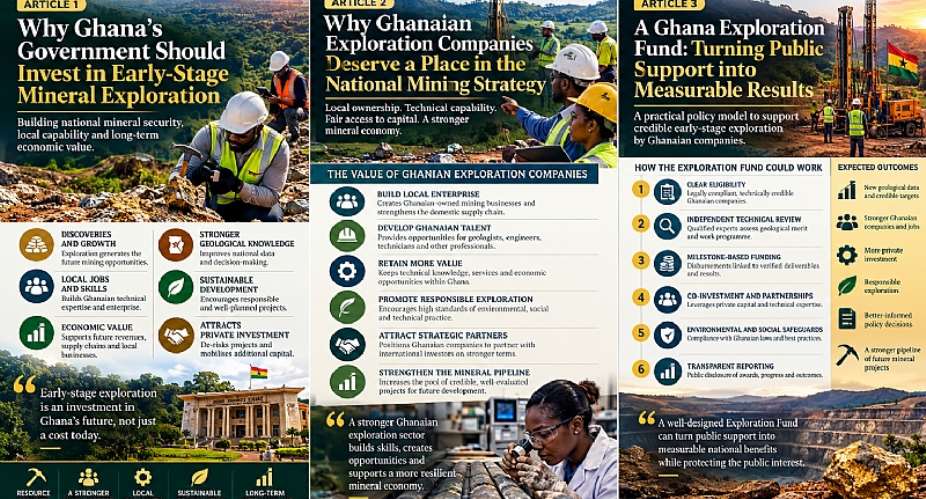
The national opportunity begins before the mine
Ghana has a long history of mineral production, particularly gold. However, the long-term strength of its mining industry depends not only on extracting known deposits but also on identifying, evaluating and responsibly developing the mineral resources of the future.
That process begins with early-stage exploration.
Before a mine can be developed, geological hypotheses must be tested, targets must be investigated, samples must be analysed and exploration results must be interpreted. This work requires specialist expertise, sustained investment and a willingness to accept uncertainty.
Yet early-stage exploration is often one of the most difficult stages to finance. Projects may need substantial technical work before they can demonstrate the evidence that conventional investors require.
This creates a strategic question for Ghana: should the country rely primarily on private investors to finance the earliest stages of mineral discovery, or should the Government establish a carefully governed mechanism to help capable Ghanaian exploration companies undertake this foundational work?
There is a strong case for the latter.
Government support for early-stage mineral exploration should be considered an investment in Ghana’s geological knowledge, domestic technical capability and future economic opportunities—not a guarantee that every exploration project will become a mine.
1. Mineral discoveries begin with exploration, not production
Mining discussions often focus on operating mines, gold exports, royalties, taxes and mineral processing. These are important, but they represent only part of the mineral-development cycle. Before production can occur, someone must invest in identifying and evaluating a potential deposit. Early-stage exploration can include geological mapping, geochemical sampling, geophysical surveys, target generation, drilling, laboratory analysis and technical interpretation.
These activities generate information that helps determine whether a mineral occurrence warrants further investigation. Without sustained exploration, a country risks relying increasingly on previously identified deposits while failing to develop an adequate pipeline of future opportunities. Government support could help Ghanaian companies undertake well-designed exploration programmes, generate new geological data and identify targets that merit further technical and commercial evaluation.
Not every programme will succeed. In fact, unsuccessful exploration is an inherent part of mineral discovery. The public-policy objective should therefore be to improve the quality of exploration, manage risk responsibly and generate valuable knowledge—not to promise discoveries.
2. Why the Government should help close the exploration-financing gap
Early-stage exploration presents a particular financing challenge. The expenditure comes before commercial production, and the outcome remains uncertain. Unlike an established operating mine, an exploration project generally cannot rely on production revenue to fund its activities. Many potential investors consequently prefer projects with more advanced technical evidence, established resources or a clearer development pathway.
This can leave credible Ghanaian companies struggling to finance the very work needed to establish whether their prospects have commercial potential. A carefully designed public support programme could help bridge this gap. Government participation need not mean paying every company's exploration costs. It could take the form of competitive grants for defined technical work, matching contributions, co-investment arrangements, shared geological-data programmes or risk-sharing facilities operated through an appropriately governed institution.
Support should be awarded only after independent technical assessment, legal and licensing checks, financial due diligence and environmental and social screening. Where appropriate, government could also partner with universities, geological institutions, specialist investors and development-finance organisations to strengthen technical capacity and mobilise additional capital. The objective would be to help credible projects generate evidence that can support informed decisions about further investment.
3. Why Ghanaian exploration companies deserve particular consideration
Ghanaian-owned exploration companies can play an important role in developing the country’s mineral sector. They can create opportunities for local geologists, engineers, surveyors, laboratory professionals, environmental specialists and other technical workers. They can also build domestic project-management capability and develop relationships with local suppliers and service providers.
However, local ownership alone does not establish technical competence or commercial merit. A Ghanaian company must still demonstrate legal compliance, sound management, a credible work programme and the capacity to account for funding.
The case for supporting Ghanaian companies is therefore not that they should automatically receive preferential treatment regardless of performance. It is that capable domestic enterprises should have a fair and transparent opportunity to compete for support and participate in the early stages of mineral discovery.
A national programme could help eligible Ghanaian companies overcome barriers that prevent them from progressing promising targets to the next stage of technical evaluation. This could strengthen the domestic exploration industry while encouraging higher standards of technical reporting, corporate governance and responsible operations.
4. Retaining more value within Ghana
The economic contribution of mineral exploration extends beyond the possibility of discovering an economically viable deposit. Exploration programmes can create demand for geological services, drilling contractors, laboratories, equipment suppliers, transport, environmental assessments, land-access services and technical consulting. When Ghanaian companies and professionals participate meaningfully in these activities, more opportunities arise to develop domestic expertise and strengthen the local supply chain.
Public support could also help universities and technical institutions collaborate with exploration companies on practical research, field training, laboratory capability and geological-data interpretation. Over time, these activities may strengthen Ghana’s capacity to evaluate mineral prospects, manage technical information and participate more effectively in project development.
However, local participation should be measured through actual contracts, skills development, technical outputs and business growth—not merely through company registration or claims of local ownership. The wider objective is to develop an exploration ecosystem in which Ghanaian enterprises can compete on technical merit and contribute to long-term economic development.
5. Strengthening Ghana’s future mineral pipeline
A sustainable mining industry needs a continuing pipeline of projects at different stages of maturity. Some exploration targets will be abandoned after initial investigation. Others may require additional drilling, advanced studies, strategic partnerships or substantial infrastructure before their potential can be understood. Only a proportion will progress towards development, and an even smaller proportion may ultimately become economically viable mines.
This is precisely why exploration requires a portfolio-based approach. Instead of committing excessive public resources to a single project, the Government could support a diversified portfolio of qualified programmes, each with clearly defined objectives and funding limits. Independent technical reviewers should determine whether proposed work is justified by available evidence. Further funding should depend on results, compliance and the quality of the next-stage work programme. Projects that fail to meet agreed technical milestones should be redesigned, paused or discontinued where appropriate. Such discipline would help the Government avoid treating every exploration expenditure as a future mine and would encourage companies to make decisions based on evidence rather than political expectations.
6. A proposed Ghanaian Early-Stage Exploration Support Programme
The Government could consider establishing a competitive programme dedicated to supporting technically credible early-stage mineral exploration.
Its design should include the following elements.
A. Transparent eligibility criteria
Applicants should demonstrate valid mineral rights or the necessary legal authority to undertake the proposed work, beneficial ownership disclosure, tax and regulatory compliance where applicable, and a credible technical team.
B. Independent technical assessment
Qualified geologists and other relevant professionals should evaluate the geological rationale, proposed exploration methods, budget, technical risks and expected deliverables.
C. Milestone-based disbursement
Funding should be released in stages against approved work programmes, verifiable expenditure and documented technical outputs rather than provided as an unrestricted lump sum.
D. Appropriate risk-sharing
Depending on the instrument, the company could contribute a portion of the funding, secure a strategic partner or meet agreed co-financing requirements. These requirements should not be so restrictive that capable smaller firms are automatically excluded.
E. Environmental and social safeguards
Supported programmes should comply with applicable Ghanaian law, including relevant mineral licensing, land-access, environmental and community requirements.
F. Independent oversight and public reporting
The programme should publish its eligibility criteria, selection process, award amounts, intended work programmes and aggregate performance results, subject to legitimate confidentiality and commercial protections.
G. Clear rules on public participation
Where support involves equity, loans, royalties, convertible instruments or another financial interest, the Government should establish the terms in advance. Ownership rights, repayment obligations, potential returns and the allocation of exploration risk should be transparent and legally reviewed. This framework would help distinguish a disciplined national exploration initiative from an open-ended subsidy scheme.
7. Protecting public funds and maintaining accountability
The case for public support must be accompanied by a credible system for managing failure, conflicts of interest and misuse of funds. Mineral exploration carries genuine geological risk. Public money must not be committed on the assumption that every project will deliver a discovery or a financial return.
A well-designed programme should therefore have:
Independent selection and technical-review procedures.
Published scoring criteria and documented funding decisions.
Conflict-of-interest declarations and safeguards against political interference.
Ring-fenced budgets, expenditure verification and appropriate audit rights.
Stage-gate reviews with authority to suspend or terminate underperforming projects.
Clear rules for the ownership, management and appropriate public use of geological data generated through public support.
Periodic independent evaluation of economic, technical and institutional outcomes.
Performance should be assessed through measurable indicators such as completed exploration programmes, quality-assured datasets, drilling and sampling deliverables, technical skills developed, private capital mobilised and the proportion of projects progressing to justified next stages. The number of discoveries may be one measure of long-term performance, but it should not be the sole measure. Geological outcomes are uncertain, and the programme should not encourage exaggerated reporting or the pursuit of drilling targets merely to meet numerical targets. Accountability is essential to public confidence and to the long-term credibility of the initiative.
8. The role of private investment and strategic partnerships
Government support should complement private investment rather than displace it. Public resources could help finance defined early-stage work that is difficult to fund commercially. As credible technical evidence develops, projects may become more suitable for additional investment from specialist exploration investors, strategic partners or other appropriate sources of capital.
Any transition to further funding would remain conditional on results, legal due diligence, technical quality, market conditions and the project's actual prospects. Co-investment could also help stretch public resources, provided that private participation is genuine, the allocation of risk is transparent and the arrangement does not unfairly transfer losses to the public while reserving all potential gains for private parties. The Government should also explore collaboration with relevant research institutions and development-finance partners where their mandates, expertise and investment criteria align with the programme. The objective is to establish a pathway through which capable Ghanaian companies can generate credible evidence, attract appropriate partners and advance projects responsibly.
9. Why this matters for Ghana’s long-term economic strategy
A strong mineral exploration sector can contribute to national development in several ways. It can improve geological knowledge, strengthen technical skills, support domestic service businesses, encourage private investment and help identify future opportunities for responsible mineral development. It can also improve the information available to policymakers and investors when evaluating the country’s mineral potential. These benefits should not be confused with guaranteed public revenue. Exploration can produce no commercial discovery, and a discovery does not automatically lead to a profitable mine. The eventual fiscal and economic contribution depends on technical results, commercial viability, regulatory compliance, investment decisions and the terms under which a project is developed.
For this reason, a national exploration support programme should be viewed as a long-term capability-building initiative with defined risk limits not as a short-term revenue-generating scheme. The Government should evaluate it against alternative uses of public funds and proceed only where the expected public benefits justify the costs and risks.
Conclusion: Invest in the foundations of tomorrow’s mining industry
Ghana should give serious consideration to a transparent, professionally governed programme that helps capable Ghanaian companies undertake early-stage mineral exploration. The rationale is clear: exploration generates the evidence on which future mineral-development decisions depend, while domestic exploration enterprises can help build the skills, services and commercial capabilities needed to sustain the sector. Public support will not eliminate geological uncertainty or guarantee discoveries. Nor should it replace private investment, independent technical judgement or the responsibility of companies to operate lawfully and responsibly.
Its purpose should be to address a genuine financing gap, improve the quality of exploration, strengthen Ghanaian participation and help develop a more credible pipeline of future mineral projects. The Government can begin with a carefully designed pilot, publish clear eligibility and funding rules, commission independent reviews and expand the programme only if its results justify doing so.
Ghana should not wait until a mineral project is ready for production before recognising the national value of the exploration work that may make it possible. Supporting credible Ghanaian exploration companies today could help build the technical knowledge, domestic enterprise and responsible investment opportunities on which tomorrow’s mineral economy depends. The question is not whether government should fund every exploration ambition. It is whether Ghana can design a disciplined way to support the most credible early-stage opportunities while protecting the public interest.
That is a policy conversation worth having.
#GhanaMining
#MineralExploration
#GhanaianBusinesses
#MiningPolicy
#ResourceDevelopment
#EconomicDevelopment


 We are going to provide emergency airstrip in regions without airports — Mahama
 Nana Konadu maiden memorial mass set for October 23
 'Double standards are not helpful, wrong yesterday is wrong today' – Ablakwa on ...
 'I am disappointed in govt for suspending ban on bus preaching' — Apostle Asempa...
 NPP has resolve internal wrangling — Bawumia
 Ghana, US Virgin Islands agree on recruitment of Ghanaian teachers, nurses
 Never Again: Mahama Pushes for Local Vaccine Manufacturing After COVID‑19
 “Soldiers Will Stay There”—Mahama Declares Permanent Military Presence in Forest...
 ‘No Borrowing Involved’ — Mahama Rolls Out US$10bn New Economy Policy
 “Ask Jean Mensa to resign first”—Tanko-Computer fires back


