




Ghana’s gold industry remains one of the pillars of the national economy. In 2024, the country produced a record 5.06 million ounces of gold and was estimated to be the world’s sixth-largest producer. Small-scale miners contributed more than 40 per cent of the total output, demonstrating the sector’s growing economic importance.
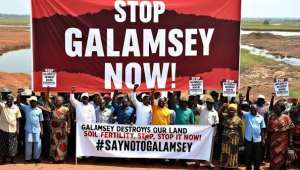
Yet behind these impressive figures lies a deepening environmental and governance crisis. Illegal artisanal and small-scale mining, popularly known as galamsey, continues to destroy forests, contaminate rivers, degrade agricultural land and endanger human health.
It is important to distinguish legitimate small-scale mining from galamsey. Ghanaian law recognises small-scale mining as a lawful economic activity when undertaken by authorised operators within approved concessions and environmental requirements. Galamsey refers to mining conducted without the necessary licences, outside permitted areas or in violation of mining and environmental regulations.
The sector provides livelihoods for many people. Ghana’s 2024 national development report estimated that small-scale mining supported approximately 1.1 million jobs. For communities facing unemployment, poverty and limited economic opportunities, mining can appear to offer immediate income that farming or formal employment cannot provide.
However, the expansion of illegal mining has transformed what was once largely a labour-intensive activity into a heavily mechanised industry. Excavators, bulldozers and high-capacity washing equipment can now clear vegetation, divert rivers and excavate large areas within a short period.
Satellite research covering southwestern Ghana found that although artisanal mining produced roughly one-third of Ghana’s gold during the period studied, its cumulative deforestation footprint was almost seven times greater than that of industrial mining. Another study estimated that artisanal and small-scale mining degraded more than 78,000 hectares of forest and land across seven mining regions over two decades.
The damage extends far beyond abandoned mining pits. Sediment from excavated land enters rivers and streams, increasing turbidity and making raw water more difficult and expensive to treat. Chemicals and heavy metals associated with gold processing may contaminate water, soil and aquatic life. Mercury exposure, in particular, can damage the brain, kidneys, lungs, immune system and developing nervous system.
The threat to Ghana’s drinking-water supply is no longer theoretical. Ghana Water Limited has reported serious treatment difficulties linked to pollution in the Pra River. At the Sekyere-Hemang and Daboase treatment plants, abnormal turbidity and reduced inflows reportedly forced production to be cut by about 30 per cent.
Galamsey also threatens agriculture and food security. Productive farmland is excavated, soils lose fertility, cocoa-growing areas are exposed to mining expansion and farmers may lose access to land. Communities can therefore receive short-term mining income while sacrificing the natural resources required to sustain livelihoods over the long term.
Successive governments have responded through military operations, equipment seizures, arrests, mining bans and various enforcement campaigns. Ghana imposed a temporary prohibition on small-scale mining in 2017 while attempting to reorganise the sector. Nevertheless, illegal mining has persisted.
One reason is that enforcement campaigns often confront the visible miners without addressing the financial, political and commercial networks behind them. Excavators, fuel, gold-processing equipment and access to concessions require substantial resources. Effective action must therefore identify financiers, equipment owners, gold buyers, exporters and officials who protect unlawful operations—not only labourers found at mining sites.
Formalisation also remains difficult. The Minerals Commission has an established procedure for obtaining and renewing small-scale mining licences, but research continues to identify bureaucracy, cost, corruption, political interference and delays as major obstacles. A 2025 study reported miners saying that licence acquisition could take up to two and a half years.
Ghana’s regulatory system also treats a wide range of operators under the broad category of small-scale mining. A person panning manually for shallow alluvial gold is fundamentally different from a well-financed operator using excavators and processing plants. Applying substantially similar licensing requirements to these different activities can exclude poorer miners while failing to impose adequate responsibility on more powerful operators.
A more effective strategy should combine firm law enforcement with realistic formalisation. Licensing should be faster, transparent and accessible through decentralised offices, but environmental standards must not be weakened. Mining in rivers, forest reserves and other prohibited areas should attract swift sanctions, including prosecution, equipment confiscation and recovery of restoration costs.
The regulatory framework should also introduce different licence categories for artisanal miners, conventional small-scale operators and mechanised mining companies. The obligations, fees, technology limits and environmental guarantees attached to each category should reflect the scale and risks of the operation. Research supports such a tiered system because Ghana’s current approach does not adequately recognise the sector’s diversity.
Satellite imagery, drones and digital mining-cadastre systems should be used to identify new sites and monitor licensed concessions. District assemblies, traditional authorities and local communities should participate in monitoring, but their decisions must be publicly documented to reduce corruption and political interference.
Every mining permit should also be accompanied by a funded reclamation plan. Operators must restore disturbed land, secure dangerous pits and protect watercourses. Where illegal miners disappear without restoring sites, assets recovered from organisers and financiers should contribute to a national reclamation fund.
Alternative livelihoods are equally essential, but they must be economically credible. Brief training programmes will not persuade young people to abandon mining if the alternatives provide no reliable income. Support should therefore concentrate on commercially viable agriculture, agro-processing, land restoration, construction, technical trades and responsible mining services.
Ghana does not have to choose between gold production and environmental protection. It must instead distinguish responsible mining from criminal extraction and govern each accordingly. Gold can support national development, but not when its extraction destroys the rivers, forests and farmlands on which the country’s future depends.
The fight against galamsey will succeed only when political commitment, community participation, regulatory reform, technology, prosecution and economic opportunity work together. Saving Ghana’s water bodies is not merely an environmental campaign; it is a national security, public health and economic survival imperative.


 We are going to provide emergency airstrip in regions without airports — Mahama
 Nana Konadu maiden memorial mass set for October 23
 'Double standards are not helpful, wrong yesterday is wrong today' – Ablakwa on ...
 'I am disappointed in govt for suspending ban on bus preaching' — Apostle Asempa...
 NPP has resolve internal wrangling — Bawumia
 Ghana, US Virgin Islands agree on recruitment of Ghanaian teachers, nurses
 Never Again: Mahama Pushes for Local Vaccine Manufacturing After COVID‑19
 “Soldiers Will Stay There”—Mahama Declares Permanent Military Presence in Forest...
 ‘No Borrowing Involved’ — Mahama Rolls Out US$10bn New Economy Policy
 “Ask Jean Mensa to resign first”—Tanko-Computer fires back


