




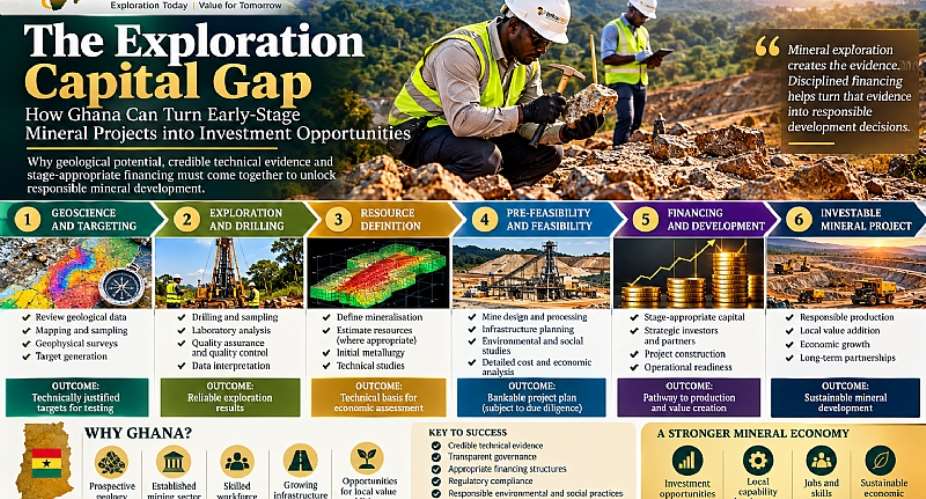
The challenge begins before the mine
Ghana has an established mining industry, a significant geological endowment and a long history of gold production. Yet the path from identifying a promising mineral occurrence to developing a commercially viable mining project remains complex. One of the most important challenges is access to appropriate exploration capital. Early-stage mineral projects often require geological mapping, geochemical sampling, geophysical surveys, drilling, laboratory analysis and independent technical interpretation before their economic potential can be assessed with confidence.These activities require funding before a project can demonstrate the level of certainty expected by many conventional investors.This creates a fundamental financing challenge: investors need credible evidence before committing substantial capital, but developing that evidence requires capital in the first place.
Addressing this gap is essential to building a stronger pipeline of credible, responsibly developed mineral projects in Ghana.
1. Exploration is a process of reducing uncertainty
Mineral exploration is not simply the search for gold or other valuable commodities. It is a staged technical process designed to test geological hypotheses and progressively reduce uncertainty.An exploration licence, promising geological setting or encouraging surface indication does not, by itself, establish a mineral resource or a commercially viable deposit.
A disciplined programme may involve:
- Reviewing historical exploration records and available geological data.
- Conducting geological mapping and appropriately designed geochemical or geophysical surveys.
- Defining targets and developing a technically justified drilling programme.
- Completing drilling, sampling, laboratory analysis and quality assurance and quality control.
- Interpreting results and, where the evidence permits, progressing towards a mineral resource estimate.
- Assessing metallurgy, mining conditions, infrastructure, environmental and social factors, and project economics at the appropriate stage.
Each phase should answer a specific technical question before the next major funding commitment is made.The objective is not to eliminate all uncertainty at once. It is to generate reliable evidence that supports better decisions about whether, where and how to invest further.
2. Why conventional financing can be difficult to secure
Many institutional investors and project financiers prefer opportunities supported by substantial technical information, clearly defined risks, credible management and a defensible commercial case.Early-stage exploration projects may not yet possess these characteristics.Their challenges can include limited historical data, uncertain drilling outcomes, insufficient working capital, incomplete environmental and social baseline information, and a lack of independent technical review.The result is a mismatch between the project’s immediate funding needs and the evidence required by potential financiers.This does not mean every early-stage project is a good investment waiting to be discovered. Some targets will not produce commercially meaningful results. Others may require more capital, time or infrastructure than originally anticipated.Effective financing must therefore recognise both the opportunity and the possibility of failure.
3. Match the funding instrument to the project stage
There is no single financing structure suitable for every mineral project. The appropriate approach depends on the quality of the evidence, the rights and obligations attached to the asset, the funding requirement and the investor’s risk tolerance.
Early-stage exploration: Founder capital, strategic partners, specialist exploration investors or appropriately structured joint ventures may support initial technical work.
Target definition and drilling: Funding can be released against an approved exploration programme, defined milestones, independent oversight and transparent reporting.
Resource definition and technical studies: As the evidence develops, specialist investors and strategic partners may consider larger commitments, subject to technical results, legal due diligence and commercial assessment.
Advanced development: Projects with sufficiently mature studies may be considered for more structured financing, strategic participation or other suitable capital arrangements. The availability and terms of such financing depend on demonstrated project economics, permitting, infrastructure, commodity-market conditions and other risks.These are potential pathways, not guaranteed sources of funding. Debt, in particular, may be unsuitable for a project that lacks reliable cash flow or a sufficiently developed basis for repayment.The principle is straightforward: financing should reflect the actual maturity of the asset, not the scale of the ambition.
4. Build investment readiness before approaching capital
A credible investment proposition requires more than a compelling geological narrative. Before engaging prospective investors, project sponsors should be prepared to demonstrate:
Legal and licence status. The relevant mineral rights, ownership arrangements, licence conditions and material obligations should be documented and independently checked.
Technical credibility. Available geological data, exploration methods, sampling procedures, laboratory results and interpretations should be organised and appropriately reviewed.
A defined work programme. The proposed expenditure should be connected to specific technical objectives, deliverables, timelines and decision points.
A transparent budget. Investors should be able to understand how funds will be allocated, how expenditure will be monitored and what happens if results differ from expectations.
Environmental and social responsibility. Applicable regulatory requirements, land access, stakeholder engagement, environmental risks and community considerations should be addressed from the beginning.
Clear governance. Decision-making authority, reporting responsibilities, conflicts of interest and the proposed rights of funding partners should be established before commitments are made. These measures do not guarantee financing. They help prospective investors assess the opportunity on a more consistent and informed basis.
5. Ghana’s opportunity extends beyond producing more gold
Ghana’s mineral economy can benefit when credible exploration programmes progress into technically sound and responsibly managed development projects. The opportunity is not simply to increase the number of exploration targets. It is to improve the quality of the project pipeline. That means strengthening geological data management, supporting competent technical work, improving transparency around mineral rights and project status, and encouraging financing arrangements that reflect the risks of each development stage.It also means recognising the wider value created by exploration and project development: skilled employment, geological and engineering services, laboratory capacity, equipment supply, environmental services and stronger local technical expertise. Domestic value addition remains important, but sustainable downstream investment depends in part on a reliable pipeline of projects supported by credible evidence, appropriate infrastructure and commercially defensible plans. Policy ambitions must therefore be matched by practical implementation, clear accountability and measurable outcomes.
6. The role of strategic partnerships
Where a project lacks the capital or technical capacity to advance independently, a strategic partnership may provide a practical route forward.A suitable partner might contribute exploration funding, technical expertise, equipment, project management capability or access to specialist networks.However, partnerships should be built on clear expectations rather than general expressions of interest.
The parties should agree on the scope of work, funding commitments, reporting standards, decision-making processes, ownership and participation arrangements, and the treatment of unsuccessful exploration results.Any transaction must also respect applicable Ghanaian law, mineral licensing requirements and relevant disclosure obligations. A partnership is valuable when it strengthens the project’s ability to generate reliable evidence and make sound development decisions not merely when it creates the appearance of investor interest.
7. A practical framework for evaluating exploration opportunities
Before committing capital or entering a partnership, four questions deserve particular attention:
- What is known? Which technical findings are documented, independently verifiable and appropriate to the project’s current stage?
- What remains uncertain? Which geological, legal, environmental, infrastructure or commercial risks could materially change the investment case?
- What will the proposed funding establish? Are the budget, work programme and milestones designed to answer clearly defined questions?
- What decision follows the results? Is there a transparent process for continuing, redesigning, pausing or terminating the programme based on the evidence?
These questions help separate a technically grounded exploration proposition from a promotional narrative. They also create a clearer basis for communication between project sponsors, technical professionals and potential funding partners.
Conclusion: Finance the evidence, not just the ambition
Ghana’s next generation of mineral projects will require more than geological opportunity. It will require disciplined exploration, credible technical reporting, appropriate capital structures, responsible project development and partnerships founded on transparency.The exploration capital gap cannot be solved by expecting investors to absorb uncertainty without adequate information. Nor can it be solved by demanding advanced-stage evidence from projects that have not yet had the resources to generate it. The more constructive approach is to finance clearly defined stages of technical work, establish measurable milestones and allow verified results to guide subsequent investment decisions. For project sponsors the task is to demonstrate what is known, disclose what remains uncertain and explain precisely how new capital will advance the project. For investors, the challenge is to distinguish speculative potential from evidence-based opportunity and to structure commitments in a way that reflects the actual risks involved. Mineral exploration creates the evidence. Disciplined financing helps turn that evidence into responsible development decisions. Ghana has an opportunity to strengthen this connection and in doing so build a more credible, resilient and sustainable mineral project pipeline.


 We are going to provide emergency airstrip in regions without airports — Mahama
 'Double standards are not helpful, wrong yesterday is wrong today' – Ablakwa on ...
 'I am disappointed in govt for suspending ban on bus preaching' — Apostle Asempa...
 NPP has resolve internal wrangling — Bawumia
 Ghana, US Virgin Islands agree on recruitment of Ghanaian teachers, nurses
 Never Again: Mahama Pushes for Local Vaccine Manufacturing After COVID‑19
 ‘No Borrowing Involved’ — Mahama Rolls Out US$10bn New Economy Policy
 “Ask Jean Mensa to resign first”—Tanko-Computer fires back
 Police arrest 41 suspects in Lapaz and Chantan narcotics operation


