




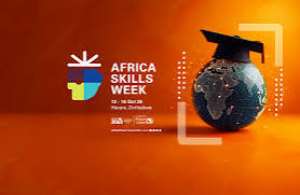
Africa’s education systems have produced millions of certificate holders, yet employers across the continent continue to struggle to find technicians, machinists, engineers, digital specialists and skilled production workers. Africa Skills Week 2026 confronted this contradiction with a direct message: education must lead not only to graduation, but also to employment, productivity, innovation and value creation.
The third edition of Africa Skills Week was held at the Harare International Conference Centre in Zimbabwe from October 12 to 16, 2026. Convened by the African Union Commission and the Government of Zimbabwe, it brought together policymakers, employers, training institutions, labour organisations, development partners and young people under the theme, “Skills for Resilient and Competitive African Industries: From Training to Value Creation.” Previous editions were hosted by Ghana in 2024 and Ethiopia in 2025. �
African Union
The central argument emerging from Harare was that Africa cannot achieve industrial transformation while its education and training systems remain disconnected from the needs of the economy. Technical and Vocational Education and Training must respond directly to agriculture, agro-processing, manufacturing, mining, construction, energy, logistics and other productive sectors.
Africa’s challenge is particularly urgent because of its rapidly expanding youth population. According to the African Union, more than 12 million young Africans enter the labour market every year, while the formal economy absorbs only about three million. Unless countries create more productive enterprises and equip young people with practical and commercially relevant skills, the demographic dividend could become a source of unemployment, frustration and social instability. �
African Union
Opening the conference, Zimbabwean President Emmerson Mnangagwa called for greater investment in relevant skills, workplace learning and enterprise development. He argued that Africa must move beyond predominantly theoretical education towards practical knowledge and technical capability.
That shift is essential if the continent is to reduce its dependence on raw commodity exports. Africa possesses enormous mineral and agricultural resources, but much of their processing and value addition still takes place elsewhere. The continent consequently exports raw materials and imports finished products at considerably higher prices, surrendering jobs, industrial knowledge and income in the process.
Reversing this pattern requires more than factories, roads and machinery. It demands trained people who can operate, maintain and improve industrial systems. A processing plant without competent technicians will eventually become idle equipment. Digital infrastructure without skilled users will not produce innovation. Industrialisation is therefore as much an investment in human capability as it is an investment in physical infrastructure.
Africa Skills Week promoted stronger partnerships between training institutions and employers so that curricula reflect actual labour-market demand. It also highlighted apprenticeships, internships, dual-training programmes, recognition of prior learning and other forms of workplace-based education. These approaches can help young people acquire practical experience while allowing industries to participate directly in developing the talent they require.
Digital literacy, artificial intelligence, robotics and green technologies were also prominent in the discussions. The African Union warned that young Africans must become creators and innovators, rather than merely consumers of imported technology. At the same time, it stressed that digital transformation should remain inclusive and human-centred, with teachers empowered to use technology effectively. �
African Union
The International Labour Organization described the event as a continental implementation platform for accelerating employability, productivity, decent job creation, lifelong learning and sustainable industrial transformation. Its agenda included skills forecasting, labour-market information systems, sector skills bodies, inclusive training and stronger employer–worker consultation. �
International Labour Organization
The Harare deliberations were also intended to support the implementation of the Continental Education Strategy for Africa 2026–2035 and the Continental TVET Strategy 2025–2034. Better coordination among education, labour, trade and industry ministries will be essential because skills policies cannot succeed when they are designed independently of national industrial priorities.
This alignment has implications for the African Continental Free Trade Area. A continental market may remove barriers to trade, but Africa will not gain its full benefits without competitive enterprises and a mobile, properly trained workforce. Harmonised occupational standards could make it easier for skilled workers to move across borders and support regional value chains in agro-processing, automotive manufacturing, pharmaceuticals and other priority industries. The African Union estimates that the AfCFTA brings together an economic market with a combined gross domestic product of approximately US$3.4 trillion. �
African Union
Among the proposed outcomes were an industry partnership and work-based learning compact, a TVET financing roadmap, measures for improving labour-market responsiveness and a declaration supporting an annual Africa Education and Skills Summit. Such a summit could provide sustained political leadership, financing and accountability for skills development. These were presented as expected outcomes, however, and their true significance will depend on formal adoption and implementation by member states. �
International Labour Organization
Africa Skills Week 2026 has therefore set an important direction, but conferences alone cannot solve the continent’s employment and industrialisation problems. Governments must modernise training workshops, support instructors, finance apprenticeships, engage employers in curriculum design and measure graduates by what they can produce—not simply by the certificates they possess.
The real test begins after Harare. It will be seen in national budgets, revised curricula, functioning training centres, credible apprenticeships and factories employing African talent. If those commitments are implemented, Africa’s young population could become the skilled workforce behind a new era of industrial growth. If implementation fails, the continent will continue producing graduates for jobs that do not exist while industries search for skills they cannot find.
Africa’s future will not be secured by diplomas alone. It will be built by people who can design, manufacture, process, repair, innovate and transform the continent’s resources into lasting prosperity.


 We are going to provide emergency airstrip in regions without airports — Mahama
 Nana Konadu maiden memorial mass set for October 23
 'Double standards are not helpful, wrong yesterday is wrong today' – Ablakwa on ...
 'I am disappointed in govt for suspending ban on bus preaching' — Apostle Asempa...
 NPP has resolve internal wrangling — Bawumia
 Ghana, US Virgin Islands agree on recruitment of Ghanaian teachers, nurses
 Never Again: Mahama Pushes for Local Vaccine Manufacturing After COVID‑19
 “Soldiers Will Stay There”—Mahama Declares Permanent Military Presence in Forest...
 ‘No Borrowing Involved’ — Mahama Rolls Out US$10bn New Economy Policy
 “Ask Jean Mensa to resign first”—Tanko-Computer fires back


