





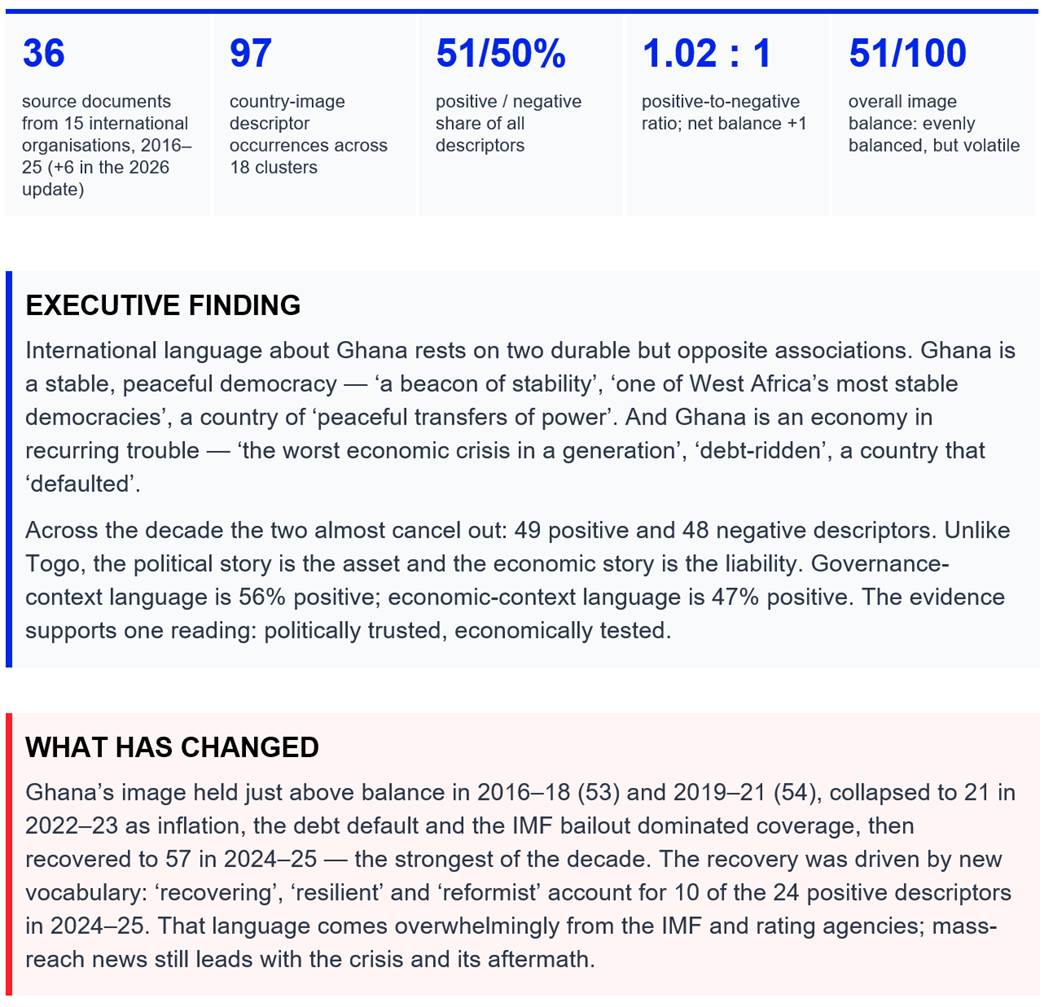
International media hold two firm views of Ghana: a stable, peaceful democracy, and an economy that keeps sliding into crisis. Across 36 source documents and 97 descriptors from 2016 to 2025, positive and negative language is almost exactly balanced — but the balance hides a sharp swing. Ghana’s image collapsed during the 2022–23 debt crisis and has since recovered to its strongest level of the decade. This study maps that swing and what it may mean for investors.
Few things shape how the world sees a country as quietly as the adjectives attached to it. When international media repeatedly describe a country as stable or unstable, open or repressive, investor-friendly or risky, those words do more than report: they build a mental picture of the place. Over time, that picture can influence a country’s image, how investors perceive it and its standing among other nations.
Repeated descriptors function as country-image signals. When the same descriptions recur across credible international sources, they can reinforce associations that shape how external audiences read opportunity, risk, stability and trust. This study does not claim that adjectives directly cause investment decisions. Its findings are framed as reputational signals, possible investor interpretations and potential latent implications.
This is the second country in a series examining how international descriptors have been assigned to West African countries over the past decade. The first edition, on Togo, found an image that was economically promising but institutionally contested. Ghana turns out to be close to the mirror image: institutionally trusted, but economically volatile.
About the data
The core study covers January 2016 to December 2025. Material from January to October 2026 is reported separately and excluded from all decade figures. The corpus was built through a systematic open-source search of credible international sources: wire services and international news outlets, multilateral and economic institutions, rating agencies, a foreign-government investment assessment, and rights and press-freedom organisations. Ghanaian government statements and promotional or investment-promotion material were excluded as sources.
Each document was read and every descriptor that characterises Ghana as a country was recorded with its polarity (positive or negative), its context (political, governance, economic, security, environmental or rights) and the cluster it belongs to. Each cluster is counted once per document. Purely geographic labels such as ‘West African nation’ were not counted. Wire copy republished by other titles is attributed to the originating agency. The image-balance score used throughout is the share of descriptors that are positive, on a 0–100 scale where 50 means balanced.
THE HEADLINE NUMBERS
The Adjective Effect at a glance
SECTION 1
The composite adjective picture
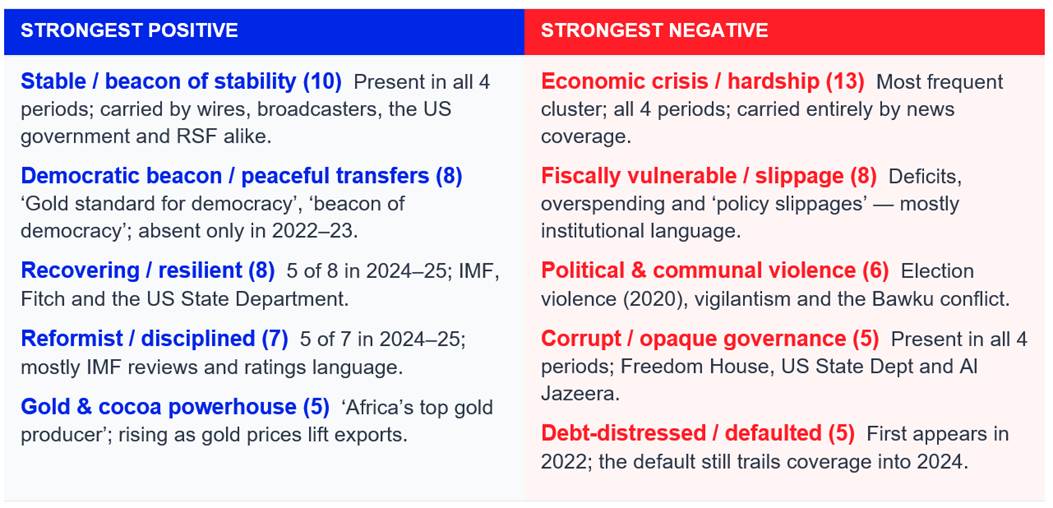
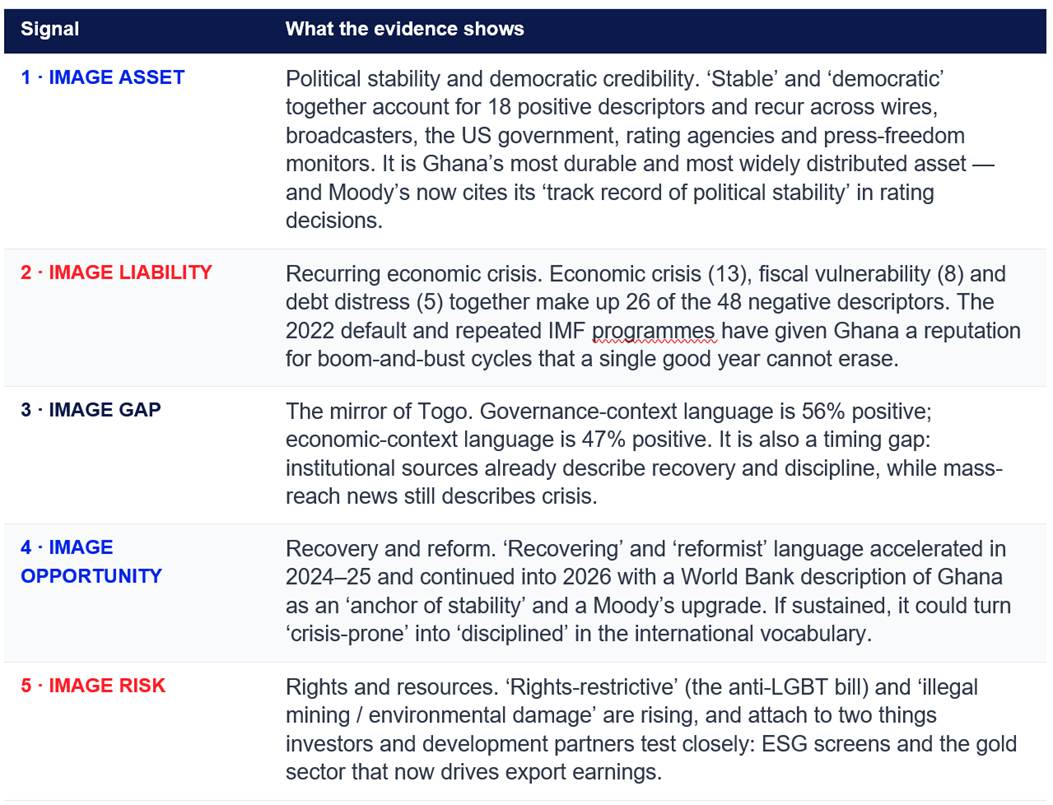
The single strongest positive association international audiences have with Ghana is political stability. It is the leading positive cluster (10 occurrences), one of only four clusters present in every period, and it is carried by every type of source: wire services, broadcasters, the US government, rating agencies and press-freedom monitors. Closely linked is Ghana’s democratic record (8), built on repeated peaceful transfers of power between rival parties.
The single strongest negative association is economic crisis and hardship (13 occurrences), the most frequent cluster overall and also present in every period. It is carried almost entirely by news coverage — every one of its 13 occurrences comes from a news outlet — and peaked during the 2022–23 debt crisis.
Chart 1 · All positive and negative descriptor clusters, 2016–2025
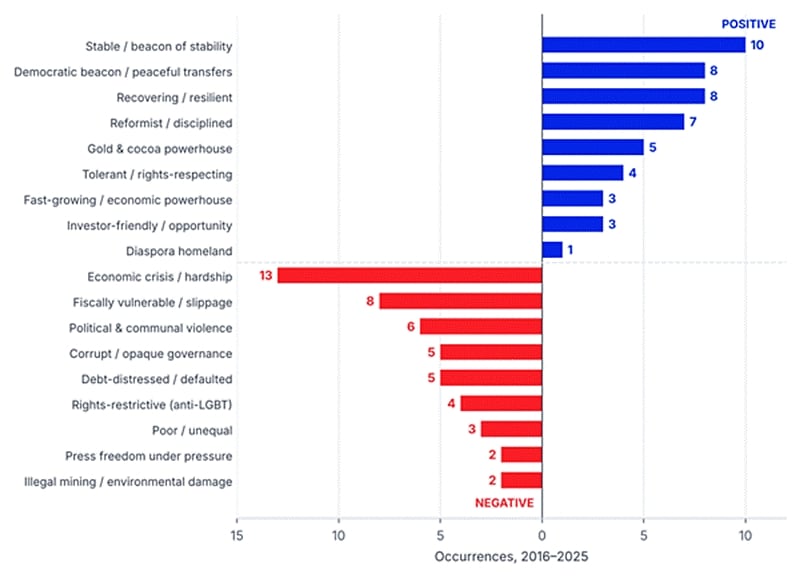
Source: Analysis of international open-source material, 2016–2025. One count per cluster per document.
The balance of description
Table 1 · Core frequency metrics, 2016–2025
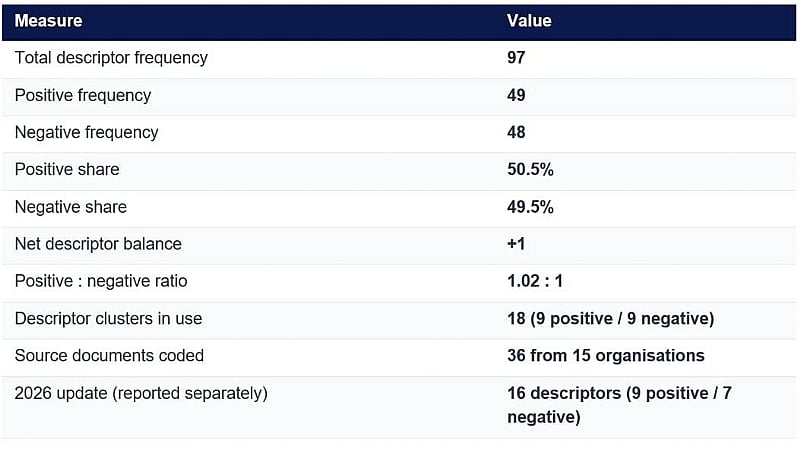
Table 2 · Positive and negative descriptors by source type
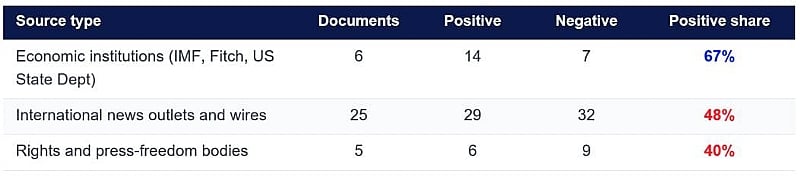
The source-type split is milder than Togo’s but runs the same way. Economic institutions are the most positive voices: the IMF, Fitch and the US State Department’s investment assessments contribute two positive descriptors for every negative one, mostly about recovery, reform and stability. News coverage is evenly split. Rights and press-freedom bodies lean negative, but even they credit Ghana’s democratic record: Freedom House rates Ghana ‘Free’, and RSF has called it a regional leader in democratic stability.
The strongest descriptors on each side
SECTION 2
Which outlets describe Ghana most negatively — and most positively?
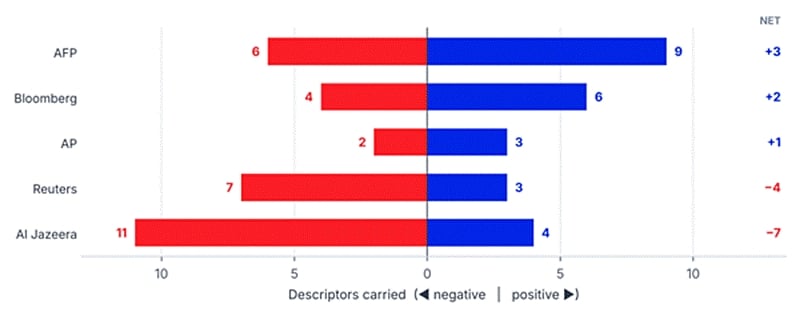
This companion analysis isolates the international news outlets in the corpus: 25 news documents from eight outlets, with institutional and rights bodies excluded. The chart covers the five outlets with two or more documents.

Chart 2 · Positive and negative descriptors by international news outlet, sorted by net balance
Source: Analysis of international open-source material, 2016–2025. One count per cluster per document. Single-document outlets (NPR, CBS News, ABC News) are shown in Table 3 only.
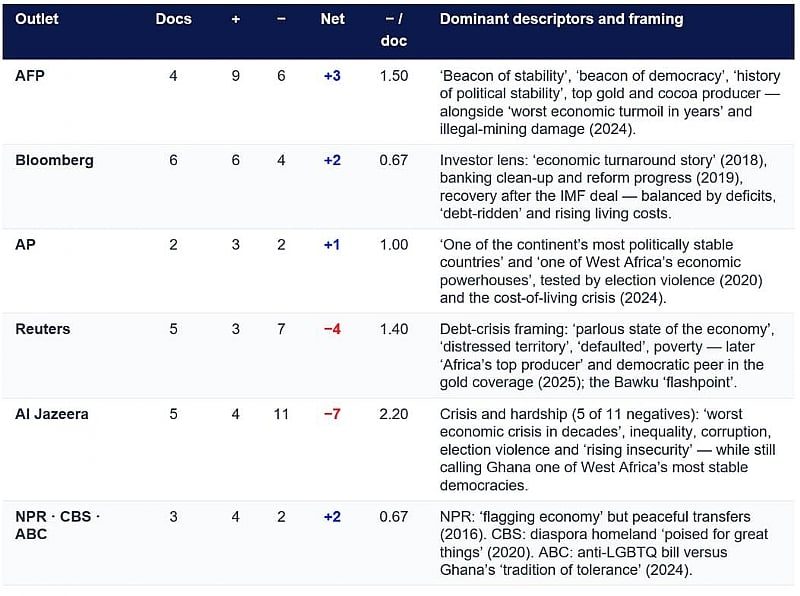
Table 3 · Outlet-level descriptor profile
What the outlet pattern suggests
- The negative weight is economic, not political. Unlike Togo, no outlet in the corpus describes Ghana as autocratic or repressive. Al Jazeera and Reuters account for 18 of the 32 negative news descriptors, and most of them concern inflation, debt and hardship.
- The stability reputation is carried by mass-reach news. AFP, AP and Al Jazeera all repeat Ghana’s stability and democratic credentials, often in the same article as the economic bad news. Ghana’s positive political story reaches the general public — the reverse of Togo, where the positive story sat in low-reach specialist sources.
- The recovery story has not yet reached the wires. ‘Recovering’ and ‘reformist’ language in 2024–25 comes mainly from the IMF and rating agencies. News coverage of the same period still leads with the cost-of-living crisis, the default and illegal mining.
READ WITH CARE
Samples are small: most outlets contribute between one and six documents, and totals depend on how many were retrieved — hence the per-document rate. Descriptors often report events or quote others (protesters, analysts, the US State Department), so this measures the language each outlet carried about Ghana, not editorial bias. Some Al Jazeera items draw on Reuters and AFP copy. The corpus is not exhaustive: material from the BBC, DW, RFI, the Financial Times, The Guardian, Jeune Afrique and Le Monde was not coded.
SECTION 3
How the image has moved, 2016–2025
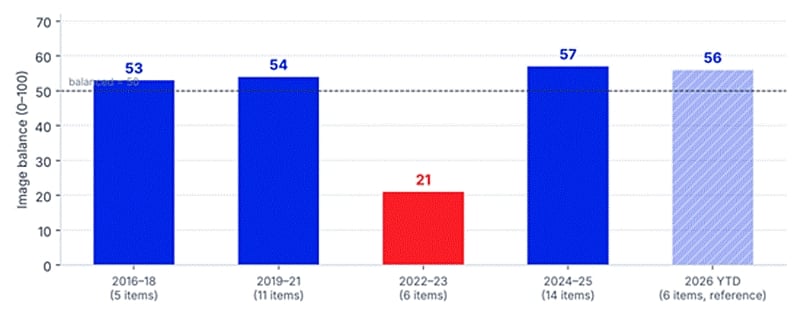
Chart 3 · Image-balance score by period (share of descriptors that are positive)
Source: Analysis of international open-source material, 2016–2025. 2026 is shaded and shown for reference only (6 documents). Period samples are small and uneven, particularly 2016–18 (5 documents).
For most of the decade Ghana’s international image sat just above balance. In 2016–18 a democratic handover and the language of ‘beacon of stability’ and ‘gold standard for democracy’ offset a ‘flagging’ economy. In 2019–21 stability language peaked — five of the ten ‘stable’ descriptors fall in this period — even as the 2020 election produced deadly violence and coverage of rising insecurity.
Then the image collapsed. In 2022–23 Ghana’s score fell to 21: soaring inflation, ‘the worst economic crisis in a generation’, a debt default and an IMF bailout crowded out almost everything else, and democratic-beacon language disappeared from the sample entirely. By 2024–25 the image had recovered to 57, the strongest of the decade. A peaceful 2024 transfer of power revived the democratic and stability language, and a new economic vocabulary of recovery and reform emerged.
Two shifts inside the numbers matter most. First, the negative vocabulary is moving from macroeconomics to governance and environment: ‘rights-restrictive’ (three of four occurrences in 2024–25) and ‘illegal mining’ (both occurrences in 2024–25) are new or rising. Second, the economic recovery is so far an institutional story; it has not yet displaced crisis language in mass-reach news.
SECTION 4
What the evidence suggests Ghana could consider
Table 4 · Country-image signals
Author’s recommendations
Evidence-based and politically neutral.
R1 · Protect the stability asset. Ghana’s democratic and stability reputation is its strongest international signal. Peaceful, transparent elections, credible handling of election-related violence and visible progress on long-running local conflicts such as Bawku protect an asset that is already widely believed.
R2 · Make the recovery durable and visible. Crisis language will only fade when recovery is sustained across cycles. Regular, verifiable releases on fiscal outturns, arrears clearance, debt metrics and energy-sector finances — data third parties can cite — are more likely to move the vocabulary than promotional campaigns.
R3 · Address the emerging governance liabilities. The rising negative clusters reflect reported conditions: illegal mining and pollution, legislation criticised by rights bodies, and attacks on journalists. Measurable action — enforcement outcomes in the mining sector, rights-compatible legislation and accountability for attacks on the press — matters more than presentation.
R4 · Monitor descriptor velocity. Track emerging and accelerating language monthly — especially ‘debt’, ‘rights-restrictive’ and ‘illegal mining’ on the risk side, and ‘recovering’, ‘disciplined’ and ‘investor-friendly’ on the opportunity side.
R5 · Establish a country-image early-warning system. A Ghana Country Image & Latent Risk Observatory would track frequency, velocity, persistence, source authority, geographic spread, issue association, investment relevance and trust and risk signals, and flag movement along the ladder below.
The descriptor escalation ladder
| ISOLATED › | RECURRING › | ACCELERATING › | DOMINANT › | ENTRENCHED |
Current positions: ‘stable’ is entrenched on the positive side; ‘economic crisis’ is entrenched on the negative side but receding; ‘recovering’ and ‘reformist’ are accelerating; ‘rights-restrictive’ is recurring; ‘illegal mining’ is isolated but new. Possible observatory outputs include a monthly Country Image Pulse, a quarterly Country Image Index, descriptor-velocity and emerging-risk alerts, an Investment Perception Monitor and executive advisory briefs.
2026 UPDATE · JANUARY–OCTOBER, REPORTED SEPARATELY
Six documents and 16 descriptors (9 positive, 7 negative) — too few to score formally, though the direction is positive. On the positive side: the World Bank’s managing director called Ghana an ‘anchor of stability for the region’ and praised a remarkable improvement in its finances; Moody’s upgraded Ghana to B3 in October, citing fiscal discipline and political stability; and Ghana rose from 52nd to 39th in the RSF World Press Freedom Index. On the negative side: Freedom House held Ghana at 80/100 (down from 83 in 2018), again citing weaknesses in judicial independence, corruption, discrimination against LGBT+ people and political violence; Amnesty International reported attacks on journalists and environmental damage from mining; and analysts described the economic gains as still fragile for households.
CONCLUSION
Author’s judgement: politically trusted, economically tested
Ghana’s international image is politically strong but economically volatile. The strongest positive signal is stability and democratic credibility, carried consistently by mass-reach news as well as institutions. The strongest negative signal is recurring economic crisis, which drove the image to its decade low in 2022–23 and still dominates news coverage.
The most important latent implication is a lag: institutional readers — the IMF, rating agencies, development partners — already see recovery and discipline, while the wider public reading news still sees crisis and default. The most likely investment implication is a sovereign-risk premium rather than political-risk exclusion: Ghana is trusted to remain stable, but not yet trusted to remain solvent.
The most important recommendation is for Ghana to make its fiscal recovery durable and independently verifiable, while protecting the stability asset and addressing the emerging rights and illegal-mining liabilities before they become entrenched.
Author’s independence.
The author is independent, non-partisan and politically neutral. This study does not promote, defend, attack or discredit the Government of Ghana or any party, official, institution or opposition group. It measures how international information environments describe Ghana and what those descriptions may signal.
About the author.
Messan Mawugbe, PhD
[email protected]

 We are going to provide emergency airstrip in regions without airports — Mahama
 Nana Konadu maiden memorial mass set for October 23
 'Double standards are not helpful, wrong yesterday is wrong today' – Ablakwa on ...
 'I am disappointed in govt for suspending ban on bus preaching' — Apostle Asempa...
 NPP has resolve internal wrangling — Bawumia
 Ghana, US Virgin Islands agree on recruitment of Ghanaian teachers, nurses
 Never Again: Mahama Pushes for Local Vaccine Manufacturing After COVID‑19
 “Soldiers Will Stay There”—Mahama Declares Permanent Military Presence in Forest...
 ‘No Borrowing Involved’ — Mahama Rolls Out US$10bn New Economy Policy
 “Ask Jean Mensa to resign first”—Tanko-Computer fires back


