




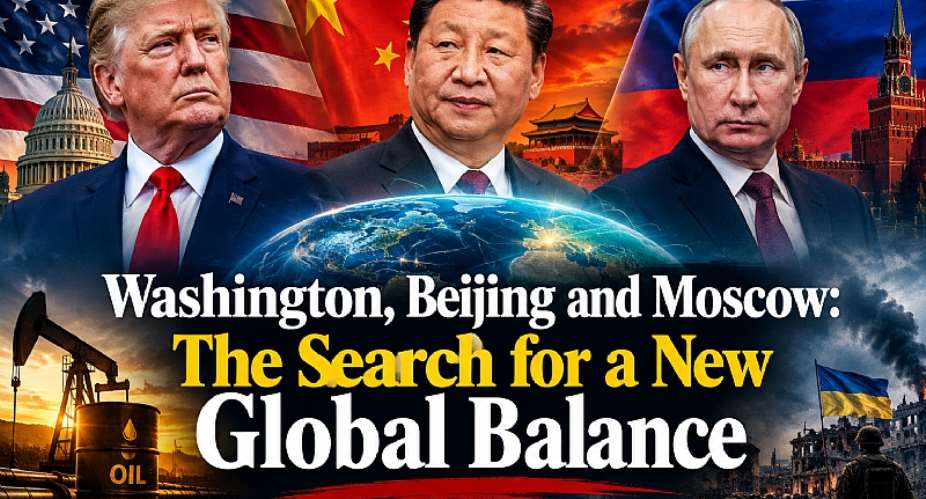
It is often said that if peace cannot unite opponents, war eventually forces them to reconsider their differences. The geopolitical recession that has emerged from competing strategic interests, artificial intelligence (AI), oil sanctions and the war involving Iran may now be approaching a diplomatic turning point. The conflicts are far from over, and negotiations could remain slow and uncertain. Nevertheless, growing economic pressures and the costs of prolonged confrontation raise an important question: Are Washington, Beijing and Moscow moving towards a pragmatic understanding of their shared global responsibilities?
Did China Get a Strategic Gift in Iraq?
The reported Trump–Xi engagement raises questions about whether economic incentives can encourage strategic restraint. If Beijing limits direct involvement in the Iran conflict, could Washington respond by allowing China greater flexibility in accessing regional energy markets? More importantly, could Iraq become the next arena for an emerging American-Chinese economic bargain?
Iraq faces competing demands: maintaining its economic stability, managing energy revenues and navigating relations with Washington, Tehran and Beijing. Any reduction in American involvement would create opportunities for other powers, although it would not automatically eliminate the United States' political and security influence. Baghdad could therefore seek to diversify its economic partnerships, while Washington might welcome a greater Chinese contribution to regional economic stability.
China's access to discounted Iraqi oil, however, should be treated as a possibility rather than an established outcome. The wider question is whether Beijing can use its economic influence to encourage de-escalation without compromising its strategic relationships.
Iran's diplomatic engagement with China, including Foreign Minister Abbas Araghchi's reported outreach ahead of high-level American-Chinese discussions, also invites scrutiny. Could Beijing serve as a mediator when direct negotiations become politically difficult? And could Washington secure greater regional restraint while China protects its energy interests?
Such an arrangement would not necessarily constitute surrender by any party. Instead, it could represent the familiar diplomatic principle of reciprocal concessions: each side gives something to secure an outcome it considers more valuable. Can this give-and-take approach break the diplomatic deadlock without creating another cycle of strategic dependency?
How Could Russian Oil Sanctions Rekindle the War?
The second dimension concerns Russia and the international energy market. If Washington eases restrictions on Russian fuel supplies to address shortages and price pressures, Moscow gains economic relief while American consumers and international markets may benefit from additional supply. Yet such arrangements could undermine the pressure intended to influence Russia's conduct in Ukraine.
President Donald Trump's reported announcement of additional Russian diesel supplies illustrates this dilemma. Temporary fuel arrangements may ease immediate market pressures, but they cannot guarantee sustained price reductions, particularly if Russian refining capacity remains damaged. The reported volumes and delivery commitments also require independent verification.
The political consequences could be equally significant. If Kyiv interprets an American-Russian energy arrangement as a unilateral concession to Moscow, trust between Washington and Ukraine could deteriorate. Conversely, Washington may argue that stabilising energy markets is a practical necessity while negotiations continue.
Can energy cooperation with Moscow coexist with meaningful pressure for peace in Ukraine?
The reported continuation of Russian strikes, including attacks causing civilian casualties, makes this question especially urgent. Civilian protection cannot become secondary to energy calculations. Any credible settlement must address Ukraine's security, territorial concerns and the humanitarian consequences of the war.
European governments and the United Kingdom also face a difficult choice. Should they reinforce sanctions against Russia when Washington pursues selective energy cooperation, or coordinate a common strategy that combines economic pressure with diplomatic engagement? A divided Western approach could weaken negotiating leverage and prolong uncertainty.
Can Great-Power Competition Become Shared Responsibility?
The emerging picture is not necessarily a formal trilateral agreement. Rather, it reflects the possibility that Washington, Beijing and Moscow may increasingly recognise the limits of confrontation. The Middle East, Ukraine and global energy markets are interconnected: disruption in one region affects prices, trade, political stability and economic security elsewhere.
AI competition adds another dimension. As technological rivalry intensifies, the absence of international safeguards could widen strategic mistrust. The same powers competing for technological and economic advantage must also consider the humanitarian consequences of their decisions.
Can the world's major powers move beyond a race for dominance towards a framework of mutual restraint and accountability?
A durable diplomatic consensus would require more than oil bargains or temporary ceasefires. It would need transparent negotiations, respect for national sovereignty, civilian protection and credible mechanisms for resolving disputes. Neither economic necessity nor great-power pragmatism alone can guarantee peace.
Ultimately, the objective should not be to divide the world into spheres of influence, but to establish a balance in which competition does not continually produce war. If Washington, Beijing and Moscow can translate their overlapping interests into consistent consultation, a new diplomatic opening may emerge.
The decisive question remains: Will the world's major powers use their leverage to manage conflict—or continue to treat instability as an instrument of power?


 Trump says Russia, Ukraine agree to energy ceasefire – 'news for me', Zelensky s...
 Ethiopia intel chief visits flashpoint Tigray region
 Djibouti boat wreck leaves 139 migrants dead, 84 missing: UN
 Brazil's Lula accuses social media giant Meta of election interference amid tigh...
 Upper Dixcove: Dumsor is killing our business – Chief Fisherman
 South Africa protests: Ghanaians warned to limit travel in Johannesburg and Durb...
 UN cautions against forced tenant evictions without prior consultation
 UN advises Ghana to strengthen Rent Control Department with requisite logistics
 ECG announces three-day power outages in parts of Accra from Monday
 Ghana’s banking assets rise to GH¢500.2billion


