




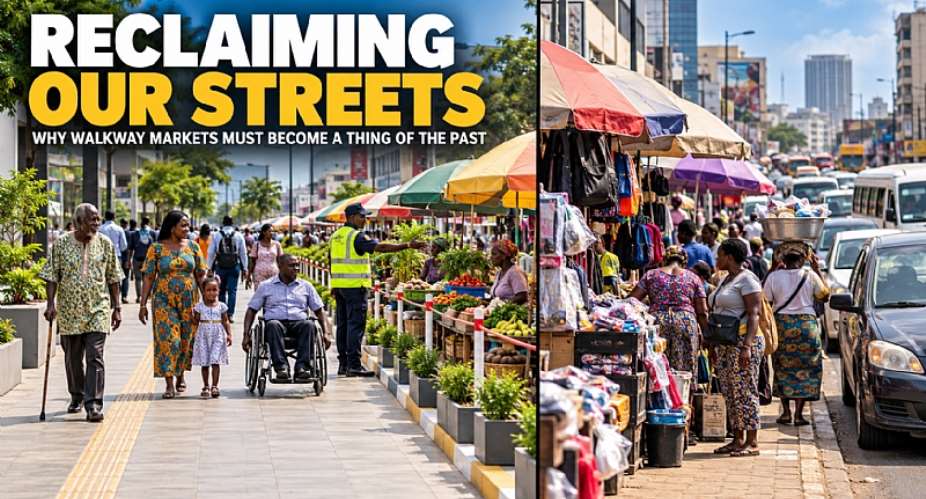
Walk through the commercial centres of Accra, Kumasi and several other Ghanaian cities, and one contradiction immediately becomes apparent. Roads, pavements, footbridges and drainage corridors constructed with public funds are steadily being overtaken by unauthorised trading.
From Accra Central, Kaneshie and Kwame Nkrumah Circle to Kejetia and Adum in Kumasi, pedestrian walkways have become extensions of markets. Tables, wooden stalls, umbrellas, containers and merchandise occupy spaces originally designed to protect people walking through busy commercial areas.
The entrepreneurial energy of Ghanaian traders must be recognised. Street trading supports thousands of families and provides affordable goods to commuters. Many traders operate from pavements because they cannot afford formal shops or because existing markets are overcrowded, poorly maintained or located away from customer traffic. Their economic circumstances deserve understanding, but hardship cannot justify converting public walkways into private trading spaces.
A pavement is first and foremost a safety facility. When it is occupied, pedestrians—including children, older people and persons with disabilities—are forced onto the road, where they compete with cars, buses, motorcycles and commercial vehicles.
This is not a minor inconvenience. Accra’s 2024 Road Safety Report found that pedestrians accounted for 56 per cent of road-traffic deaths in the city. Nationally, pedestrian knockdown deaths reportedly increased from 590 in 2024 to 704 in 2025. During the first four months of 2026 alone, 666 pedestrian knockdowns and 181 deaths were recorded across Ghana.
Not every pedestrian death is caused by pavement trading, but forcing people into active traffic clearly increases their exposure to danger. No trader’s need to earn an income should deprive another citizen of the right to walk safely.
The occupation of walkways also worsens congestion. Buyers stop in narrow spaces, vehicles slow down to pick up passengers beside trading areas and delivery trucks block lanes while loading goods. Emergency vehicles may struggle to move through congested commercial districts. What begins as an individual attempt to make a living eventually imposes delays, risks and economic costs on thousands of other people.
Sanitation is another concern. Many informal trading areas lack sufficient waste containers, toilets and organised collection services. Plastic bags, food waste, cardboard and discarded packaging can accumulate around pavements and enter nearby gutters.
It would be inaccurate to claim that walkway trading is the sole or leading cause of urban flooding. Flooding in Accra is driven by several interconnected factors, including inadequate drainage capacity, development in waterways, intense rainfall, poor planning and weak solid-waste management. However, waste entering drains reduces their effectiveness and aggravates flood risks. The government and World Bank have committed substantial resources through the Greater Accra Resilient and Integrated Development Project to improve drainage and solid-waste management for millions of residents. Public behaviour must support, rather than undermine, that investment.
The occupation of pavements also damages the appearance and accessibility of Ghanaian cities. A country positioning itself as a centre for tourism, trade and investment cannot accept commercial districts where pedestrians must squeeze between stalls, vehicles and open drains. Clean and walkable cities are not luxuries reserved for wealthy countries; they are evidence of functioning local government and civic responsibility.
Municipal assemblies have repeatedly attempted to address the problem. In May 2025, the Accra Metropolitan Assembly began clearing unauthorised trading activities from parts of the Central Business District. In February 2026, it introduced another operation involving several neighbouring assemblies and directed traders to remain behind designated red lines. Kumasi authorities have undertaken similar exercises around Kejetia, the Central Market and other congested areas.
The repetition of these exercises reveals the weakness of eviction without long-term planning. Traders are removed, the task force withdraws and, within weeks or months, the same pavements are occupied again. Sustainable decongestion requires consistent enforcement, political courage and workable alternatives.
Assemblies should identify unused stalls in existing markets, publish transparent allocation procedures and offer affordable payment arrangements to low-income traders. New markets must be located near transport routes and designed with sanitation facilities, storage areas, security, lighting and convenient access for customers. Where pavements are wide enough, carefully demarcated trading zones may be permitted, provided an adequate path remains open for pedestrians. Accra’s red-line policy offers one attempt to balance livelihoods with movement, but it must be monitored consistently.
Enforcement must also respect human dignity. Beating traders, destroying goods or demanding unauthorised payments cannot be accepted as decongestion. Assemblies should provide notice, engage trader associations and establish clear procedures for confiscated goods and appeals. Officers accused of extortion or abuse must be investigated.
Traders, in turn, must accept that public space belongs to everyone. Paying a daily toll or unofficial fee does not convert a pavement into private property. Market associations should help maintain discipline, organise waste collection and discourage members from returning to restricted areas.
Ghana does not have to choose between livelihoods and orderly cities. It can protect both through proper market planning, fair enforcement and sustained public education. Periodic operations designed for publicity will not solve the problem. What is required is a permanent urban-management policy supported by suitable trading spaces and consistent consequences for encroachment.
Our pavements must once again become safe places for walking. Reclaiming them is not an attack on enterprise; it is a defence of public safety, sanitation, accessibility and the collective right to a well-managed city.


 1,568 new lawyers must use law to advance justice — Chief Justice
 GH¢800,000 worth of goods lost in Kia Rhino truck fire at Amanfrom
 I never said Ghana has more nurses than it needs — Akandoh
 I have tried reaching Boakye Agyarko after NPP chairmanship race, but to no avai...
 Ghana’s Corporate Illusion: Why We Celebrate Professional Titles More Than Natio...
 Sam George, Armah-Kofi Buah, Phyllis Naa Koryoo and OPK among 1,568 lawyers call...
 Visa scandal: 'Ampofo Ankrah’s suspension not enough; Kofi Adams must also step ...
 'Let integrity, discipline guide your conduct' — Samson Lardi tells new lawyers
 Labour Minister optimistic teachers will suspend strike by close of day
 Dr Ato Forson urges MMDCEs to eliminate waste in public spending


