




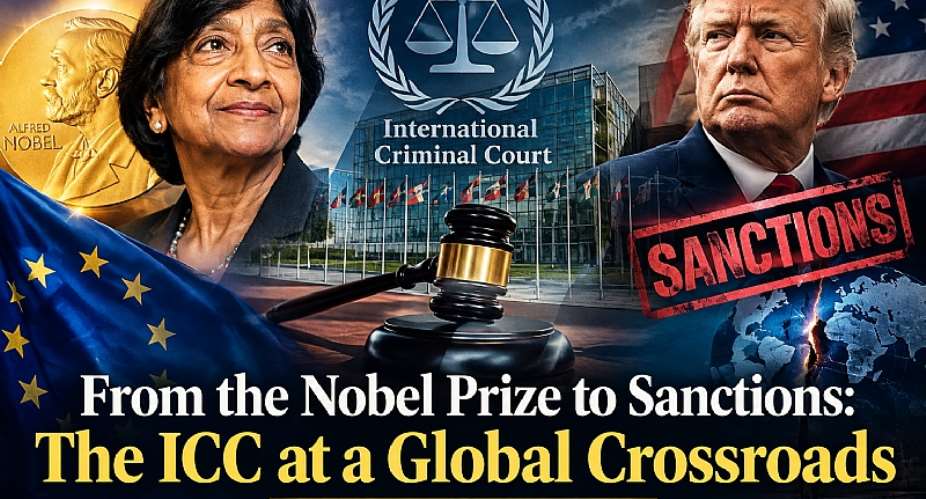
The international order is approaching another crossroads. On Friday, 9 October 2026, the Nobel Peace Prize was awarded to South African jurist Navi Pillay for her efforts to promote peace and international law. A former judge of the International Criminal Court (ICC) and former UN High Commissioner for Human Rights, Pillay has spent decades defending human rights and international accountability. In a light-hearted remark following the announcement, she joked that she might share the prize with Donald Trump if her colleagues applauded more enthusiastically. Yet, what followed transformed the moment of celebration into a serious diplomatic test: the United States announced sanctions against the ICC.
Is Europe witnessing a turning point in its relationship with Washington, or are American policies simply accelerating an existing transatlantic divide?
How did Washington respond?
Hours after the Nobel announcement, US Secretary of State Marco Rubio declared that President Trump would not permit the ICC to prosecute Americans. Washington announced sanctions intended to restrict transactions with the court and potentially disrupt its access to banking, insurance, technology and other essential services. The measures include a six-month transition period for affected American companies, alongside specified exemptions.
The Trump administration has long opposed the ICC's investigations involving American personnel and its arrest warrants for Israeli leaders, including Prime Minister Benjamin Netanyahu. Washington argues that the court's actions threaten American sovereignty and exceed its legitimate authority. However, critics contend that if international justice is to be credible, can powerful states demand accountability for others while resisting scrutiny of their own conduct and that of their allies?
The ICC has pursued cases involving individuals from different countries, including Russian President Vladimir Putin and former Libyan leader Muammar Gaddafi. The legal circumstances differ between cases, and the court's jurisdiction is not universal. Nevertheless, selective cooperation with international justice raises a fundamental question: Can the rule of law retain its credibility when political alliances determine which investigations powerful governments support?
Can the ICC survive the pressure?
The ICC rejected the sanctions, describing them as an attack on an independent judicial institution and the international legal order. Its officials have vowed to continue investigations and prosecutions within the court's mandate. The tribunal has also called upon its member states to provide practical and political support.
Founded under the Rome Statute in 2002, the ICC prosecutes genocide, crimes against humanity, war crimes and, under specific conditions, the crime of aggression. It is not a substitute for national courts, nor does it possess universal jurisdiction over every alleged international crime. Its effectiveness depends substantially on state cooperation, including assistance with arrests, evidence and institutional operations.
This makes the European response particularly significant. EU countries are parties to the Rome Statute, and the court is headquartered in the Netherlands. European governments must now consider whether to strengthen financial and technological safeguards, coordinate diplomatic resistance and explore legal mechanisms to protect European entities from the extraterritorial effects of American sanctions.
Will Europe defend an institution whose principles it formally supports, even when doing so creates friction with its principal security ally? France, Spain, Italy and other European states must balance their positions on international justice with their respective security and diplomatic relationships. European strategic autonomy has long been debated, but this crisis makes the practical implications more immediate.
From institutional weakness to global accountability
The challenge extends beyond Washington and Brussels. If the United Nations Security Council remains constrained by veto politics and the ICC faces financial and technological isolation, what mechanisms will protect civilians when powerful states or their allies are accused of serious international crimes? Without effective institutions, the danger is that geopolitical influence will increasingly determine the consequences of alleged violations.
The reported Minab school incident during the US-Iran conflict demands a credible, independent examination of the evidence, including responsibility for any attack and the circumstances in which it occurred. Civilian deaths must not be dismissed because of the identity of the alleged perpetrator. Equally, allegations concerning attacks by the Houthis or other armed actors, including those affecting Saudi Arabia, should be assessed under the applicable law and on the strength of available evidence. Where jurisdictional requirements are met, credible allegations should receive impartial investigation.
The same principle must apply to the victims of the 11 September 2001 attacks in the United States and to victims of violence elsewhere. However, accountability must follow the law and evidence rather than political equivalence: different incidents may involve different perpetrators, legal classifications and jurisdictional questions. If individuals associated with terrorism can face prosecution, why should political office or strategic alliances automatically shield anyone from lawful scrutiny?
The choice before the international community
The ICC cannot defend itself through declarations alone. Its member states must determine whether they are prepared to sustain the institution through coordinated diplomatic, financial and technological measures. The European Union, in particular, faces a test of whether its commitment to international law can withstand pressure from Washington without undermining essential transatlantic cooperation.
The objective should not be to weaken the United States or isolate any nation. It should be to preserve a legal framework in which allegations are investigated independently, defendants receive due process, and victims have a credible path to justice.
If the UN and the ICC become ineffective, who will restrain the powerful when diplomacy fails? The answer should not be a world in which might alone determines right. It should be a renewed commitment to institutions that are independent, accountable and capable of applying the law consistently. International justice will remain imperfect, but its imperfections should be addressed through reform and lawful scrutiny—not through intimidation or institutional paralysis.

 1,568 new lawyers must use law to advance justice — Chief Justice
 GH¢800,000 worth of goods lost in Kia Rhino truck fire at Amanfrom
 I never said Ghana has more nurses than it needs — Akandoh
 I have tried reaching Boakye Agyarko after NPP chairmanship race, but to no avai...
 Ghana’s Corporate Illusion: Why We Celebrate Professional Titles More Than Natio...
 Sam George, Armah-Kofi Buah, Phyllis Naa Koryoo and OPK among 1,568 lawyers call...
 Visa scandal: 'Ampofo Ankrah’s suspension not enough; Kofi Adams must also step ...
 'Let integrity, discipline guide your conduct' — Samson Lardi tells new lawyers
 Labour Minister optimistic teachers will suspend strike by close of day
 Dr Ato Forson urges MMDCEs to eliminate waste in public spending


