





The Intersection
Africa stands at the precipice of a dual transformation. As the continent races to industrialize and meet the needs of a rapidly growing, youthful population, it must also transition to sustainable, low-carbon energy systems. For young African entrepreneurs and business founders, this convergence is not merely a policy shift; it is the genesis of a multi-billion-dollar innovation frontier.
Nowhere is this intersection more critical—and more ripe for entrepreneurial disruption than in the health sector. The global energy transition is fundamentally reshaping how healthcare is delivered, how medical supply chains operate and how environmental determinants of health are managed.
Drawing on comprehensive policy frameworks, including the Africa Health Strategy (2016–2030) and the African Energy Transition Strategy and Action Plan (ETSAP), this article outlines data-driven business opportunities emerging at the nexus of energy and health. It will serve as a strategic guide for young founders ready to build profitable, impact-driven ventures that will define Africa's sustainable future.
Africa's Strategic Vision: Energy and Health Targets
To identify viable business opportunities, founders must first understand the macroeconomic targets driving continental and national investments. The policy landscape is defined by ambitious, interconnected goals across both health and energy.
The Africa Health Strategy envisions an integrated, prosperous Africa free from the heavy burden of disease. While the continent has made significant strides—such as reducing maternal mortality from 990 to 510 per 100,000 live births (1990–2013) and cutting malaria incidence by 48% (2000–2013),substantial gaps remain. The strategy's core objectives include achieving Universal Health Coverage (UHC), strengthening health systems performance and addressing the socio-economic and environmental determinants of health. Crucially, the strategy recognizes that climate change and environmental degradation directly affect food security, nutrition, and disease transmission, requiring cross-sectoral solutions.
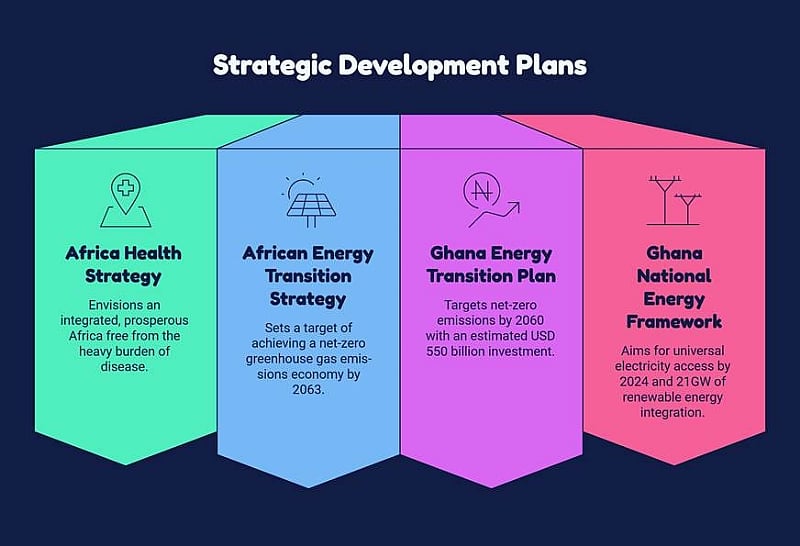
The African Energy Transition Strategy and Action Plan (ETSAP) sets a high-level target of achieving a net-zero greenhouse gas emissions economy by 2063. Its pillars demand 100% electrification, universal access to clean cooking and a 70% improvement in energy productivity.
At the national level, Ghana provides a compelling case study of these ambitions in action. The Ghana Energy Transition and Investment Plan (ETIP) targets net-zero emissions by 2060 and requires an estimated USD 550 billion in capital investment. Concurrently, Ghana's National Energy Transition Framework (2022-2070) aims for universal electricity access by 2024 and to integrate 21GW of renewable energy into its mix.
| "The transition to clean energy is intrinsically linked to health outcomes. Ghana's framework estimates that minimizing energy-related indoor air pollution could avoid 48,218 premature deaths, while the adoption of clean cooking fuels will save women and children 30.05 million hours previously lost to foraging for wood." — Source: Ghana's National Energy Transition Framework (2022-2070) |
Emerging Business Opportunities at the Nexus of Energy and Health
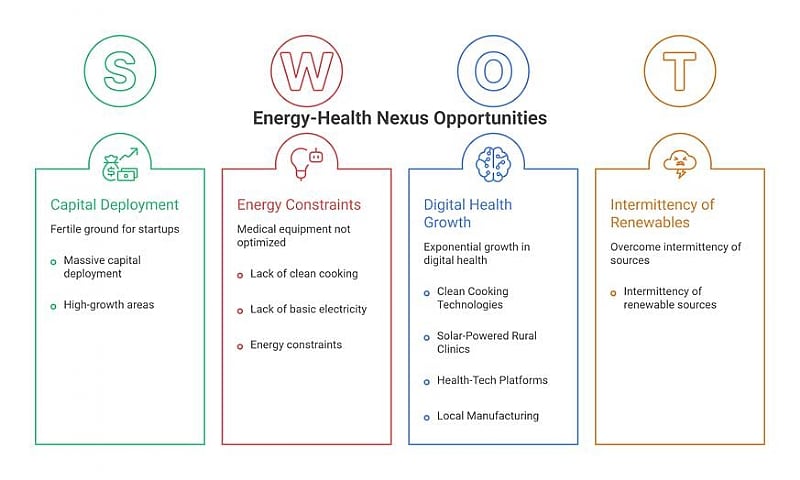
The massive capital deployment required to meet these targets, such as the $140 billion in additional capital expenditure projected by Ghana's ETIP, creates fertile ground for startups. Young founders should focus on the following high-growth areas:
· Clean Cooking Technologies and Fuels
Approximately 1 billion people in Africa lack access to clean cooking solutions, relying instead on traditional biomass. The ETSAP notes that this reliance causes severe indoor air pollution, resulting in economic losses estimated at $791.4 billion annually.
Manufacturing and distributing advanced electric cookstoves, improved biomass stoves, and biogas digesters. In Ghana alone, clean cooking technologies are projected to account for 16% of CO2 abatement by 2060. Startups can leverage innovative financing models, such as Pay-As-You-Go (PAYG) and carbon credit monetization to make these technologies affordable for low-income households.
· Solar-Powered Rural Clinics and Cold Chain Logistics
The Africa Health Strategy emphasizes strengthening district- and community-based health systems. However, the ETSAP highlights that 600 million Africans still lack access to basic electricity, severely crippling rural healthcare delivery.
Develop decentralized renewable energy solutions (mini-grids and off-grid solar systems) tailored to healthcare facilities. Founders can build "Energy-as-a-Service" (EaaS) models for rural clinics, ensuring reliable power for life-saving equipment, maternal care units and vaccine cold chains. Integrating Battery Energy Storage Systems (BESS) is critical to overcome the intermittency of renewable sources.
· Health-Tech Platforms Enabled by Stable Power
As electrification expands and smart distribution networks improve grid stability, the digital health sector will grow exponentially.
This includes building telemedicine platforms, electronic health record (EHR) systems, and health data analytics tools. With stable power, rural and peri-urban populations can finally access digital health services. Startups can also develop IoT-enabled medical devices that monitor patient health remotely, supported by expanding digital and energy infrastructure.
· Local Manufacturing of Energy-Efficient Medical Devices
Pillar 6 of the ETSAP and the Ghana ETIP strongly advocate transformative industrialization and localizing value chains. Currently, Africa imports most of its medical equipment, which is often not optimized for the continent's energy constraints.
Designing and manufacturing energy-efficient, climate-resilient medical devices (e.g., low-power incubators, solar-powered oxygen concentrators). By using local materials and aligning with energy-efficiency standards (MEPS), founders can reduce healthcare costs and build robust domestic manufacturing businesses.
The Role of Higher Education
To capitalize on these opportunities, Africa requires a workforce equipped with interdisciplinary skills. The Ghana ETIP projects that the energy transition could support an additional 400,000 net new jobs by 2060, while the National Framework estimates up to 1.4 million jobs across the transition period. Higher education institutions must evolve to become engines of this green-health innovation.
· Curriculum Evolution and Interdisciplinary Research
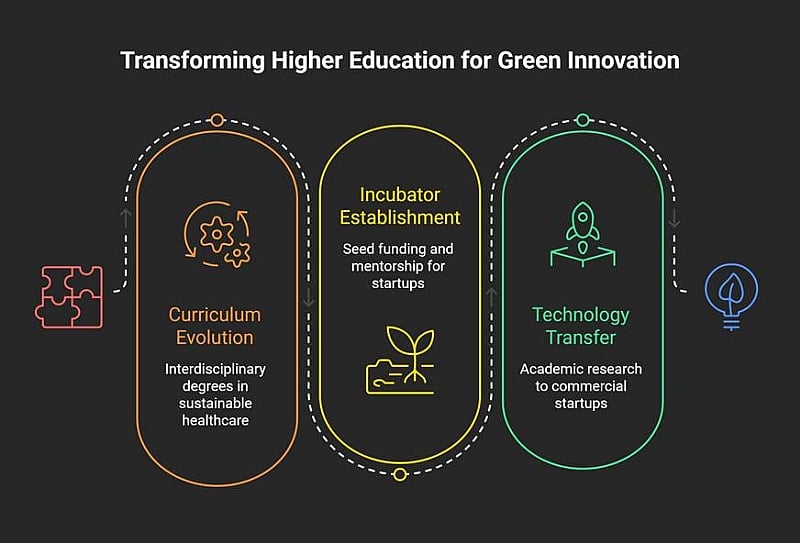
Universities must break down silos between engineering, public health, and business faculties. The Africa Health Strategy calls for institutionalized mechanisms to define and produce African research. Institutions should offer specialized degrees in sustainable healthcare engineering, focusing on renewable energy applications in medical settings and climate-resilient health systems.
· Incubators and Technology Transfer
As outlined in Pillar 5 of the ETSAP (Innovation, Technology, and Human Capacity), universities should establish dedicated incubators and Centers of Excellence (CoEs). These hubs can provide young founders with seed funding, mentorship and access to R&D facilities to prototype clean-tech health solutions. By facilitating technology transfer from academic research to commercial startups, universities can directly accelerate the deployment of innovations like green hydrogen applications in pharmaceutical manufacturing or advanced battery storage for hospitals.
The Young African Founders
The global energy transition is not merely an environmental necessity; it is the most significant economic restructuring of our time. For Africa, this transition, combined with the urgent need to strengthen health systems, presents a once-in-a-generation opportunity. With hundreds of billions of dollars projected for investment, including Ghana's $550 billion roadmap, policy and market demand are aligning.
Young African business founders are uniquely positioned to lead this charge. By building ventures that deliver clean cooking solutions, solar-powered healthcare logistics and energy-efficient medical technologies, entrepreneurs can build highly profitable businesses while simultaneously saving lives and protecting the planet
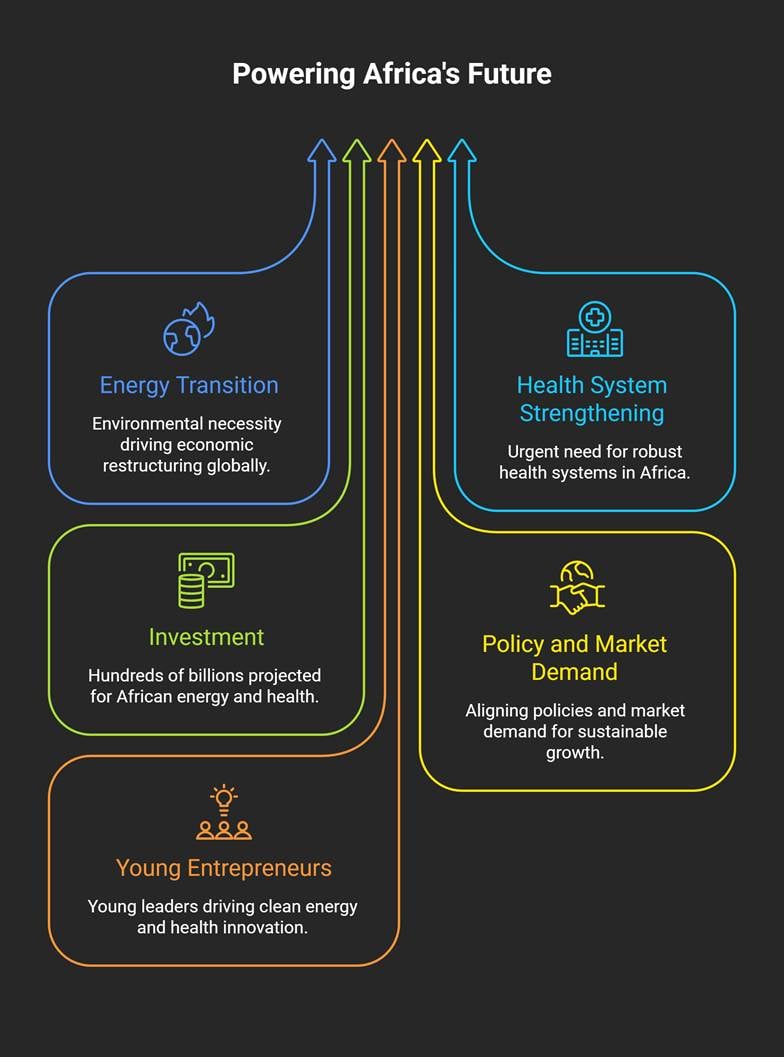
. Continental and national strategies have laid out the blueprint; now young African innovators must execute the vision and power the future of African health.
Ernest Asamoah
Email:[email protected]


 1,568 new lawyers must use law to advance justice — Chief Justice
 GH¢800,000 worth of goods lost in Kia Rhino truck fire at Amanfrom
 I never said Ghana has more nurses than it needs — Akandoh
 I have tried reaching Boakye Agyarko after NPP chairmanship race, but to no avai...
 Ghana’s Corporate Illusion: Why We Celebrate Professional Titles More Than Natio...
 Sam George, Armah-Kofi Buah, Phyllis Naa Koryoo and OPK among 1,568 lawyers call...
 Visa scandal: 'Ampofo Ankrah’s suspension not enough; Kofi Adams must also step ...
 'Let integrity, discipline guide your conduct' — Samson Lardi tells new lawyers
 Labour Minister optimistic teachers will suspend strike by close of day
 Dr Ato Forson urges MMDCEs to eliminate waste in public spending


