




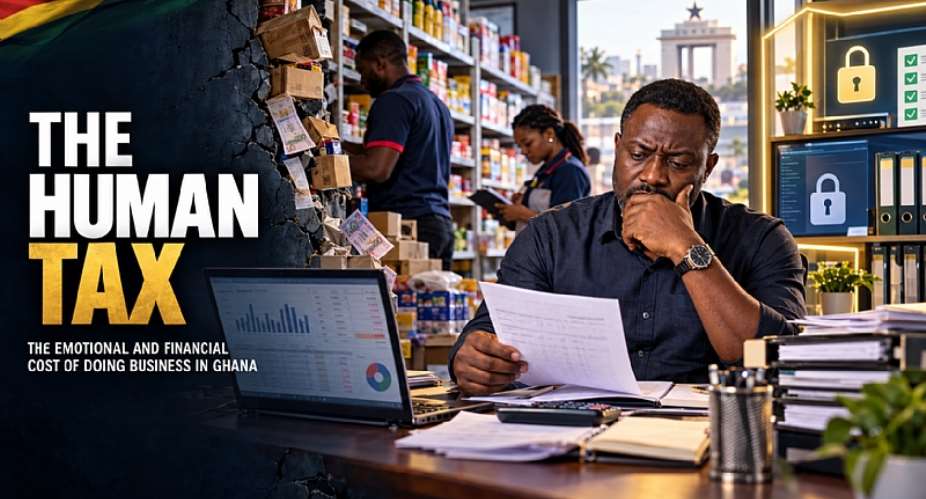
Ghana remains one of West Africa’s most energetic business environments. Its political stability, expanding digital economy, youthful population and entrepreneurial culture attract local investors and members of the diaspora. Yet behind the optimism is a difficult reality seldom captured in investment brochures: many business owners are weakened not only by taxes, inflation, unreliable utilities and limited finance, but also by failures of trust inside and around their enterprises.
Entrepreneurs sometimes describe this burden as a “human tax”—the money, time and emotional energy lost through employee theft, absenteeism, dishonest reporting, diverted stock, broken partnerships, inflated invoices and weak accountability. For a small enterprise operating on narrow margins, the disappearance of a few products or one fraudulent payment can threaten salaries, loan repayments and the survival of the business.
This concern should not become a judgement against Ghanaian workers. Most employees are honest people confronting the same economic pressures as their employers. The problem is not a national character defect. It arises when financial pressure, weak supervision, poor recruitment, blurred responsibilities and opportunities for fraud meet a workplace without effective controls.
Research on internal fraud among small and medium-sized enterprises in Accra has confirmed that Ghanaian SMEs face fraud risks and need stronger preventive systems. The Bank of Ghana has also reported increasing staff involvement in fraud within regulated financial institutions, showing that the challenge is not limited to informal shops or family businesses. It can arise even in organisations with professional structures.
The wider business environment adds pressure. The World Bank’s 2023 Enterprise Survey found that tax rates were the obstacle most frequently identified by Ghanaian firms, while electricity, informal-sector competition and corruption were also reported. Businesses supplying government waited, on average, more than four months for payment. Such delays can strain cash flow and cause mistrust to spread across an organisation.
Partnerships based entirely on friendship or family ties are another vulnerability. Diaspora investors sometimes transfer funds to relatives or associates without budgets, contracts, reporting procedures or independent verification. When money is diverted, the relationship collapses alongside the investment. The lesson is not that relatives cannot be trusted, but that affection cannot replace governance.
The solution is to move from sentimental management to accountable management. Every business should record sales, expenses and inventory through a system that owners can review. Cash collection, procurement, stock control and bookkeeping should not be controlled by one person. Bank reconciliations, stock counts and unannounced audits can expose irregularities before they become existential losses.
Employment and partnership arrangements should be written and understood by all parties. Contracts must define authority, performance expectations, access to company assets and consequences for misconduct. Background and reference checks should accompany recruitment for financially sensitive roles. Digital controls, including individual user accounts and approval limits, can create an audit trail, but technology must support—not replace—active supervision.
Fairness is equally important. Employers who delay salaries, underpay workers, ignore grievances or make promises they cannot honour also destroy trust. Accountability must operate in both directions. Businesses should provide clear expectations, timely compensation, respectful leadership and incentives for employees who protect company assets, improve efficiency and demonstrate integrity.
Ghana’s entrepreneurial potential remains considerable, but sustainable businesses cannot be built on goodwill alone. Trust is valuable, yet trust without verification exposes both people and capital. The strongest enterprises will combine humane leadership with contracts, internal controls, accurate data and consistent consequences.
The human tax is real, but it is not unavoidable. Entrepreneurs should not become cynical about everyone around them. They should build organisations in which honesty is rewarded, wrongdoing is difficult, responsibilities are separated and every cedi can be accounted for.


 AMA boss promises free housing for Kofikrom squatters
 If you are building markets while teachers are at home, you lack priorities – Go...
 Government has resolved 80% of issues behind teachers’ strike – Manuribe
 Ghana extends condolences to Nigeria over tragic Ondo plane crash
 Community watch committee arrest three illegal miners at Jema
 Dafeamekpor rejects claims GLS accreditation followed NDC return to power
 Disgruntled lawyers have withdrawn from active GBA participation — Dafeamekpor
 Ghana Law Society is not competing with GBA—Dafeamekpor
 Afenyo-Markin accuses govt of using ‘red herrings’ to divert attention from drug...
 Police to arraign Nana Akua Addo’s husband after hospital discharge


