




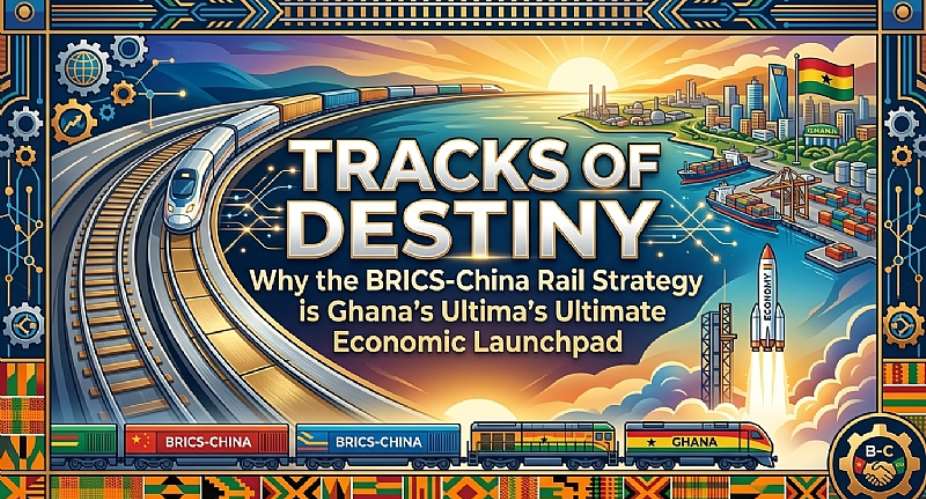
The blueprint for Ghana’s economic independence is no longer written in the restrictive pages of traditional structural adjustment programs; it is being forged in standard gauge steel. For over half a century, this republic has limped along on a broken, colonial-era narrow-gauge railway network—a relic designed purely to extract our wealth rather than connect our people. But as President John Dramani Mahama’s administration pushes forward with Ghana’s formal application to join the BRICS economic bloc, and Dr. Frederick Appoh, Chief Executive Officer of the Ghana Railway Development Authority (GRDA), rolls out the aggressive 2026 Railway Master Plan, we stand at the precipice of a transport revolution.
By playing a sophisticated diplomatic game that pits China’s raw engineering muscle against India’s proven bilateral reliability, Ghana can finally stitch the industrial south to the agrarian north. Managed closely by Minister for Finance Dr. Cassiel Ato Forson, this multi-billion dollar master plan is not just about laying tracks; it is about building a definitive, interconnected trade corridor that anchors our economy and establishes Ghana as the transit hub of West Africa.
The Steel Arteries: Three Corridors Set to Reshape Our Geography
To understand the magnitude of this shift, Ghanaians must look past political rhetoric and examine the concrete economic corridors designed to strip heavy freight off our crumbling highways.
- The Western Line (Our Industrial Backbone): Running from the bustling Takoradi Port through Dunkwa to Kumasi , this standard-gauge lifeline is actively reclaiming its status as Ghana’s primary mineral artery. With the Kojokrom-Manso stretch operational and work pushing hard through Huni Valley, this line is legally tied to our future. It ensures that bulk bauxite, manganese, and timber move directly from the earth to the sea with maximum efficiency.
- The Accra-Kumasi Rail (The Intercity Engine): Spanning ~300 km, this corridor represents a stroke of engineering genius. Rather than navigating separate, costly rights-of-way, the standard-gauge rail is being procured to run exactly 40 feet parallel to the new 6-lane Accra-Kumasi Expressway. This dual-threat multi-modal corridor will permanently dismantle the economic chokehold of intercity traffic between our two largest commercial hubs.
- The Eastern Corridor & Central Spine (The Sahelian Gateway): Anchored by the completed 97km Tema-Mpakadan segment, where passenger services commenced in late 2025, the network is scaling northwards. The ambitious 595 km Central Spine will cut through Buipe, Tamale, and Bolgatanga before hitting the Paga border. This line transforms Ghana into the undisputed maritime gateway for landlocked Burkina Faso, Mali, and Niger, capturing billions in regional transit fees.
The BRICS Chessboard: How Ghana Can Leverage China and India
Critics often worry about over-reliance on foreign powers, but our entry into the BRICS framework shifts the balance of power entirely back into Ghanaian hands. We are no longer beggars at the table of a single lender; we are strategic partners choosing our builders.
- Breaking the Monopoly of Western Debt: Accessing the BRICS New Development Bank (NDB) allows Finance Minister Dr. Cassiel Ato Forson to fund transnational rail links without the asphyxiating conditionalities traditionally imposed by Western institutions.
- The China-India Duopoly: Ghana’s procurement strategy wisely divides the map according to geopolitical strengths. We can deploy Chinese state-owned giants like China Railway Wuju Group to handle the capital-heavy, resource-backed mining lines out west, while leveraging Indian concessionary credit lines—which successfully built the Tema-Mpakadan line—to handle passenger networks and Volta Lake multimodal transport.
- A Unified Standard Gauge: Crucially, because both superpowers are bound to strict Standard Gauge profiles, our network remains entirely integrated. An Indian-financed locomotive can ride flawlessly on Chinese-laid tracks, ensuring total domestic interoperability.
Boankra: The $330 Million Operational Heart of the Revolution
The entire multi-billion-dollar network finds its operational anchor at the $330 million Boankra Integrated Logistics Terminal (BILT) near Kumasi. Spanning a massive 413-acre site, Boankra is the "Dry Port" that will save our national roads. Long delayed by a historic lack of railway connectivity, the current administration is explicitly syncing Boankra directly to the upcoming rail lines.
As Transport Minister Joseph Bukari Nikpe recently assured Parliament, Phase One of the Boankra facility stands at 83% completion, bringing the total physical progress of the terminal to a solid 50.54%. Supported heavily by GPHA Board Chairman Johnson Asiedu Nketiah and built by local giant Justmoh Construction Limited under a Build-Operate-Transfer (BOT) model, Boankra will revolutionize trade architecture through strict, data-driven targets:
- Decongestion by the Numbers: Instead of heavy-duty trucks enduring days of gridlock to clear goods at Tema or Takoradi, cargo containers will be loaded onto GRDA's newly introduced container freight trains. These initial trains possess the capacity to haul 20 to 30 containers simultaneously directly to Boankra at a competitive financial structure of $10 per tonne.
- Slashing Transit Costs: By completing the terminal infrastructure and container stations, the Ghana Shippers Authority (GSA) projects a drastic reduction in total transit times and shipping costs for local businesses.
- Capturing AfCFTA Trade: Tying the Accra-Kumasi rail to Boankra turns the terminal into a prime export processing zone. It aggregates agricultural commodities like cocoa and shea butter from the middle belt, moving them down the line while serving as the primary transshipment station for Sahelian cross-border trade.
Ecological Stewardship: The Buipe-Tamale Safeguards
An editorial on national development would be irresponsible if it ignored the environmental cost. The Buipe to Tamale section traverses the highly sensitive White Volta River basin and northern wetlands.
Encouragingly, feasibility blueprints from engineering firms like Gauff Ingenieure and ILF show strict adherence to Ghana’s LI 1652 Environmental Assessment Regulations. Rather than building solid earthen embankments that act as artificial dams—permanently flooding local farms—the project mandates raised viaducts and open pier bridges. This ensures seasonal floodwaters flow naturally, satisfying the National Green Finance Taxonomy Framework and opening the door for Ghana to issue lucrative international "Green Bonds." Furthermore, built-in cattle crawls and pedestrian underpasses ensure that local pastoralists and farmers are never sliced off from their ancestral lands.
Actionable Policy Recommendations for the State
If this grand vision is to succeed on the Modern Ghana platform and in the halls of government, we must suggest three non-negotiable policies:
- Enforce Ironclad Local Content Clauses: Consortiums like the Ghana European Railway Consortium (GERC) must not just bring engineers; they must build local factories. The mandate for GERC to build a concrete rail sleeper plant in-country must be emulated across all contracts to keep industrial knowledge inside Ghana.
- Ring-Fence Mineral Freight Revenues: The high-yield cash flows generated from moving bauxite on the Western Line must be structurally ring-fenced in dedicated escrow accounts. These funds must act as a financial backstop to cross-subsidize and expand the less profitable passenger lines in the north.
- Establish the Ghana National Railway Academy: We cannot rely on foreign technicians forever. Under the leadership of the GRDA, government must partner with KNUST and technical universities to train local signaling experts, track mechanics, and locomotive drivers, turning rail maintenance into a purely Ghanaian enterprise.
The Verdict: A Nation on the Right Track
The colonial narrow-gauge mentality, which treated infrastructure as a tool for exploitation, must be permanently buried. The Accra-Kumasi Expressway rail alignment, the Central Spine to Paga, and the Boankra Inland Port are not isolated engineering projects—they are the literal tracks upon which Ghana’s economic sovereignty will ride. By boldly stepping into the BRICS alliance, maintaining structural neutrality, and demanding strict local equity, Ghana can finally build a connected, self-reliant nation. The trains are coming; it is time for Ghana to command its own destiny.
✍️ Submitted by:
Retired Senior Citizen
For and on behalf of all Senior Citizens of the Republic of Ghana 🇬🇭
Teshie-Nungua
[email protected]


 AMA boss promises free housing for Kofikrom squatters
 If you are building markets while teachers are at home, you lack priorities – Go...
 Government has resolved 80% of issues behind teachers’ strike – Manuribe
 Ghana extends condolences to Nigeria over tragic Ondo plane crash
 Community watch committee arrest three illegal miners at Jema
 Dafeamekpor rejects claims GLS accreditation followed NDC return to power
 Disgruntled lawyers have withdrawn from active GBA participation — Dafeamekpor
 Ghana Law Society is not competing with GBA—Dafeamekpor
 Afenyo-Markin accuses govt of using ‘red herrings’ to divert attention from drug...
 Police to arraign Nana Akua Addo’s husband after hospital discharge


