




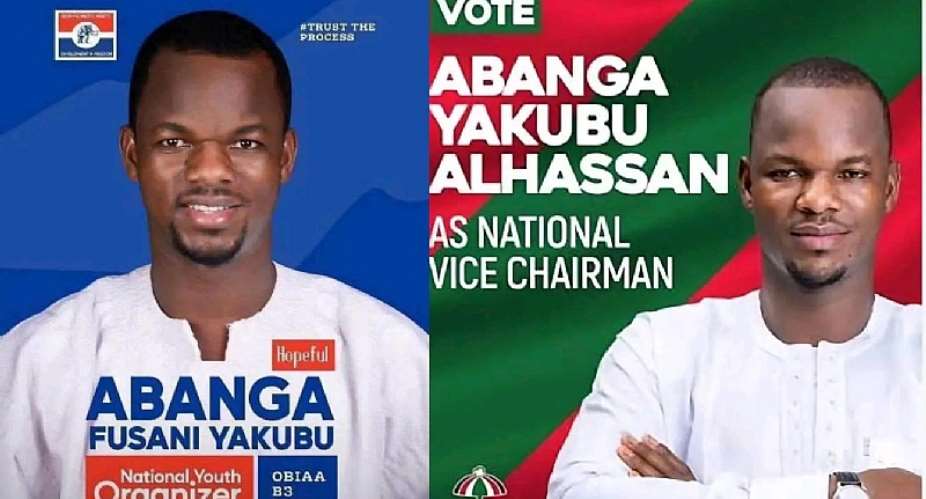
Ghana’s politics is often portrayed as a fiercely divided contest between the New Patriotic Party (NPP) and the National Democratic Congress (NDC). Political disagreements sometimes extend beyond policy into friendships, workplaces, communities and even families. Yet the unusual story of twin brothers Fuseini Yakubu Abanga and Alhassan Yakubu Abanga offers an important reminder that political differences need not destroy personal relationships.
The brothers have built political careers on opposite sides of Ghana’s dominant partisan divide. Fuseini Yakubu Abanga, popularly associated with the NPP, represented the party as its parliamentary candidate for Aowin in the 2024 general election and has been active in the party’s national youth politics. His twin brother, Alhassan Yakubu Abanga, has risen within the NDC and serves as the party’s Third National Vice Chairman.
Their political separation is not merely symbolic. During Fuseini’s unsuccessful attempt to win the Aowin parliamentary seat in 2024, he publicly acknowledged that his own twin brother campaigned against him. From a purely family perspective, the situation may appear extraordinary. From a democratic perspective, however, it illustrates an important principle: relatives do not have to surrender their individual political convictions simply because they belong to the same family.
More recently, the relationship between the brothers attracted public attention when allegations concerning illegal mining, popularly known as galamsey, were raised against Alhassan. Fuseini, despite belonging to the rival NPP, publicly distinguished between his political differences with his brother and what he personally knew about him.
He reportedly said he could not politically defend an NDC member but added that he had never personally known his brother to engage in illegal mining and knew him instead as someone involved in legitimate mining concessions. That distinction is significant. It was not necessarily a declaration that every allegation was false; rather, it demonstrated the difficulty of balancing political allegiance, family loyalty and the principle that allegations should be established through credible investigation and due process.
That principle must remain central to public discussion. Allegations of involvement in illegal mining are serious, particularly because galamsey has become one of Ghana’s most urgent environmental and governance challenges. Rivers, forests and agricultural lands have suffered severe damage, while successive governments have faced pressure to demonstrate that politically connected individuals will not be protected.
At the same time, allegations should not automatically be presented as established guilt. Investigative and prosecutorial institutions must be allowed to determine the facts. Political affiliation—whether NPP or NDC—should neither provide immunity from investigation nor become a substitute for evidence.
This is where the Abanga story becomes larger than the two brothers themselves.
Ghana’s democracy has reached a stage where political competition is firmly embedded in national life, but excessive partisanship continues to create unnecessary divisions. Too often, people are classified first by party colour and only afterwards as citizens. An NPP supporter is expected to defend everything associated with the NPP, while an NDC supporter is sometimes expected to do the same for the NDC. Those who acknowledge merit on the opposite side can even be accused of disloyalty.
That culture weakens democratic reasoning.
Democracy does not require citizens to hate people with whom they disagree. Neither does belonging to a political party require abandoning independent judgment. One can campaign vigorously against a relative, friend or colleague during an election and still respect that person outside the political arena.
Ghana has seen other prominent examples of relatives occupying opposite sides of the NPP-NDC divide. The Jinapor brothers—Samuel Abu Jinapor of the NPP and John Abdulai Jinapor of the NDC—are perhaps among the best-known examples. Their political careers demonstrate similarly that family relationships and political convictions can coexist even when individuals belong to rival parties.
The Abanga twins make the phenomenon particularly striking because they are twins who have advanced within competing political organisations. One can therefore imagine the unusual family conversations that arise when the political fortunes of one party improve at the expense of the other.
Yet there is something healthy about such a situation.
If members of the same family can disagree politically, campaign against one another and still recognise their relationship after an election, Ghanaian society should be capable of doing the same.
Elections should be contests of ideas, records, policies and leadership—not permanent declarations of hostility between citizens.
The real lesson from the Abanga twins is therefore not simply that two brothers belong to different political parties. It is that political disagreement and human relationships do not have to be mutually exclusive.
Ghana needs more of that democratic maturity.
Politicians can disagree without becoming enemies. Supporters can campaign passionately without insulting or attacking one another. Families can vote differently without allowing elections to destroy relationships. And when serious allegations arise against political figures, citizens should demand impartial investigation rather than determining guilt or innocence according to party colour.
The Abanga twins may continue travelling along different political roads. Their parties will compete, their political interests will sometimes clash, and future elections may again place them on opposing sides.
But they remain brothers.
Perhaps that is the most valuable message their unusual political journey offers Ghana: parties may divide our votes, but they should never be allowed to destroy the relationships and common citizenship that ultimately bind us together.

 EOCO returns seized £6,700, ¢2,750 cash, phones and laptops to Hanan Abdul Wahab
 Africa launches own credit agency in bid for cheaper borrowing
 'We want new friends who'll treat us as equal partners' — says Foreign Affairs M...
 ‘Let’s not be too hard on civil Society groups who are still critical of us’ — A...
 Trump says he will speak to Putin over reported plague death in Russia
 'I will not share NPP strategies with my twin brother Alhassan Abanga in NDC' — ...
 Afenyo-Markin insists National Cathedral should be completed
 ‘GoldBod’s structure encouraging galamsey, buys whatever aggregators bring’ – Af...
 Mahama holds discussions with India's External Affairs Minister
 Afenyo-Markin cautions NPP members against acts that undermine the party


